

Why Healthy Family Communication Changes Everything
Healthy family communication is the daily practice of speaking, listening, and connecting in ways that make every family member feel safe, heard, and valued.
If you’re looking for a quick overview, here’s what it really comes down to:
- Listen first. Give your full attention before responding.
- Speak with “I” statements. Say “I feel…” instead of “You always…”
- Stay curious, not reactive. Ask open-ended questions instead of yes/no ones.
- Create connection rituals. Device-free meals, bedtime chats, and weekly check-ins build trust over time.
- Repair when things go wrong. Apologize, forgive, and reconnect — it’s normal to stumble.
- Adapt to your child’s age. Toddlers, school-age kids, and teens all need different approaches.
- Seek help early. Family therapy is a strength, not a last resort.
Sound simple? In theory, yes. In practice, it’s one of the hardest things families actually do.
Between school pickups, work deadlines, and the constant pull of screens, meaningful conversation can feel like a luxury. And when you do try to connect, you might get a grunt, a shrug, or a door closing in your face.
You’re not alone in that. Most moms feel it. The good news is that communication is a skill — and skills can be learned, practiced, and improved, even on a Tuesday night when everyone’s exhausted.
Whether your kids are toddlers or teens, the strategies ahead are practical, research-backed, and designed for real moms with real schedules. Let’s dive into how we can make connection feel a little easier and a lot more natural.
The Heart of Connection: Foundations of Healthy Family Communication
At its core, healthy family communication isn’t just about exchanging words. It is the life-giving thread that binds our families together and supports our collective mental health. Studies from the American Psychological Association show that positive family interactions are directly linked to better mental health outcomes, physical health, and overall life satisfaction.
When we communicate poorly, it doesn’t just lead to missed appointments or messy bedrooms. It contributes directly to household stress, anxiety, and depression. According to the National Institute of Mental Health, creating a safe space for emotional expression is a vital buffer against life’s external pressures.
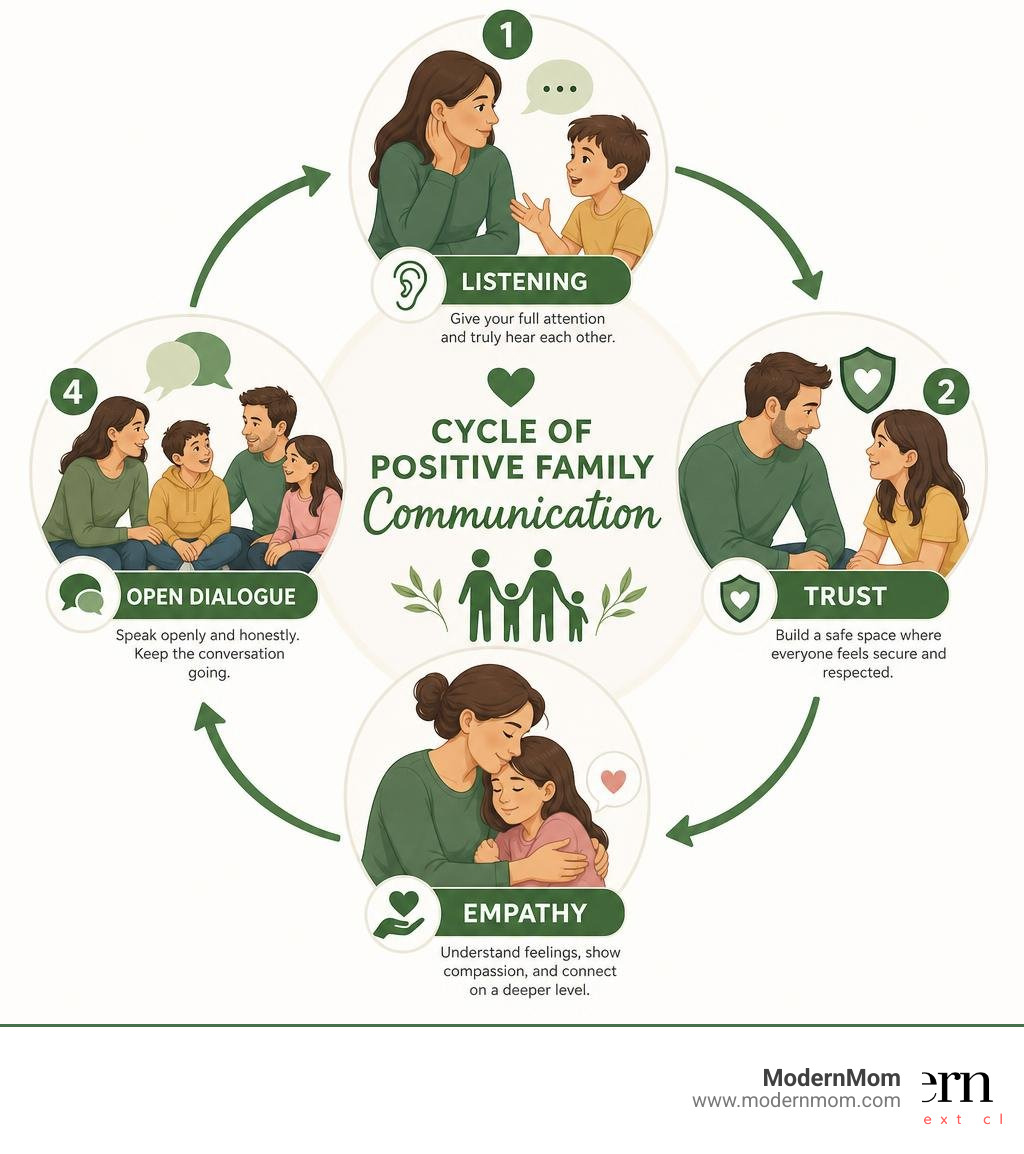
Building this safe space requires four key pillars: respect, trust, empathy, and open dialogue. We must treat our kids as valued individuals with their own valid opinions and boundaries. When we combine this respect with empathy, we transform our home from a place of reactive arguments into one of supportive dialogue.
As moms, we often carry a heavy burden of expectation. If you are feeling overwhelmed by trying to keep it all perfect, take a breath. Understanding how to let go of unnecessary pressure can free up the emotional energy you need to connect with your kids. For some encouragement on this, check out 5 Reasons Why You Should Let Go of Mom Guilt.
By focusing on these foundations, we create a resilient household. For a deeper look at how these dynamics protect your family’s well-being, explore this resource on family dynamics and well-being.
Practical Tools to Transform Daily Conversations
How do we take these big concepts and bring them into our busy living rooms? It starts with the physical and non-verbal cues we send before we even open our mouths.

Our bodies often speak louder than our words. If we ask about our child’s day while staring at a laptop, we send a clear message: You are secondary to my screen.
Instead, make a conscious effort to practice positive non-verbal communication. Turn your body toward your child, make gentle eye contact, and nod to show you are engaged.
For young kids, get down to their physical eye level. This simple posture shift removes the intimidating power dynamic and immediately helps them feel safe. Pair this with verbal affirmations and clear, consistent tones. If you are looking to build a stronger parenting foundation, check out these 7 Tips to Help You Be a Better Parent.
Active Listening: The Secret to Mutual Understanding
Most of us listen with the intent to reply, not to understand. Active listening changes that entirely. It is a four-step method that turns transactional talk into a real emotional connection:
- Stop distractions: Put down your phone, close your laptop, and give undivided attention.
- Listen fully: Focus on the content and the underlying feelings without interrupting or formulating your defense.
- Reflect: Paraphrase what you just heard. Try saying, “It sounds like you felt really left out at recess today.”
- Validate and ask: Acknowledge their experience as real and ask open-ended questions to invite more detail.
Crucially, active listening means holding back on unsolicited advice. When we jump straight into “fix-it” mode, we often shut down the conversation before our kids feel understood. Letting them talk without interruption helps them develop their own problem-solving skills and builds their self-esteem. To master this art, read this excellent guide to active listening at home.
Using “I-Statements” to Reduce Blame and Defensiveness
When conflict arises, our instinct is often to point fingers. “You never clean your room!” or “You are always ignoring me!” immediately triggers defensiveness.
Instead, we can use the “I-statement” formula to express our feelings without placing blame:
“I feel [emotion] when [behavior] because [impact]. I need [request].”
For example, instead of yelling, “You never help with dinner!” try saying: “I feel overwhelmed when I have to handle dinner alone because I am exhausted after work. I need us to agree on a quick chore schedule.”
This shifts the focus from character criticism to a specific, behavior-focused complaint. It teaches our kids that it’s okay to express frustration constructively. For more on implementing these healthy strategies, see the guide on healthy communication for families.
Turning Disagreements into Connection: Conflict Resolution at Home
Arguments are going to happen. But healthy families don’t avoid disagreements; they use them as opportunities to build stronger bonds.

The secret lies in emotional regulation. When tempers flare, our brains go into fight-or-flight mode. Nothing productive happens here.
Instead, normalize taking a cooling-off period. A 20-to-30-minute break allows everyone’s heart rates to return to normal. Once calm, we can sit down and work toward a win-win compromise where everyone’s basic needs are met.
Modeling Healthy Disagreement for Watching Eyes
Our children are absolute sponges. They learn how to handle conflict by watching how the adults in the house treat each other.
Seeing adults disagree is not inherently harmful to kids. In fact, observing parents navigate a disagreement calmly, respectfully, and with a clear focus on resolution teaches them that love and differences of opinion can coexist.
Show them what it looks like to stay regulated, listen to another perspective, and actively repair the relationship afterward.
Repair Rituals and Setting Loving Boundaries
When we make mistakes—and we will—we must model the art of a genuine apology. A simple, “I am sorry I lost my temper and yelled. That wasn’t okay,” teaches our kids accountability.
Alongside repair, we must establish clear boundaries. Boundaries aren’t punishments; they are guidelines for emotional safety. Use a clear template: clarify the need, communicate it calmly, state the natural consequence, and stick to it with empathy.
Small Habits, Big Impact: Daily Routines for Closer Bonds
Consistency is the absolute backbone of healthy family communication. We don’t build deep relationships through one-off “big talks.” We build them through small, predictable daily routines.
| Practice | Frequency | Tone | Main Goal |
|---|---|---|---|
| Daily Check-Ins | Daily (10-15 mins) | Informal & relaxed | Emotional connection and tracking daily feelings |
| Family Meetings | Weekly (15-30 mins) | Structured & collaborative | Planning schedules, solving problems, and celebrating wins |
Creating Device-Free Zones and Family Check-Ins
One of the easiest ways to improve family dialogue is to designate screen-free times. Dinner tables and car rides are perfect opportunities for this.
Try to dedicate at least 10 minutes of completely distraction-free time to each child daily. Ask open-ended questions like, “What made you laugh today?” or “What was the hardest part of your afternoon?” For more practical tips on building these everyday habits, check out these tips for improving parent-child dialogue.
The Power of Weekly Family Meetings
A structured weekly family meeting (lasting 15 to 30 minutes) can work wonders for household peace. Use a simple four-part agenda:
- Appreciation: Everyone shares one thing they appreciate about another family member.
- Priorities & Planning: Discuss the upcoming week’s calendar, chores, and schedules.
- Problem-Solving: Bring up any household issues and brainstorm solutions together.
- Fun: End with a quick game, a treat, or planning a fun weekend activity.
Meeting Them Where They Are: Age-Appropriate Strategies
Every child is unique, and their developmental stage dictates how they process information. We must adapt our communication style to match their growing brains.
Toddlers and Young Kids: Simple Words and Big Feelings
Toddlers live in a world of massive emotions and limited vocabulary. When they act out, use simple emotion-labeling. Saying, “You look really angry that we have to leave the park,” helps them feel understood.
Use clear, positive directions instead of a list of “don’ts.” Instead of “Stop running!” try “Please use your walking feet.” If a conversation goes off the rails, offer a gentle “do-over” phrase: “Would you like a do-over to ask for that juice cup nicely?”
School-Age Kids: Building Confidence and Problem-Solving
As kids enter school, they begin navigating complex social dynamics. This is the perfect time to practice open-ended questions. Instead of solving their problems for them, guide them to find their own solutions. Ask, “What do you think you could do next time that happens?”
This is also a vital stage for discussing big, complex topics. For guidance on how to navigate these essential conversations, see our guide on talking to your kids about race and ethnicity.
Teenagers: Deep Questions and Respecting Autonomy
With teenagers, the dynamic shifts. They are fiercely protective of their growing autonomy. If you ask factual questions like, “How was school?” you will likely get a one-word grunt.
Instead, ask deep, value-based questions: “What do you think about how that situation was handled?”
Use the brilliant “Helped, Hugged, or Heard” framework. When your teen comes to you venting, ask them directly: “Do you want to be helped (do you want advice), hugged (do you want comfort), or heard (do you just need to vent)?”
Most of the time, they just want to be heard. Respecting their need for privacy while keeping the door open for connection matters more than forcing a conversation on your schedule. Try opening the door with low-pressure moments — a late-night snack, a short drive, or a shared errand — and let your teen choose how much to say. When they do talk, listen first, keep your reactions steady, and save advice for when they ask for it.
Overcoming Barriers and Knowing When to Seek Support
Modern life is full of hurdles that disrupt our best intentions. Stress, packed schedules, and digital fatigue can easily block healthy dialogue. To build lasting bridges, we must proactively recognize these obstacles and choose small, realistic habits that protect connection even on busy days.
Navigating Modern Obstacles to Healthy Family Communication
Screens are perhaps the biggest barrier to modern connection. Establish a clear household screen plan with tech-free zones (like the dinner table) and a central charging station where all devices go to sleep at night.
Watch out for passive-aggressive patterns, like heavy sighing or silent treatments, which erode trust. If you are parenting teens, keep a close eye on their emotional health. Unspoken stress can sometimes lead to severe crises. For critical information on this, review these surprising stats.
When to Seek Professional Guidance for Healthy Family Communication
Sometimes, despite our very best efforts, communication patterns remain stuck. If you experience persistent conflict, emotional withdrawal, or constant shouting, it may be time to seek a family therapist.
Proactive counseling is not a sign of failure; it is an incredible tool that provides a safe, neutral space to heal and grow. To learn more about how professional support can help, read about how a therapist can help strengthen family bonds.
Frequently Asked Questions About Family Communication
My child just grunts or says “fine” when I ask about their day. How do I get them to open up?
Try changing how and when you ask. Avoid direct questioning the second they walk through the door or get in the car—they need time to decompress.
Instead, wait until you are doing a low-pressure activity together, like washing dishes, driving, or taking a walk. Ask specific, open-ended questions: “What was the most surprising thing that happened today?” Share a funny story about your own day first to model sharing and invite them to do the same.
Is it okay to take a break from a heated family discussion?
Absolutely. In fact, it is highly recommended. When emotions are running high, our brains are physically incapable of rational problem-solving.
Agree on a 20-to-60-minute cooling-off period. The crucial step is committing to a specific time to return to the discussion once everyone is calm, showing your kids that taking space is a tool for resolution, not avoidance.
How do we handle generational differences in communication styles?
Embrace intergenerational learning. Older generations may value direct, face-to-face talks, while younger kids are immersed in digital communication.
Create opportunities to bridge this gap. Have your kids teach grandparents how to use video calls or share emojis, and in return, have older family members share stories or vintage family recipes. This builds mutual respect and appreciation for different styles.
Conclusion
At the end of the day, building a home filled with healthy family communication is a continuous journey. It is not about being a perfect parent or never raising your voice. It is about showing up, listening with your whole heart, and making sure your kids know that their voice matters.
The long-term benefits of this effort are immeasurable. You are equipping your children with the emotional resilience, empathy, and relationship skills they will use for the rest of their lives.
You don’t have to do this alone. Finding your village of supportive moms can make all the difference. Learn more about building your community in How to Make Momrades. And if you are navigating complex family transitions, find guidance on keeping your primary relationships strong in How to Make Marriage Work After Separation.