
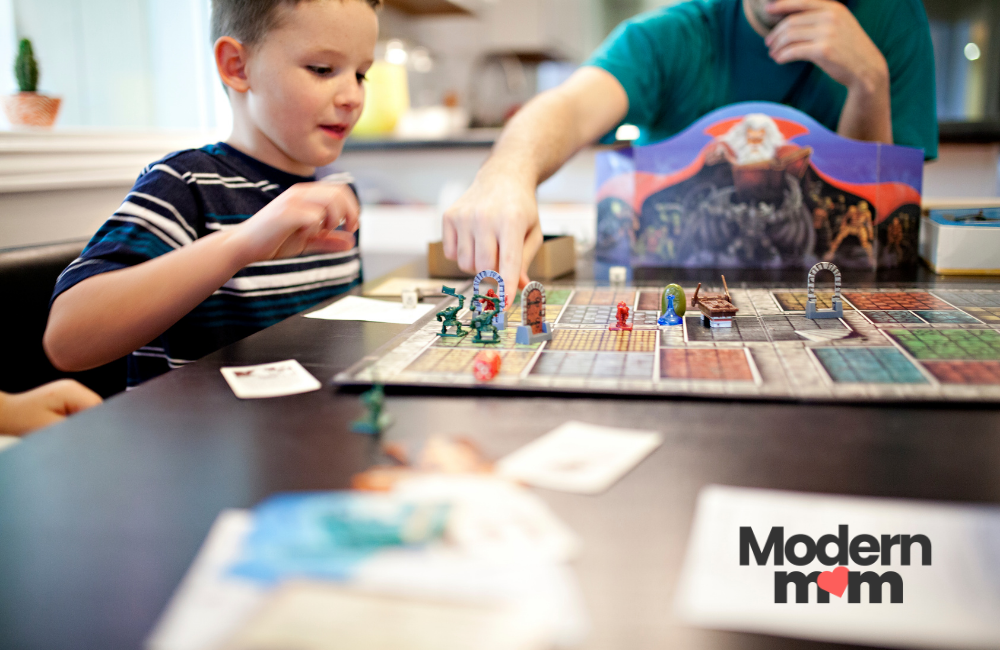
Who says learning has to look like homework? Some of the best kids games are the ones that get children laughing, thinking, creating, and solving problems without realizing how much they’re learning along the way.
Whether your child loves board games, science experiments, word challenges, or playing online, there are plenty of ways to turn everyday fun into an opportunity to develop new skills. And you don’t need an overflowing toy closet or expensive subscriptions to make it happen.
From preschoolers just discovering letters and numbers to older kids who love a good challenge, these 25 educational kids games offer something for almost every age, interest, and attention span.
Why Learning Through Games Matters
Play isn’t just a break from learning. It’s one of the ways children explore new ideas, test their abilities, and figure out how the world works.
The right games can give kids opportunities to practice important skills, including:
- Reading and language: Recognizing letters, building vocabulary, spelling, and storytelling.
- Math: Counting, adding, subtracting, recognizing patterns, and thinking strategically.
- Science: Observing, experimenting, asking questions, and making predictions.
- Problem-solving: Working through challenges, planning ahead, and trying different solutions.
- Social skills: Taking turns, cooperating, communicating, and learning how to handle winning and losing.
Best of all, kids don’t need to master every skill to enjoy the experience. Sometimes the most valuable part is simply discovering something new and wanting to try again.
Reading and Word Games for Kids
Reading practice doesn’t always have to mean sitting down with a book. Word games can make letters, sounds, and storytelling feel like an adventure.
1. Bananagrams
Part word puzzle, part friendly competition, Bananagrams challenges players to build interconnected words using letter tiles. It’s a fun way for confident readers to practice spelling, vocabulary, and flexible thinking.
For younger children who aren’t ready to build words independently, try making short words together or matching letters to familiar sounds.
Best for: Elementary-aged kids and older children who enjoy wordplay.
2. Zingo!
Think bingo with a playful twist. With Zingo, kids match picture-and-word tiles to their game cards, practicing word recognition, visual matching, and attention as they play.
The fast-moving format makes it especially appealing to preschoolers and beginning readers.
Best for: Preschoolers and early elementary students.
3. Storytelling Dice
Grab a set of writing dice, or make your own using pictures drawn on paper. Roll the dice and challenge each player to create a story featuring the images.
A dinosaur, a bicycle, and a birthday cake? Sounds like the beginning of a pretty interesting adventure.
Kids can take turns adding sentences, inventing characters, or creating alternate endings.
Best for: All ages, with younger children telling stories aloud.
4. Alphabet Scavenger Hunt
Give your child a letter and challenge them to find objects around the house that begin with that sound.
Try an alphabet race for older children or work together to find one object for every letter.
This easy, no-cost game encourages letter recognition, phonics, and observation.
Best for: Preschoolers and early readers.
Math Games That Are Actually Fun
Math feels a lot less intimidating when numbers become part of a game instead of another worksheet.
These kids games encourage counting, quick thinking, and mathematical problem-solving.
5. Sum Swamp
In this addition-and-subtraction board game, Sum Swamp players navigate a swamp filled with creatures and obstacles by solving simple math problems.
It’s a playful way to practice number skills without making the experience feel like a classroom exercise.
Best for: Early elementary students learning basic arithmetic.
6. Yahtzee
Yahtzee is a classic dice game is packed with opportunities to practice math. Kids add up scores, recognize number combinations, and make decisions about which dice to keep or roll again.
Younger players can focus on counting and addition, while older kids can explore probability and strategy.
Best for: School-aged children and family game nights.

7. Grocery Store Math Challenge
Turn pretend shopping—or a real trip to the grocery store—into a math game.
Give your child a pretend budget and ask them to choose items without going over the limit. Younger children can count products or compare prices, while older kids can calculate totals, discounts, and change.
Best for: Elementary-aged kids, with challenges adjusted to their abilities.
8. Math Card Battle
All you need is a regular deck of playing cards.
For a simple version, each player flips over two cards and adds the numbers together. Whoever has the highest total wins the round.
Change the rules to practice subtraction or multiplication, or challenge players to make a target number using several cards.
Best for: Kids learning arithmetic, with difficulty adapted by age.
Science and STEM Games for Curious Kids
Got a child who constantly asks “why” or “how”? Science games give curious minds an opportunity to investigate those questions through exploration and experimentation.
9. Sink or Float Challenge
Gather a collection of household objects, such as a plastic spoon, cork, toy block, and small stone.
Before placing each object in water, ask your child to predict whether it will sink or float.
Keep track of the results and talk about what surprised them.
Best for: Preschoolers and elementary-aged kids. Supervise all water activities.
10. Build the Tallest Tower
Challenge kids to build the tallest freestanding tower using building blocks, paper cups, or recycled cardboard.
Introduce additional challenges, such as building with only 20 pieces or making a tower strong enough to support a small toy.
Children experiment with balance, stability, engineering, and creative problem-solving.
Best for: Preschoolers through older elementary students.
11. Nature Detective
Head into the backyard, a park, or a nearby trail and turn an ordinary walk into a science investigation.
Challenge kids to find different leaf shapes, spot animal tracks, identify insects, or discover evidence of changing seasons.
Encourage them to draw their findings or make a list of questions to explore later.
Best for: All ages.
12. Homemade Marble Maze
Using cardboard, paper tubes, tape, and other recyclable materials, challenge kids to create a maze that guides a marble from start to finish.
They’ll need to experiment with slopes, obstacles, and different designs to make the maze work.
For younger children, use a larger ball that doesn’t present a choking hazard.
Best for: Older elementary-aged kids with adult supervision.
Logic and Problem-Solving Games for Kids
Some of the most engaging kids games are built around solving puzzles, spotting patterns, and thinking several steps ahead.
These activities encourage persistence and flexible thinking while keeping the focus on fun.
13. Qwirkle
Qwirkle challenges players to create lines of matching shapes and colors using wooden tiles.
The rules are straightforward, but planning where to place each tile adds an interesting layer of strategy.
It’s a strong option for kids who enjoy patterns, puzzles, and friendly competition.
Best for: Elementary-aged kids and older players.
14. Rush Hour
In this single-player logic game, Rush Hour has kids slide vehicles around a grid to clear a path for a trapped car.
Challenges become more complicated as players progress, encouraging them to plan ahead and reconsider solutions that aren’t working.
Best for: School-aged children who enjoy independent puzzles.
15. Chess
Chess is a classic strategy game that encourages players to anticipate moves, evaluate options, and think ahead.
You don’t need to introduce every rule at once. Start by teaching how individual pieces move, then gradually introduce more complicated strategies.
Best for: Elementary-aged kids and older beginners.

16. DIY Escape Room
Turn your living room into an escape room using homemade clues, puzzles, and hidden messages.
For younger kids, create picture clues or simple matching challenges. Older children can solve riddles, number codes, and logic puzzles.
Choose a fun mission, such as finding a missing treasure or solving a mystery before the timer runs out. There’s no need to actually lock anyone in a room!
Best for: Elementary-aged kids, tweens, and family groups.
Free Online Kids Games Worth Exploring
Not all screen time is created equal. Educational online games can be a useful addition to hands-on activities when they’re engaging, age-appropriate, and thoughtfully selected.
These resources offer opportunities to practice academic skills, experiment with ideas, and explore new interests.
17. PBS KIDS Games
PBS KIDS offers games featuring familiar characters and activities built around skills such as reading, math, science, and problem-solving.
Younger children can explore colourful, character-driven activities, making this a convenient starting point for parents looking for online learning games.
Best for: Preschoolers and younger elementary-aged kids.
18. Khan Academy Kids
The free Khan Academy Kids app offers interactive learning activities for children ages 2–8.
Through stories, games, and playful lessons, kids can explore foundational reading, writing, math, and social-emotional skills.
The app is free to use without advertisements or subscriptions.
Best for: Toddlers, preschoolers, and younger elementary students.
19. NASA Kids Science
Have a space-loving child? NASA Kids Science offers games, activities, videos, and educational resources that introduce children to space, Earth science, and scientific discovery.
Kids can explore topics such as satellites, the atmosphere, and the environment while developing an interest in science.
Best for: Curious elementary-aged children and older kids.
20. Scratch
Scratch takes interactive learning a step further by giving kids the tools to create their own games, animations, and digital stories.
Instead of simply playing a video game, children experiment with programming concepts, sequences, characters, and problem-solving.
It’s especially appealing to creative kids interested in technology, art, or storytelling.
Best for: Ages 8 and up, including tweens interested in beginner coding.
Indoor Kids Games That Don’t Require a Screen
Sometimes the best kids games are the simplest ones. These activities require little preparation and use materials you probably already have at home.
21. Memory Tray Game
Arrange several small, age-appropriate objects on a tray and give your child 30 seconds to study them.
Cover the tray, remove one object, and ask them to identify what’s missing.
Increase the challenge by adding more objects or shortening the observation time.
Skills practiced: Observation, visual memory, and concentration.
22. Simon Says
This familiar game encourages kids to listen carefully, follow directions, and control their impulses.
Make it more challenging with multi-step instructions or movement combinations.
Skills practiced: Listening, attention, and self-regulation.
23. Treasure Hunt With Clues
Hide a small treasure somewhere in the house and create clues that guide your child from one location to the next.
For younger kids, use drawings and simple instructions. Older kids can decipher riddles, solve math problems, or interpret maps.
Skills practiced: Reading comprehension, reasoning, and problem-solving.
24. DIY Board Game Challenge
Instead of playing an existing board game, challenge your kids to invent one.
They’ll need to decide on a goal, design a playing surface, write rules, and figure out how players win.
Then comes the best part: testing the game and changing anything that doesn’t work.
Skills practiced: Creativity, writing, logical thinking, and collaboration.

25. Would You Rather?
This simple conversation game can turn a car ride or family dinner into an entertaining exercise in creative thinking.
Ask questions like:
- Would you rather explore the ocean or travel to space?
- Would you rather have the ability to fly or become invisible?
- Would you rather live in a treehouse or an underwater home?
Encourage kids to explain their answers and defend their choices.
Skills practiced: Language, reasoning, and communication.
How to Choose the Best Kids Games for Every Age
Not every game will work for every child, and that’s okay. The most engaging activities are usually the ones that match your child’s interests, abilities, and stage of development.
Here’s a general guide to getting started.
| Age group | Games to try |
|---|---|
| Ages 2–4 | Simple matching games, movement games, picture-based activities, and sorting challenges |
| Ages 5–7 | Beginning word games, counting games, scavenger hunts, and simple board games |
| Ages 8–10 | Strategy games, science challenges, coding activities, and creative puzzles |
| Ages 11–13 | Advanced word games, chess, escape-room puzzles, coding projects, and complex board games |
These age ranges are flexible. A child who loves word games may be ready for more challenging activities earlier, while another might prefer hands-on building projects over reading-based games.
Always check product age recommendations and supervise activities involving small pieces, water, or online interactions.
Making Game Time More Meaningful
You don’t need to turn every game into a lesson to make playtime worthwhile.
In fact, sometimes the best thing parents can do is simply join in, encourage curiosity, and let kids take the lead.
A few simple approaches can help:
- Let kids choose. Children are often more engaged when they have a say in what they’re playing.
- Ask open-ended questions. Try “How did you figure that out?” or “What would you do differently next time?”
- Keep it playful. Avoid turning a fun activity into a test of what your child knows.
- Mix things up. Combine board games, outdoor activities, creative play, and digital experiences.
- Make room for mistakes. Trial and error is part of learning, and games provide a relatively low-pressure place to practice.
For digital games, establish reasonable limits, review privacy settings, and spend time playing together when possible. A balanced approach leaves room for screen-based activities alongside physical play, reading, and time outdoors.
The Best Kids Games Are the Ones They’ll Want to Play Again
Educational games don’t need complicated rules, expensive equipment, or a screen to make a difference.
A deck of cards can become a math challenge. A walk through the park can turn into a science investigation. A homemade treasure hunt can build reading and reasoning skills.
Whether your child is learning to recognize letters, experimenting with engineering, or developing a new strategy to beat you at a board game, playful experiences create opportunities to learn.
And sometimes the best sign that a game is working isn’t how much your child can tell you afterward.
It’s hearing, “Can we play again?”