

Why Self Care Journaling Might Be the Reset You’ve Been Putting Off
Self care journaling is one of the simplest, most research-backed tools for reducing stress, clearing mental clutter, and finding your footing again — especially when life feels like too much.
If you’re short on time, here’s what you need to know:
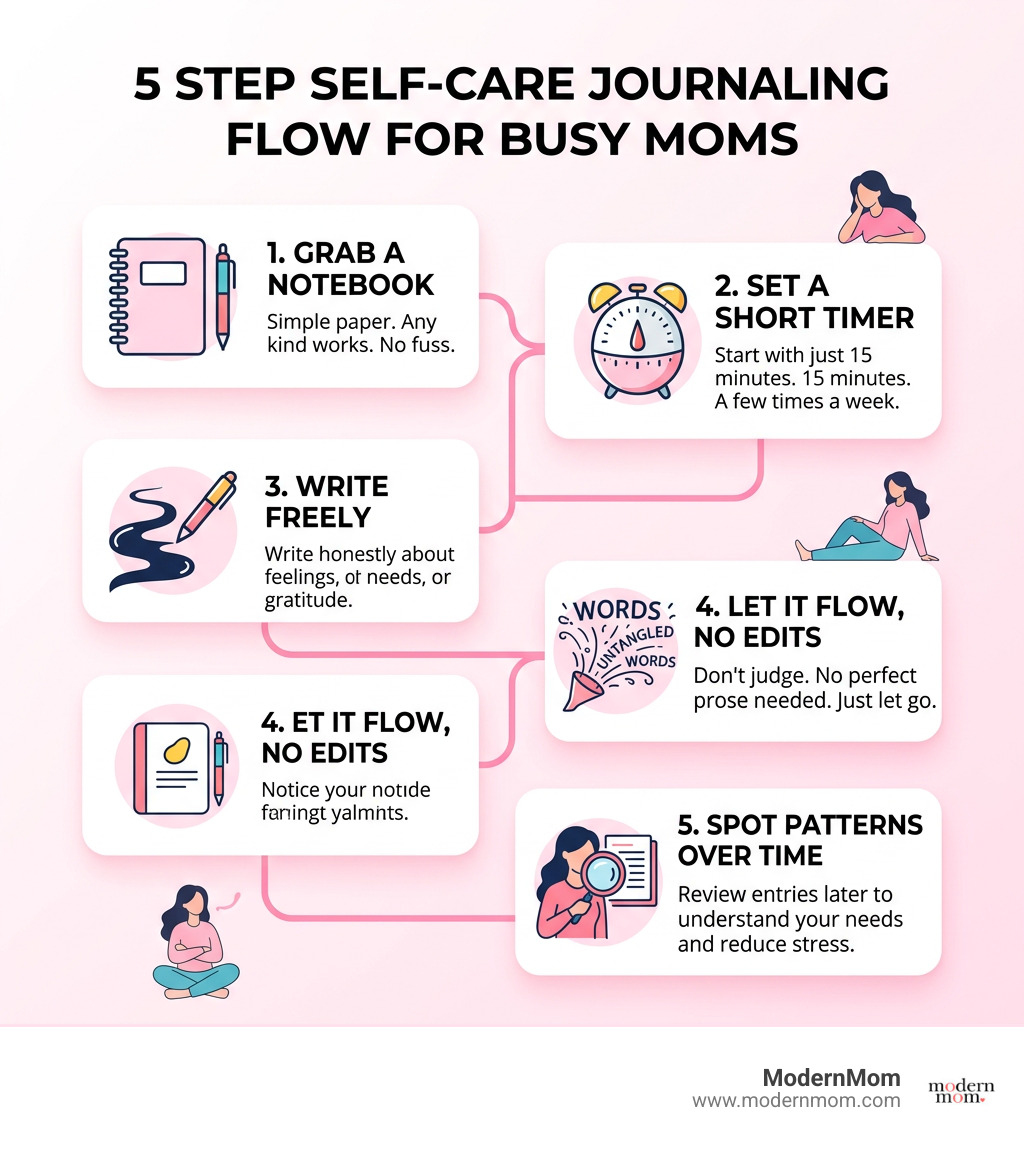
How to start self care journaling (quick-start guide):
- Grab any notebook — no special journal required
- Set a timer for 15 minutes, three times a week
- Write honestly about how you’re feeling, what you need, or what you’re grateful for
- Don’t edit yourself — just let it flow
- Review your entries after a few weeks to spot patterns
That’s it. No perfect prose. No daily commitment. Just a few minutes of honest writing that research shows can reduce stress by up to 28% and even improve immune function.
For moms especially, the mental load is relentless. Work, kids, appointments, everyone else’s needs — and somewhere at the bottom of that list, your own. A self care journal doesn’t fix everything, but it gives you a place to put it all down for a few minutes. Think of it as a pressure valve for your brain.
More for your self care journaling journey:
What is Self Care Journaling and Why It Works
We’ve all heard of diaries—those pink, bedazzled books from our childhood where we hid “juicy” secrets like who we had a crush on or that we snuck an extra scoop of ice cream. But self care journaling is a different beast entirely. While a diary chronicles what happened during your day, a self-care journal focuses on how those events affected your inner world.
Think of it as a dedicated space for Journaling for Emotional Wellness. It’s a tool that helps you move from just surviving the chaos of motherhood to actually understanding your needs. By putting pen to paper, you engage in reflective journaling, which sharpens your self-awareness and helps you recognize patterns in your thoughts and behaviors.

When we journal for self-care, we aren’t just recording history; we’re building emotional intelligence. It’s like having a conversation with your wisest friend—the one who doesn’t judge you for feeling burnt out or overwhelmed. It allows you to distinguish between “what is happening” and “how I am reacting,” giving you the space to breathe before you respond to the next toddler meltdown or work deadline.
The Science of Self Care Journaling
If you think journaling is just “fluff,” the data might surprise you. Research shows that journaling can reduce stress by a staggering 28%. But the benefits go beyond just feeling “zen.” According to Positive Psychology, writing about stressful or traumatic events is actually linked to a stronger immune system and fewer sick days from work.
One specific method, known as positive affect journaling, involves writing about positive experiences for 15 minutes, three times a week. Clinical trials found that participants who did this for 12 weeks showed significantly reduced mental distress and increased well-being compared to those who didn’t.
Neuroscientifically, the act of “affect labeling”—or simply naming your emotions on the page—actually reduces activity in the amygdala (the brain’s fear center) and boosts the prefrontal cortex. This creates a grounding effect on your nervous system, improving what experts call “psychological flexibility.” In short: your brain gets better at handling the curveballs life throws at you.
Identifying Your Emotional Triggers
For many of us, especially those navigating special needs mom stress, our internal noise can become deafening. We carry a heavy “mental load” that saps our cognitive resources. Self care journaling acts as an external hard drive where you can offload that noise.
By tracking your moods and symptoms over time, you can begin to see the “why” behind your “what.” You might notice that your anxiety spikes every Tuesday afternoon, or that you feel most depleted after talking to a specific person. This isn’t about judging yourself; it’s about honoring your finite energy. When you see the patterns on paper, you gain the power to change them.
Choosing Your Method: From Bullet Journals to Apps
The “best” way to journal is whichever way you’ll actually do. Some moms swear by the tactile feel of a beautiful notebook and a colorful pen, while others need the convenience of technology.
- Analog (Paper): Handwriting engages the brain differently than typing. It slows you down and forces a level of presence that digital tools sometimes lack. You can try Ryder Carroll‘s Bullet Journaling method if you love lists and organization, or Art Journaling if you prefer colors and sketches over sentences.
- Digital: If you’re a mom on the go, The Day One journaling app is a lifesaver. It allows you to snap a photo, record a quick audio memo, or type a few lines while waiting in the school pickup line. It’s searchable, private, and always with you.
| Feature | Paper Journaling | Digital Apps |
|---|---|---|
| Tactile Feel | High – very grounding | Low – glass screen |
| Portability | Medium – requires a bag | High – always on phone |
| Privacy | Physical lock/hiding spot | Passcode/Biometrics |
| Searchability | Low – must flip pages | High – instant search |
| Creativity | High – pens, stickers, ink | High – photos, audio, video |
Setting Up Your Writing Environment
You don’t need a private library to journal, but creating a small “ritual” can signal to your nervous system that it’s time to relax. This is part of one mother’s search for peace in a busy household.
Try to incorporate sensory cues. Maybe it’s the smell of a specific candle, the taste of your favorite herbal tea, or a soft playlist in the background. Whether you prefer a quiet morning session before the kids wake up or a brain dump in the evening to help you sleep, find a “safe space” where you can be honest. Even if that space is just your car for five minutes before you walk into the house!
How to Build a Habit That Actually Sticks
The biggest mistake people make is thinking they have to journal every single day for an hour. That is a recipe for “blank-page syndrome” and eventual burnout. Instead, follow the research-backed 15-minute rule: aim for three sessions a week.
Consistency beats perfection every time. If you miss a week, don’t beat yourself up—just start again. This is about fostering mental health, not adding another chore to your to-do list. One of the best ways to stay consistent is “habit stacking.” Pair your journaling with something you already do, like drinking your morning coffee or sitting in bed before turning out the light. For more tips, check out How to Start a Self-Care Journal and Actually Stick With It.
Effective Self Care Journaling Prompts for Beginners
Staring at a white page can be intimidating. If you aren’t sure where to start, use a free self-care journal template or try these prompts:
- For Anxiety: “What is one thing making me feel heavy right now, and what is one small thing I can control?”
- For Gratitude: “List three tiny moments from today that made me smile (even if it was just a good cup of coffee).”
- For Boundaries: “Where did I say ‘yes’ today when I really wanted to say ‘no’?”
- For Goal Setting: “If I had an extra hour of ‘me time’ tomorrow, how would I spend it?”
- For Self-Compassion: “What would I tell a friend who was feeling exactly how I feel right now?”
Common Mistakes to Avoid
We often approach self-care like a job performance review, but your journal is not a productivity scorecard. Avoid these common traps:
- Self-Judgment: Don’t worry about your handwriting, your grammar, or if you sound “whiny.” This is a judgment-free zone.
- Over-Analysis: You don’t have to find a deep, life-changing meaning in every entry. Sometimes, just venting is enough.
- The To-Do List Trap: Don’t let your journal turn into a list of errands. If you find yourself writing “Buy milk,” stop and ask, “How do I feel about having to buy the milk?”
- Privacy Concerns: If you’re worried about someone reading your thoughts, use a digital app with a password or find a very secure hiding spot. You won’t be honest if you’re writing for an audience.
Your self-care journey is personal. Whether you’re building an affordable home gym or starting a meditation practice, journaling is the glue that helps those habits stick by helping you process the “why” behind them.
Frequently Asked Questions about Journaling
How long does it take to see results?
While you might feel an immediate “release” after venting on paper, clinical trials suggest that the most significant benefits for mental distress and well-being appear after about 12 weeks of consistent practice (three times a week).
Can I journal if I’m not a “writer”?
Absolutely! You don’t need to write long paragraphs. You can use bullet points, draw pictures, or use a “stream of consciousness” style where you just write whatever pops into your head without editing. There are no grades here.
Is digital journaling as effective as paper?
It depends on your goal. Handwriting is often cited as better for “brain engagement” and memory, but digital journaling offers accessibility and the ability to include photos. The most effective method is the one you will actually use.
Conclusion
At ModernMom, we know that taking care of yourself isn’t a luxury—it’s a necessity. Self care journaling is an act of self-honoring. It’s a grounding practice that reminds you that you are a person with your own needs, dreams, and feelings, not just a “mom-bot” running on caffeine and chaos.
Start small. Be messy. Be honest. Your future, calmer self will thank you for it. For more ways to find your balance, check out our four tips to control your moods and reach moodtopia.