

What to Do When College Is Finished and You Need a Job
If college is finished, now i need a job is exactly where you’re at right now—take a deep breath. You aren’t alone, and there’s a clear path forward for you or your graduate.
Here’s what to do first:
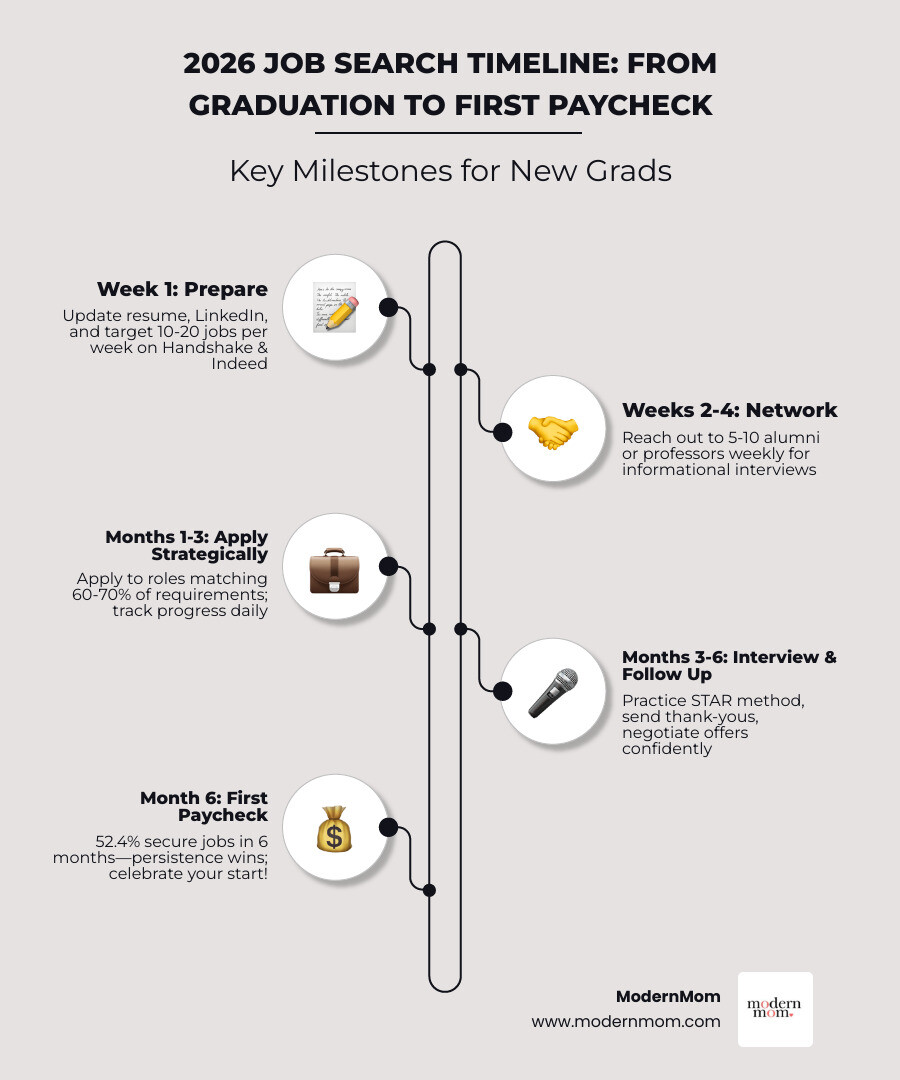
- Start immediately—don’t wait for the “right moment.”
- Update LinkedIn and resumes with all experience, including projects and volunteer work.
- Target 10–20 job applications per week on platforms like Handshake and LinkedIn.
- Reach out to 5–10 people weekly for informational interviews.
- Apply when you meet 60–70% of requirements—job descriptions are often wish lists.
- Expect a timeline of 3–6 months—that’s completely normal.
The hard truth? Only 52.4% of 2023 graduates had secured employment within six months of graduating. With many entry-level roles asking for years of experience, the job market can feel like a door that won’t open.
But here’s the good news: the graduates who land jobs fastest aren’t always the most qualified—they’re the most strategic. Whether you’re a mom cheering on your new grad or a woman stepping back into the workforce, this guide gives you the real-world playbook.
Modern Mom is here to help you navigate the career-building trenches. Let’s walk through every step together so you can move forward with confidence.
The Reality of the 2026 Job Market
As we navigate 2026, the landscape for new graduates has shifted significantly. While hiring is projected to be up, the competition remains fierce. On average, a single corporate job opening attracts 250 resumes, yet only a handful of candidates make it to the interview stage.
We’re currently facing what experts call the “experience paradox.” Even though you’re looking for an “entry-level” role, 61% of these postings now ask for 2–3 years of experience. This can be incredibly discouraging when you’ve spent the last few years in a lecture hall.
However, understanding Landing Your First Job After College: A No-BS Guide means realizing that “experience” doesn’t just mean a previous full-time salary. It includes your lab work, your summer shifts, and your volunteer hours.
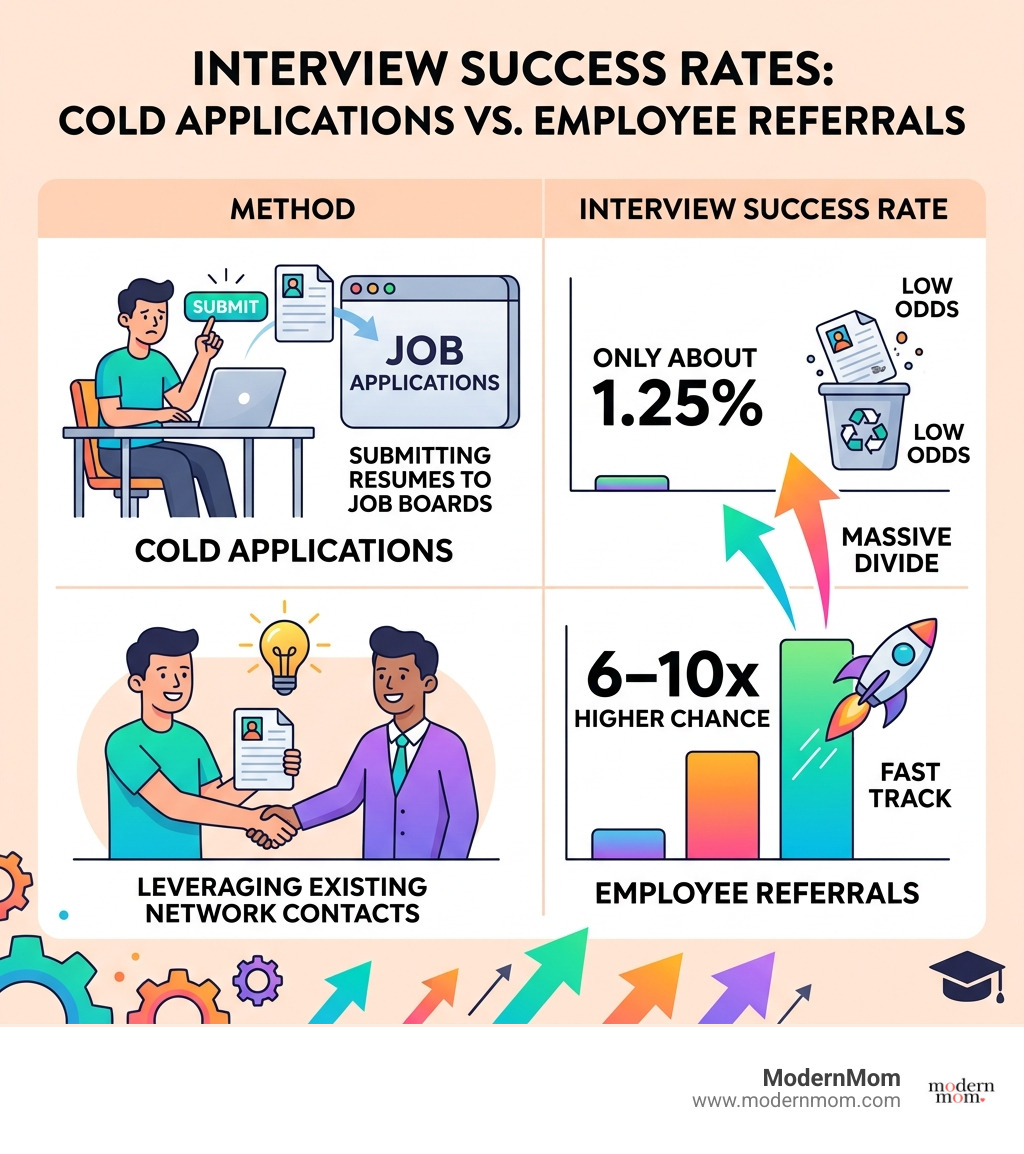
Data shows a massive divide in how people actually get hired. Cold applications have a success rate of only about 1.25%. Compare that to employee referrals, which give you a 6–10x higher chance of landing an interview.
College is Finished, Now I Need a Job: Your 2026 Action Plan
To beat the odds, try a “funnel” approach: treat the job search like a professional project. Set a weekly goal of 10-20 high-quality applications and 5-10 networking “touches” to keep your momentum steady.
That means building a simple system instead of relying on motivation alone. Use a spreadsheet or notes app to track where you applied, who you contacted, when you followed up, and what the next step is. A basic routine helps you feel less overwhelmed and makes it easier to spot what’s working.
Your primary tool is your resume. In 2026, most resumes are first “read” by an Applicant Tracking System (ATS). If your resume isn’t optimized, a human might never see it.
A Step-by-Step Plan for landing a job in 2026 involves keeping your layout clean. Avoid tables, icons, or complex columns that confuse the software.

A strong resume also needs results, not just responsibilities. Instead of writing “helped with social media,” try “created 12 Instagram posts per month and increased student club engagement by 20%.” Numbers give hiring managers proof that you can contribute.
If you’re a recent grad with limited formal experience, keep it to one page and lead with the most relevant material. That might be internships, senior projects, campus leadership, freelance work, or part-time jobs that built customer service, organization, or communication skills.
Crafting an ATS-Proof Resume
Keyword mirroring is your best friend. Look at the job description and pick out 15-25 key terms. If they ask for “cross-functional collaboration” and you have it, use those exact words.
Don’t be afraid to include non-traditional experience. Did you manage a student organization’s Instagram? That’s social media management.
A helpful format is to create sections for:
- Education
- Relevant experience
- Projects
- Leadership and volunteer work
- Skills and certifications
Project sections can be especially useful when you don’t yet have a long work history. If you built a website, completed a research project, analyzed data, tutored younger students, or organized a campus event, include it. Employers care about problem-solving, initiative, and follow-through.
For bullet points, use an action-focused formula such as CAR: Challenge, Action, Result. It keeps your writing concrete and persuasive. Even one strong bullet can make a recruiter pause and take notice.
Staying Mentally Strong
Let’s be real: job hunting is one of the top three most stressful life events. It’s easy to fall into a cycle of refresh-and-reject. To stay sane, try to maintain a routine.
Dress up for your “work hours” even if you’re just at your kitchen table. Your career transition requires patience and a structured plan. Create “rejection rituals” to help you bounce back quickly.
That ritual can be simple: log the rejection, take a 10-minute walk, send one new networking message, and move on. The goal isn’t to pretend rejection doesn’t hurt. The goal is to keep one disappointing email from stealing your whole week.
It also helps to separate your worth from your search results. Not hearing back quickly doesn’t mean you failed. It usually means hiring teams are slow, roles are competitive, or companies are still sorting through hundreds of applications.
If you’re supporting your child through this season, or returning to work yourself after caregiving, that emotional support matters more than you may realize. Celebrate small wins like finishing a resume draft, booking a coffee chat, or getting a first-round interview. Momentum often builds quietly before it becomes visible.
Networking Without the “Sleaze” Factor
Many of us cringe at the word “networking,” but it’s really just about building relationships. Focus on “weak ties”—acquaintances, friends of friends, or alumni. These people are often more helpful than your inner circle because they have access to different networks.
A great New Grad Guide for 2026 suggests requesting “15-minute coffee chats.” Ask questions like, “What do you wish you knew when you started?” People love to give advice.
Since employee referrals account for a huge portion of hires, these conversations are your golden ticket. Reach out to five alumni a week on LinkedIn with a personalized note. You aren’t asking for a job; you’re asking for their story.

Acing the Interview with the STAR Method
If you get the interview, you’ve already beaten 98% of the competition! Now, you just need to prove your “A-game.” About 70% of interview questions are behavioral, meaning they start with “Tell me about a time when…”
The STAR method is your secret weapon:
- Situation: Set the scene briefly.
- Task: What was the challenge?
- Action: What specifically did you do?
- Result: What was the outcome?
According to a New Grad Job Search Guide, you should also research the company’s recent news and culture. Don’t forget the basics: for virtual interviews, ensure your lighting is in front of you and always send a thank-you email within 24 hours.
Field-Specific Strategies and Public Sector Paths
Not all jobs are found on LinkedIn. If you’re in a specialized field like wildlife science, your timeline might look different. Check niche sites like USAJobs for federal roles or state-specific portals.
Working for the government is a different beast. Unlike the private sector, the process is strictly regulated to ensure fairness. You’ll need to provide substantiated proof of your education, so have your transcripts ready.
Government applications require following a very specific checklist. You must apply for every single requisition individually—applying once for a general title isn’t enough.
Frequently Asked Questions about Post-Grad Job Hunting
How long does it typically take to find a job after graduation?
On average, it takes between 3 to 6 months to land a first professional role. Some grads have something lined up by May, but for many, the search continues into the fall. Don’t beat yourself up if it doesn’t happen in the first month.
Should I apply for jobs if I don’t meet 100% of the requirements?
Yes! Follow the 60–70% rule. If you meet the core requirements but lack a few “nice-to-have” skills, apply anyway. Job descriptions are often “wish lists.” Focus on your transferable skills and your ability to learn quickly.
What are the best platforms for new graduates in 2026?
- Handshake: Specifically built for students and recent grads.
- LinkedIn: Essential for networking and finding the “hidden” job market.
- USAJobs: The go-to for federal and stable government careers.
- Direct Company Pages: Many firms hire directly from their own sites to save on fees.
Conclusion
When “college is finished, now I need a job” is your daily mantra, remember that your first job is just a starting point. It doesn’t have to be your “dream job” or your “forever career.” Most graduates stay in their first role for about two years before moving on.
At Modern Mom, we know that transitions are hard, whether it’s a child starting school or a graduate starting a career. Stay consistent, keep refining your resume, and lean on your village for support. The right opportunity is out there—you just have to keep knocking.