

Why Reconnecting in a Relationship Matters More Than You Think
Reconnecting in a relationship starts with recognizing the distance and choosing to bridge it. Here’s how to start:
Quick Steps to Reconnect:
- Schedule 20 minutes of distraction-free time together this week
- Start a daily check-in to share one win and one worry
- Increase small touches like hand-holding or goodbye hugs
- Try one new activity together to create novelty
- Ask open-ended questions about hopes, worries, and dreams
- Address conflicts with “I” statements and active listening
- Seek couples therapy if patterns persist or trust is broken
At least once a week, someone says, “We just aren’t close anymore” or “It feels like we’re roommates who just share household responsibilities and kids.” Sound familiar?
The spark fading doesn’t mean your relationship is broken. It means it needs attention.
Most long-term couples admit they’re stuck in what experts call “Relationship Inc.”—running your partnership like a business, focused on logistics, bills, and schedules instead of each other. You manage the house. You coordinate the kids. But where did the two of you go?
Here’s the good news: couples often feel closer after simply talking about feeling disconnected. That’s right—just naming the distance can start closing it.
This isn’t about grand gestures or expensive vacations. Research shows that reconnecting happens through small, consistent actions in everyday life. A 20-second hug. A real conversation over dinner. Asking your partner about their day and actually listening.
Whether you’re navigating the exhaustion of new parenthood, the stress of juggling careers and family, or just the slow drift that happens when life gets busy, you can find your way back. Reconnection is possible—and it starts with simple, intentional steps.
Think of your relationship like any other important partnership in your life—it thrives on intentionality. It’s about showing up, communicating clearly, and making space for what truly matters. This guide will walk you through exactly how to do that, one simple step at a time.
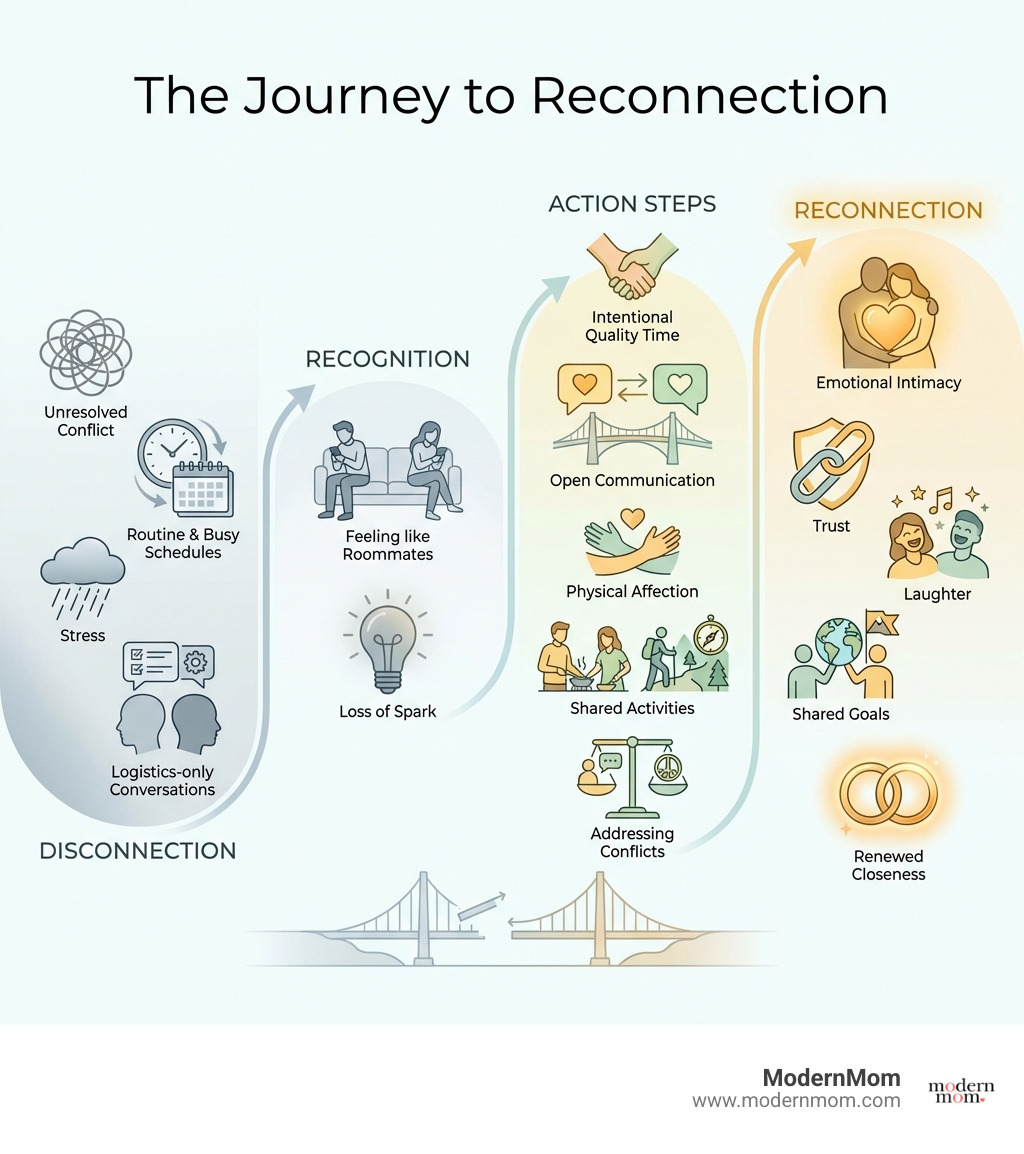
Why Do We Drift Apart? Understanding the Common Causes of Disconnection
Life has a way of getting in the way, doesn’t it? We start our relationships with so much passion and curiosity, eager to learn every detail about our partner. But over time, the relentless pace of daily life can slowly chip away at that connection.
Many couples find themselves in a rut, feeling like they’re merely co-existing rather than truly connecting. This isn’t a sign of failure; it’s a common experience, especially for long-term partners. The majority of long-term couples admit they’re stuck in the rut of what some experts call “Marriage Inc.” or “Relationship Inc.” It’s when we treat our partnership like a business, focused on managing life’s responsibilities rather than nurturing our bond.
Routine, responsibilities, unresolved conflict, and not spending quality time together are just a few reasons couples grow apart. When we’re juggling careers, managing a household, and raising children, it’s easy for our relationship to recede into the background. We pour our time and energy into work, kids, and chores, forgetting to invest in the “us” that started it all.
Signs You’re Growing Apart
How do you know if you and your partner are drifting? The signs can be subtle at first, often masquerading as “just being busy.” However, if you notice these patterns, it might be time to intentionally work on reconnecting in a relationship:
- Less physical touch: Hugs become quick and perfunctory, hand-holding is rare, and casual affection diminishes.
- Conversations about logistics only: Your chats revolve around schedules, bills, and childcare, with little room for deeper emotional sharing.
- Avoiding difficult topics: You might sidestep sensitive subjects to keep the peace, but this often leads to unspoken resentments building up. Joe Ricciardi, a licensed clinical social worker, notes, “Many couples find certain topics extremely difficult to open up about… But what you don’t say may show somewhere else, or it may fuel the distance in the relationship.”
- Lack of laughter: The easy, shared humor you once enjoyed feels distant.
- Feeling lonely together: You might be in the same room, but you feel emotionally miles apart.
- Minimal quality time: Even when you’re together, you’re distracted by phones, TV, or other tasks.
- Assuming you know everything: Nicholas Hardy, a Texas-based therapist, points out that we often assume we already know what there is to know about our partners. This stops us from actively learning and growing with them.
The “Relationship Inc.” Trap
“Relationship Inc.” is a common pitfall where our partnership starts to feel more like a functional corporation than a loving connection. We become adept at managing the household, the kids’ schedules, and the bills, but we lose sight of the emotional investment needed for our romantic relationship.
This trap is particularly easy to fall into for modern moms. We’re often the CEOs of our households, juggling countless tasks and responsibilities. The transition to parenthood, for example, can drastically shift priorities. Studies show that about 90% of couples feel less happy in their relationship after having children. The new workload, desire for “me time,” decreased physical intimacy, and sleep deprivation can all contribute to this distance.
Dr. Carly Snyder emphasizes that while every stage of parenthood is transient, the relationship with your partner is at the core of everything and needs investment. When we prioritize tasks over connection, we risk losing the “us” in the process.
The Foundation of Reconnection: Nurturing Emotional and Physical Intimacy

When we talk about reconnecting in a relationship, we often think of “intimacy.” But what does that really mean? It’s more than just physical closeness; it’s about a deep, shared understanding and connection that makes us feel truly seen and valued.
Elyssa Helfer, a licensed marriage and family therapist, explains, “Long-term relationships require ongoing intentionality and commitment… We cannot expect to maintain connection when we are no longer creating new contexts for emotional and sexual intimacy.” Relationships are living things that need care and attention, as Angela Amias, a couples therapist, reminds us.
What is Emotional Intimacy and How Do You Rebuild It?
Emotional intimacy is the cornerstone of a strong relationship. The Gottman Institute, a world-renowned research center on relationships, defines it as “a sense of shared meaning and emotional connection that arises when partners are attuned to each other’s inner worlds and communicate with empathy and understanding.” It’s about being emotionally open, responsive, and engaged.
To rebuild emotional intimacy, we need to:
- Cultivate Vulnerability: This means daring to share our true feelings, fears, and dreams with our partner, knowing they will be met with empathy, not judgment.
- Engage in Deep Conversation: Move beyond surface-level chats about logistics. Ask thoughtful questions that ignite curiosity, such as “What’s something silly or spontaneous you’d love us to try together?” or “When did you last feel truly seen by me?” These questions can reignite curiosity and create space for emotional honesty.
- Practice Active Listening: This is crucial. It means listening to understand your partner without forming a rebuttal in your head. As experts often say, preparing to defend yourself or “win” an argument leads to distance and resentment. We need to quiet our own minds and truly hear what our partner is saying, rather than listening to our own thoughts and judgments about them.
- Build “Love Maps”: This concept from Dr. John Gottman involves knowing your partner’s inner world – their history, concerns, preferences, hopes, and dreams. It’s about continuously asking questions and remembering the answers. For instance, do you know your partner’s favorite musical group, or one of their best childhood experiences? This cognitive mapping is a lifelong process that strengthens your bond.
Rekindling the Spark: How to Nurture Physical Connection
Physical connection is a vital part of reconnecting in a relationship, and it extends far beyond sexual intimacy. It’s about communicating safety, affection, and reassurance through touch.
- Beyond Sex: While sex is an important aspect for many couples, physical intimacy also includes non-sexual touch. This can be especially true for moms, who might find their bodies feeling less like their own after childbirth. It’s important to be patient and for physical intimacy to be woman-led in the early stages post-baby. Studies show that couples who have sex weekly report more relationship satisfaction, but doing it more often doesn’t necessarily add further satisfaction.
- Affectionate Gestures: Think about the “micro-moments” of physical connection. Hugs, hand-holding, cuddling on the couch, a gentle touch on the arm, or a brief massage. These small gestures, offered with intention, can significantly restore closeness.
- Love Languages: Understanding your partner’s love language can guide how you express physical affection. If their primary love language is Physical Touch, these gestures will resonate even more deeply.
- Small Rituals: Establish little routines like a 20-second hug each morning, holding hands during a walk, or a two-minute cuddle at night. These consistent, small acts signal care, curiosity, and presence.
Rebuilding physical closeness often starts gently. These moments lower stress and make it easier to talk about deeper needs, as physical touch often follows emotional closeness.
Practical Steps for Reconnecting in a Relationship

Reconnecting in a relationship doesn’t require grand gestures, though those can be lovely too! More often, it’s about small, consistent efforts that show care, curiosity, and presence. Larissa House, a licensed clinical social worker, notes, “It’s how couples treat each other in the day-to-day that will help keep them connected,” rather than big vacations.
Create Intentional Quality Time (Even When You’re Exhausted)
In our busy lives, quality time often feels like a luxury. But it’s a necessity for connection. The goal is intentional, distraction-free time.
- Ditching Distractions: Put away your phones, turn off the TV, and truly focus on each other. Even 20 minutes can make a difference.
- Tech-Free Time: Schedule a weekly tech-free dinner or an hour where you unplug and simply talk or play a game.
- At-Home Date Nights: You don’t need a babysitter or a fancy restaurant. Cook a new recipe together, have a picnic in the living room, or watch a movie you both love after the kids are asleep.
- Micro-Moments: Dr. Rashmi Parmar suggests synchronizing work breaks. If you’re both working from home, take a five-minute break every couple of hours to chat, grab a coffee, or just stretch together. These brief, coordinated interactions add up.
- Shared Hobbies: Start a project or learn something new together. This could be anything from building a small garden to taking an online cooking class. Nicholas Hardy explains that “when you start something new together, it takes a lot of pressure off.” It fosters teamwork and shared experiences.
Aim for at least an hour a week of quality time together; two hours is even better. It might feel like another item on your to-do list at first, but it’s an investment in your happiness.
Master Communication for Reconnecting in a Relationship
Communication is the “gas that makes the car go,” as Renetta Weaver, a licensed clinical social worker, puts it. Effective communication is vital, especially after conflict.
- Repair Attempts After Arguments: When you’ve just had a big fight, picking up the pieces can feel impossible. But skilled communication can help. Once tempers have calmed, give each person space to communicate their point of view. Being open and honest about your thoughts and intentions can restore a sense of safety, according to psychologist Zofia Czajkowska.
- Using ‘I’ Statements: Instead of accusatory phrases, use “I” statements to express your feelings. For example, “When X happens, I feel Y, and I think it would be helpful if you could do Z to reassure me or prevent that from happening in the future.” This expresses your needs without placing blame.
- Active Listening: This means truly listening to understand your partner, rather than just waiting for your turn to speak. Avoid forming rebuttals in your head.
- Avoiding Blame: Most arguments are about a failure to connect emotionally, not about who is “right.” Focus on understanding each other’s perspective and collaborating on a solution.
- Recognizing Bids for Connection: Dr. John Gottman’s research highlights “bids” for connection—small requests for attention, affection, or support. These can be as simple as “Do we need milk?” or even a complaint like “It never occurs to you to empty the dishwasher, does it?” Responding positively to these bids, by turning towards your partner rather than away, builds your “Emotional Bank Account” of trust and intimacy.
- Honest Conversations, Even When It’s Tough: Couples actually feel closer after talking about how they feel disconnected. Consider Renetta Weaver’s “power hour” technique: “Set aside a power hour each week to talk about 3 things your partner did well, 2 things your partner could have done better, and 1 thing you plan to do differently this week.”
Bring Back the Spark with Novelty and Play
One of the biggest culprits of relationship drift is routine and monotony. We fall into predictable patterns, and the excitement wanes. Novelty, however, is an aphrodisiac!
- Breaking Routines: Challenge yourselves to try something new, even if it’s small. It creates new memories and reminds you of the fun you can have together.
- New Adventures: Plan a new, interesting, or adventurous date or getaway. This doesn’t have to be expensive. It could be a road trip to a nearby town you’ve never explored, or a picnic at a new park.
- Trying New Things Together: Learn a skill, take a class, or try a new restaurant. Exploring uncharted territory side by side is an easy way to bring about more teamwork in a relationship.
- Playfulness: Laughter can create the same chemical bond as intimacy. Set aside time for silliness—play a board game, do a puzzle, or watch a playlist of funny videos.
5 Simple and Novel Date Ideas:
- Try a new recipe together: Pick a cuisine you’ve never attempted, like pasta from Italian chefs or a Mexican street taco course, and make it a team effort.
- Visit a local museum or art gallery: Engage your minds and find something new to discuss.
- Take an online class as a couple: Learn a new language, improve your iPhone photography skills, or master the Moonwalk!
- Go for a hike or nature walk: Explore a new trail and enjoy the outdoors together.
- Recreate your first date at home: Reminisce about those early days, the nerves, the excitement, and what led you to fall in love. It’s a wonderful way to go down memory lane.
Rebuilding a Stronger Bond: Trust, Safety, and Shared Goals
Beyond the daily actions, reconnecting in a relationship also involves deeper work: ensuring a foundation of trust and safety, and aligning on your shared future.
How to Rebuild Trust and Emotional Safety
Trust is the bedrock of any strong relationship. When distance creeps in, or conflicts arise, trust can erode.
- Following Through on Promises: Reliability is key. When you say you’ll do something, do it. This builds confidence that your partner is dependable.
- Being a Safe Space for Vulnerability: Create an environment where both partners feel safe to share their deepest thoughts and feelings without fear of judgment or ridicule. Zofia Czajkowska emphasizes that being open and honest about one’s thoughts and intentions about the relationship itself and the future can restore — or newly create — a sense of safety.
- Honest Apologies: When you make a mistake, offer a sincere apology that acknowledges the impact of your actions.
- Creating a Home Where Both Partners Feel Heard and Valued: This means actively listening, validating feelings, and showing empathy, especially during difficult conversations. If your Emotional Bank Account is in debt of disconnection, trust and intimacy erode away. We need to make more positive deposits than negative ones.
The Power of Shared Values and a Common Vision
What brought you together initially often includes shared values and dreams. Over time, these can get buried under the weight of daily life. Reconnecting means refinding and realigning them.
- Discussing Future Goals: What are your individual hopes and aspirations? What are your collective dreams for your family, your home, your retirement? Make time to talk about these things.
- Aligning on Core Values: Revisit what truly matters to both of you. Do you still share the same core beliefs about family, finances, or lifestyle? How have they evolved?
- Creating a Team Mentality: When you face challenges, approach them as a united front. This “us against the problem” mindset reinforces your bond.
- Working Towards Something Together: Whether it’s planning a vacation, saving for a down payment, or even tackling a home renovation project, having a shared objective can bring you closer. It builds teamwork and provides small wins along the way.
When to Seek Professional Help (And Why It’s a Sign of Strength)
Sometimes, despite our best efforts, we find ourselves stuck. Old patterns resurface, arguments escalate, or the emotional distance feels too vast to bridge on our own. This is when seeking professional help isn’t a sign of failure, but a powerful act of commitment to your relationship.
- When to Consider Therapy:
- If you’re stuck in repetitive negative communication patterns.
- If you find it difficult to express your needs or feel unheard.
- If you’re facing deeper unresolved issues, such as past betrayals, resentment, or significant life stressors that are impacting your connection.
- If you feel like “roommates” and can’t find your way back to intimacy.
- If one partner resists reconnection efforts, a therapist can help facilitate a neutral conversation.
- What to Expect from Couples Counseling: A licensed therapist can provide a safe, neutral space for both partners to communicate, understand underlying issues, and learn new, healthier interaction patterns. They can offer tools and strategies custom to your specific challenges.
- It’s Never Too Early or Too Late: As Marcus Hunt, an associate marriage and family therapist, advises, “It’s never too early or too late to seek help. If you are willing to make your relationship better and look at yourself individually and what you need to change — rather than just what your partner needs to change — then the relationship can get better.” Seeking support is a sign of strength and a proactive step towards a healthier, happier future together.
Conclusion
Reconnecting in a relationship is a journey, not a destination. It requires ongoing intentionality, commitment, and a willingness to show up for each other, even when life gets messy. It’s the small, consistent steps and micro-moments of love that truly weave the fabric of a lasting connection.
You have the tools and the capacity to find your way back to the closeness and passion you desire. Accept the everyday acts of kindness, the honest conversations, and the shared laughter. You are not alone in this journey, and every effort you make strengthens the beautiful bond you share.
For more guidance on strengthening your partnership, explore our complete guide on making your relationship work.