

What Every Mom Needs to Know About Military Draft Concerns Right Now
Military draft concerns for parents are completely understandable — especially with news about automatic Selective Service registration changes and ongoing geopolitical tensions making headlines in 2026.
Here’s the short answer most parents need right away:
- No draft is active. The U.S. hasn’t had a military draft since 1973.
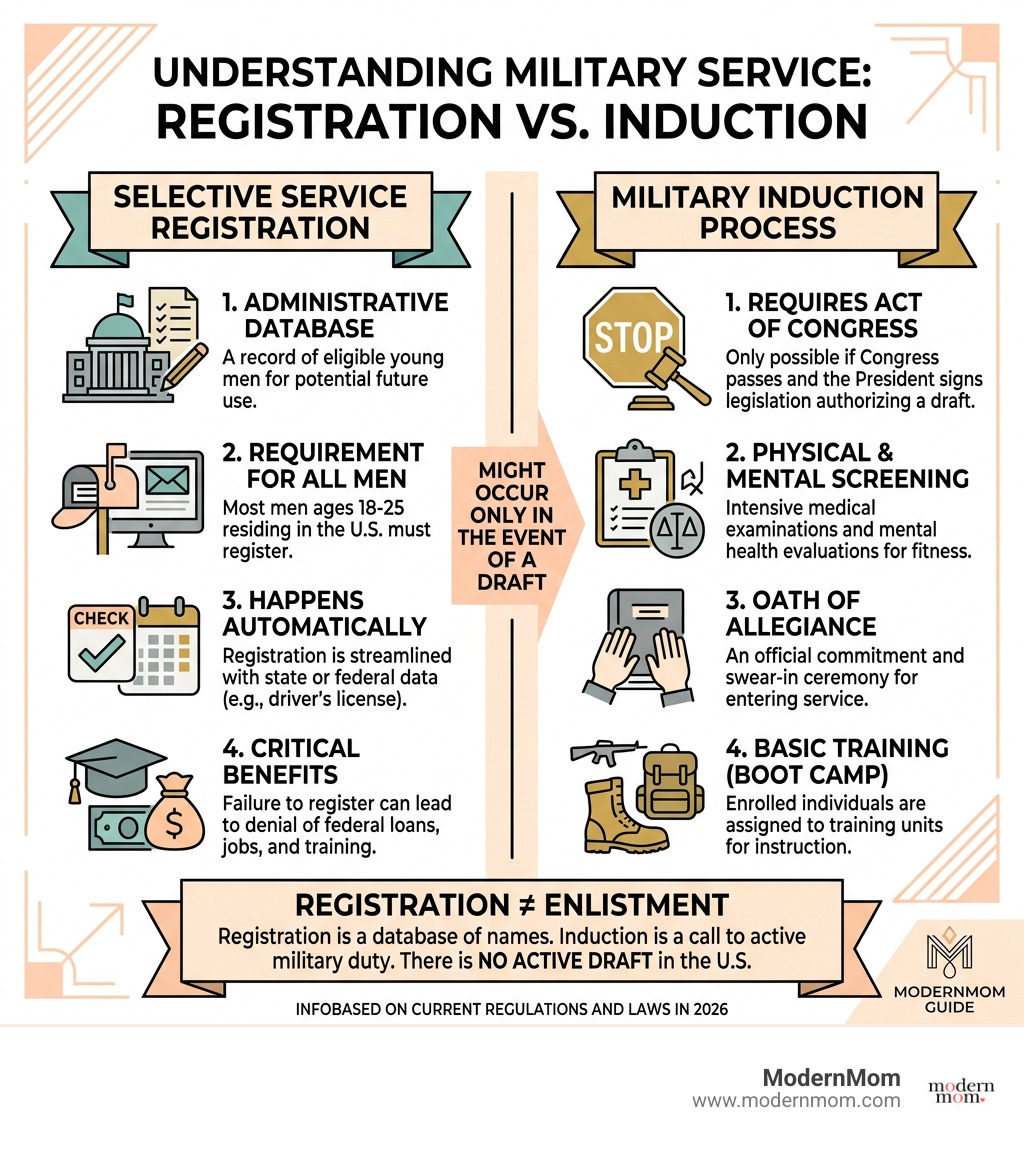
- Automatic registration is administrative. Starting December 18, 2026, eligible young men will be registered for the Selective Service database automatically — but this does not mean a draft is starting.
- A draft would require an act of Congress. It can’t happen overnight. There is currently no active draft, and reinstating one would require major political action that does not appear imminent.
- Registration ≠ induction. Being in the Selective Service database simply means your son’s name is on file in case Congress ever authorized a draft.
- Penalties for non-registration are real. Failing to register can affect college financial aid, federal jobs, and carries felony-level fines — so compliance still matters.
It’s okay to feel worried. But knowing the facts can replace anxiety with confidence.
Understanding the 2026 Automatic Registration Change
If you’ve been scrolling through social media lately, you might have seen alarming posts about a “new draft law.” Let’s clear the air. The National Defense Authorization Act (NDAA) for 2026 includes a significant shift in how the Selective Service System (SSS) operates. Starting December 18, 2026, the process for registering young men will move from a manual “self-report” system to an automatic one.
For decades, young men were required to proactively go to the post office or a website to register within 30 days of their 18th birthday. However, compliance has been slipping. In 2024, only about 81% of eligible men registered, which was a 3-percentage point drop from the previous year. To fix this, the government is shifting the burden from the individual to the Selective Service system.
This administrative shift means the Selective Service will now use federal data—primarily from the Social Security Administration—to automatically add eligible men to the database. It’s essentially a data-syncing exercise. The goal is to push compliance above 90% without requiring 18-year-olds (who, let’s be honest, aren’t always great with paperwork) to remember a federal deadline. You can find more important info for you or your son about the military draft regarding these procedural updates to ensure you’re fully up to speed.
Addressing concerns for parents regarding the new law
We know what you’re thinking: “If they’re making it easier to register, are they getting ready to use the list?” It’s a logical question, but experts say the answer is no. This change is about administrative efficiency, not military mobilization.
While young men have traditionally been expected to register within 30 days of turning 18, the new automatic system is designed to reduce missed registrations and their consequences. For families, that means one less deadline to worry about, even as the broader debate over draft registration remains very much alive.

Is a Draft Imminent? Separating Fact from Fiction
With global conflicts and military tensions dominating headlines in 2026, it’s easy for our minds to jump to the worst-case scenario. However, the gap between “having a list of names” and “forcing people into uniform” is massive.
Reinstating a draft would require a literal act of Congress. Both the House and the Senate would have to pass legislation, and the President would have to sign it. In the current political climate, there is almost zero appetite for this. The U.S. has relied on an all-volunteer force since the end of the Vietnam War in 1973, and military leadership actually prefers it that way. Professional, highly trained volunteers are generally considered more effective than reluctant draftees in modern, high-tech warfare.
For a deep dive into the logistics, you can read more about whether the US could bring back the draft, who would be called first, and who qualifies. The consensus among historians and defense analysts is that a draft is an extreme emergency measure, not something that would be triggered by localized regional conflicts.
Expert perspectives on military draft concerns for parents
Military experts like Mark F. Cancian have noted that these registration changes shouldn’t cause alarm. He and other analysts point out that the military, politicians, and the general public are all strongly aligned against conscription.
The historical context is also a powerful deterrent. During the Vietnam War, the draft became a flashpoint for massive social unrest, and the military suffered from morale and discipline issues. Unless the nation faced an existential threat that volunteers couldn’t meet, the political and social hurdles to a draft remain are considerable.
The Eligibility Checklist: Who is Actually Required to Register?
If a draft were ever called, not everyone on the list would actually serve. In fact, many young Americans wouldn’t even qualify.
Under current federal rules, Selective Service registration applies to most male U.S. citizens and male immigrants living in the United States between ages 18 and 25. That includes many documented and undocumented immigrants. But registration is not the same thing as being inducted into military service.
Data often cited by military recruiters and analysts shows that only a minority of young Americans meet basic military eligibility standards without a waiver. Common barriers include physical health issues, drug use, criminal history, and educational requirements.
| Group | Registration Required? | Notes |
|---|---|---|
| Male Citizens | Yes | Must register within 30 days of 18th birthday. |
| Male Immigrants | Yes | Includes documented and undocumented. |
| Women | No | Currently exempt from registration. |
| Active Duty Military | No* | Exempt only while on continuous active duty. |
*Exemption rules are limited and fact-specific. The Selective Service also recognizes some narrow exemptions, including certain cases involving continuous confinement or institutionalization.
Many parents have questions about who may be exempt, deferred, or treated differently under the current rules. As of April 2026, women are still not required to register for the Selective Service, despite ongoing legislative debates over the last decade.
Current Selective Service rules still rely on sex assigned at birth rather than gender identity. We believe that framework is discriminatory, and it is one reason draft registration remains controversial. Families with transgender or nonbinary children may want to review the current rules carefully and seek individualized guidance if needed.
Other exemptions apply to those who are “continually confined”—meaning they are in a hospital, psychiatric institution, or prison for the entire duration of their eligibility (ages 18 to 26). Members of the clergy and certain students in divinity schools may also be exempt from service, though they still generally need to register.
How the Draft Process Works: Lottery and Call-Up Order
If the unthinkable happened and Congress authorized a draft, it wouldn’t be a free-for-all. The process is designed to be a random, fair lottery based on birthdays.
The order of the call-up is very specific:
- 20-Year-Olds: This group is the first to be called.
- 21-Year-Olds: They are second in line.
- 22 to 25-Year-Olds: The sequence continues up the age bracket.
- 18 and 19-Year-Olds: These are the last to be called, as the military prefers slightly older, more mature recruits.
The entire system is supported by over 2,000 local draft boards across the country. These boards are staffed by civilian volunteers—people from your own community—who would be responsible for reviewing claims for deferments or exemptions.
Postponements for students and high school seniors
One of the biggest military draft concerns for parents is whether a son would be called up in the middle of his senior year or a college semester. The short answer is: No.
Current rules allow for temporary postponements:
- High School Students: A student can usually have his induction postponed until he graduates or turns 20, whichever comes first.
- College Students: If a draft were called, a college student could typically finish his current semester. If he is a senior in his last year, he can usually finish the entire academic year.
It’s important to note that the broad “college deferments” common during the Vietnam era were eliminated in 1971. Today, the focus is on a brief postponement to ensure students aren’t losing their hard-earned credits or failing to graduate.

Practical Steps for Moms to Manage Draft Anxiety
As moms, our “worry radar” is always on. When it comes to military draft concerns for parents, the best way to manage anxiety is through action and information.
- Verify Registration: You don’t have to wait for the automatic system to kick in. You can check your son’s registration status at sss.gov using his Social Security number.
- Keep Good Records: If your son has medical conditions or physical limitations that would disqualify him, keep those records organized. While he still has to register, those documents would be vital if he were ever called for an exam.
- Talk Openly: Don’t let the headlines be the only source of information for your teen. Explain that registration is a legal requirement, like getting a driver’s license, and that it doesn’t mean he’s going to war tomorrow.
- Check Financial Aid: Ensure he is registered (or will be automatically) so his FAFSA and college aid aren’t interrupted. Even though the federal government decoupled registration from aid in 2020, some states and specific grants still require it.
Families with moral, religious, or political objections to conscription may also wish to review advocacy and legal resources representing different perspectives.
Frequently Asked Questions about Selective Service
Does automatic registration mean my son is being drafted right now?
Absolutely not. Automatic registration is simply an update to how the government collects names for its database. Since 1973, the U.S. has maintained a 100% volunteer military. The Selective Service exists only as an insurance policy for a “worst-case” national emergency.
What are the penalties if my son isn’t registered?
While the government rarely prosecutes individuals for failing to register, the administrative penalties are stiff. Failing to register is technically a federal felony. More practically, it can lead to a permanent loss of eligibility for federal student loans, federal job training programs, and all federal security-clearance jobs. For immigrants, failing to register can significantly complicate the path to U.S. citizenship.
Can my son claim conscientious objector status during registration?
There is no “box to check” for conscientious objector (CO) status on the registration form. If a draft were ever enacted, a person would first receive an induction notice. At that point, they would apply for CO status through their local draft board. They would need to demonstrate that their opposition to war is based on deeply held moral, ethical, or religious beliefs.
Conclusion
Navigating military draft concerns for parents in 2026 requires a balance of staying informed and staying calm. While the headlines about automatic registration might seem scary, the reality is that it’s a procedural update designed to protect our kids from the legal fallout of forgetting to register.
At ModernMom, we know that your family’s safety and future are your top priorities. Whether you’re dealing with the stress of potential policy changes or just trying to get through the school week, we’re here to provide the facts and the support you need.
Stay connected with us for more updates on policy changes that affect your home. Visit ModernMom for more family health and wellness tips and join our community of moms who are navigating this modern world together, one step at a time.