

Why Planning High School Courses Sets Your Teen Up for Success
Choosing high school courses is one of those “big” parenting moments that can feel a little heavy. These choices shape your teen’s path to graduation and college, and the decisions they make now can open (or close) important doors later.
It’s a lot to juggle, especially when you’re a busy mom trying to help your teen make choices that actually matter. The course your teen picks in Grade 9 can determine whether they qualify for a competitive university program in Grade 12.
Core subjects required in most high schools:
- English/Language Arts (typically 3-4 years)
- Mathematics (typically 3-4 years)
- Science (typically 2-3 years)
- Social Studies/History (typically 3-4 years)
- Physical Education and Health
Course types that shape your teen’s path:
- U (University Preparation) — for students heading to university
- C (College Preparation) — for students heading to college programs
- M (University/College) — works for both pathways
- E (Workplace Preparation) — for students entering the workforce
- Open — available to all students, counts as compulsory or elective credit
The good news? You don’t have to figure it all out alone. This guide breaks down everything — from decoding course codes to planning for university science requirements — so you and your teen can make confident, informed choices together.
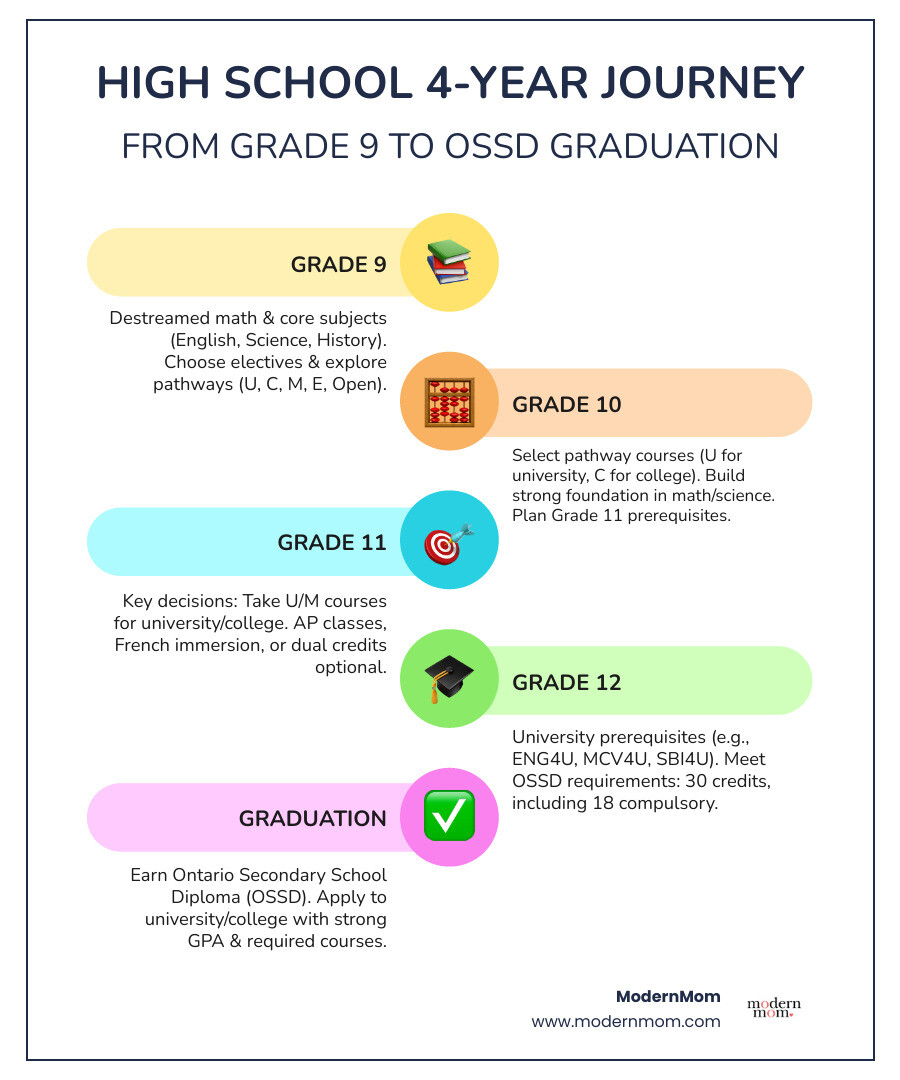
High school courses terms simplified:
Decoding the Different Types of High School Courses
When we first look at a course catalog, it can feel like we’re reading a different language. Between “destreamed” classes and “academic” vs. “applied” streams, it’s easy to get a little dizzy. But understanding these high school courses is the first step in helping our kids find their groove.
In many regions, like Ontario, Grade 9 has moved toward “destreamed” courses. These are designed to give all students a high-quality learning experience that emphasizes real-life applications. It keeps doors open longer, so a 14-year-old doesn’t have to decide their entire career path on day one.
As they move into Grades 10, 11, and 12, the paths become more specific. Academic courses focus more on theory and independent research, while Applied or College-stream courses focus on concrete, hands-on applications. We suggest checking out Course Types to see how these fit into your local school board’s framework.
Choosing the right stream isn’t just about difficulty; it’s about how your teen learns best and where they want to go. If they’re dreaming of a career that requires a degree, they’ll likely need those theoretical “U” courses. If they want to jump into a specialized trade, “C” or “M” courses might be the perfect fit. You might even wonder, More info about does a college degree help you get a better job, and the answer often depends on the specific career path your teen chooses.

Understanding Course Codes and Pathways
Ever noticed those letters at the end of a course code? They aren’t just random! In many systems, the fifth character tells you exactly where that course is meant to lead:
- University Preparation (‘U’): These focus heavily on theory and independent research skills.
- College Preparation (‘C’): These focus on problem-solving and critical thinking through concrete examples.
- University/College (‘M’): These meet entrance requirements for both university and college programs.
- Workplace Preparation (‘E’): These focus on practical, real-world skills for students moving straight into the workforce.
- Alternative (‘K’): These are non-credit courses focused on building specific life skills or supporting unique educational needs.
Mapping Your Path to University and College
Planning for the future is a marathon, not a sprint. To graduate with an Ontario Secondary School Diploma (OSSD), for example, students need 30 credits (18 compulsory and 12 optional), 40 hours of community involvement, and to pass the literacy requirement.
Most universities require at least six Grade 12 “U” or “M” courses for admission. This is where GPA starts to matter deeply. While we want our kids to be well-rounded, their “top six” average is often the make-or-break number for competitive programs. For more on the nitty-gritty of the process, check out More info about college admissions.
Comparison of University vs. College Course Expectations
| Feature | University Prep (U) | College Prep (C) |
|---|---|---|
| Focus | Theoretical & Conceptual | Concrete & Applied |
| Research | Independent research & analysis | Hands-on problem solving |
| Goal | Degree programs | Diploma or certificate programs |
| Workload | Heavy emphasis on academic writing | Focus on practical skills & projects |
It’s also vital to look at High school classes required for college admission early. Some colleges might require specific math or science credits that you wouldn’t expect!
Essential High School Courses for Science Majors
If your teen has their heart set on a science degree, they need to be strategic. Let’s look at Western University’s Science programs as a prime example. To get in, they absolutely must have:
- ENG4U (Grade 12 English)
- MCV4U (Calculus and Vectors)
- Two additional sciences/maths from a specific list, including Biology (SBI4U), Chemistry (SCH4U), Physics (SPH4U), or Computer Science (ICS4U).
Even if a program only requires “two of the following,” many first-year university science courses assume you’ve taken Grade 12 Biology and Chemistry. Skipping them in high school can make that first year of university much harder!
Also, watch out for “supplemental” requirements. For the Western Integrated Science (WISc) program, there’s an extra application step. Mark your calendars: the WISc Application WISc Application(Required)Deadline:April 7, 2026 is a hard deadline you don’t want to miss.
How to Select the Best High School Courses for Your Teen
Selecting high school courses should be a collaborative effort. We recommend sitting down with your teen and a “roadmap” to browse by pathway.
- Start with the end in mind: Look at university or college program requirements first.
- Check prerequisites: You can’t take Grade 12 Physics (SPH4U) if you didn’t take Grade 11 Physics (SPH3U).
- Balance the load: Don’t put all the hardest “U” courses in one semester.
- Follow their passion: Use electives to explore interests like Photography (AWQ4M) or Entrepreneurship (BDI3C).
Advanced Placement and Specialized Learning Options
For students who want an extra challenge, Advanced Placement (AP) courses are a fantastic option. There are 40 different AP subjects available, ranging from AP Calculus to AP Art and Design. These courses are college-level and can often earn your teen university credit before they even step foot on campus.
One exciting development is the expansion of courses like AP African American Studies. This interdisciplinary course covers 400 years of history, art, and literature. Educators note that these types of courses are valuable for all students, encouraging critical thinking and a deeper understanding of the world. You can browse the full list of AP Courses and Exams to see what might spark your teen’s interest.
French Immersion and International Languages
In our globalized world, being bilingual is a huge asset. Many high schools offer French Immersion (like the FIF4U course in Grade 12) or Core French. But it doesn’t stop there! Depending on the school, your teen might be able to take:
- Spanish (LWSDU)
- Simplified Chinese (LKBDU)
- Hindi (LIHDU)
- Punjabi (LIPDU)
- Korean (LKKDU)
These high school courses don’t just look great on a resume; they open up a world of travel and cultural connection.
Flexible Learning: Online Schools and Time Commitments
Sometimes the traditional 8-to-3 school day doesn’t work for everyone. Maybe your teen is a high-level athlete, an artist, or just learns better at their own pace. Online options like TVO Learn or Ontario Virtual School have become very popular.
Here are some quick facts about online high school courses:
- Time Commitment: Each full-credit course requires approximately 110 hours of study.
- Cost: Many online Grade 12 courses cost around $574 per course.
- Variety: There are often over 140 courses available in both English and French.
Online learning requires a lot of self-discipline. Before signing up, consider More info about pros and cons of alternative certification to see if a non-traditional path is right for your family.
Supporting Every Learner with Credit Recovery
We know that life happens. Sometimes a student struggles with a course and doesn’t get the credit. This is where Credit Recovery and Dual Credit programs come in.
- Credit Recovery: This allows a student to meet the expectations of a course they previously failed without having to repeat the entire 110 hours. It’s about filling the gaps and moving forward.
- Dual Credit: These programs allow students to take a course that counts toward both their high school diploma and a college certificate. It’s a great way for students to see the “real world” value of their education.
For parents of neurodivergent students, navigating these options is even more critical. We have resources to help, such as More info about autism and the new school year, to ensure every student has the support they need to succeed.
Frequently Asked Questions about High School Courses
What are the required courses for Western University Science?
To be eligible for admission to Western Science, students must complete Grade 12 English (ENG4U), Calculus and Vectors (MCV4U), and two additional courses from a list that includes Biology, Chemistry, Physics, Computer Science, and Earth and Space Sciences. It’s highly recommended to take Biology and Chemistry if your teen plans on taking those subjects in their first year of university.
What is the difference between ‘U’ and ‘M’ course types?
‘U’ stands for University Preparation and is specifically designed to meet the entrance requirements for university programs. ‘M’ stands for University/College Preparation; these courses include content that is relevant for both university and college programs, giving your teen more flexibility.
How many hours of study are required for an online high school course?
Standard high school credit courses, whether online or in-person, are designed around 110 hours of planned study time. This ensures that the student has enough time to deeply engage with the material and meet all curriculum expectations.
Conclusion
Navigating high school courses can feel like a full-time job, but remember: you’re your teen’s best advocate. By understanding the pathways, keeping an eye on prerequisites, and staying open to flexible learning options, you can help them build a roadmap that leads to a bright future.
Whether your teen is thriving in AP Calculus or needs the extra support of a credit recovery program, there’s a path forward. If you’re managing unique challenges, like More info about back to school for an 8th grader with autism, know that you aren’t alone in this journey.
We’re here to help you every step of the way with practical advice and a supportive community. For more tips on helping your kids succeed, Browse more education resources at ModernMom. You’ve got this, Mama!