
Why Talking to Toddlers Feels So Hard (And How to Actually Get Through)
Talking to toddlers is one of the most rewarding — and honestly baffling — parts of early parenthood. One minute you’re having a sweet moment, and the next you’re watching a full meltdown unfold because their water cup is the wrong shade of blue.
You’re not doing it wrong. Toddlers are just wired differently than us.
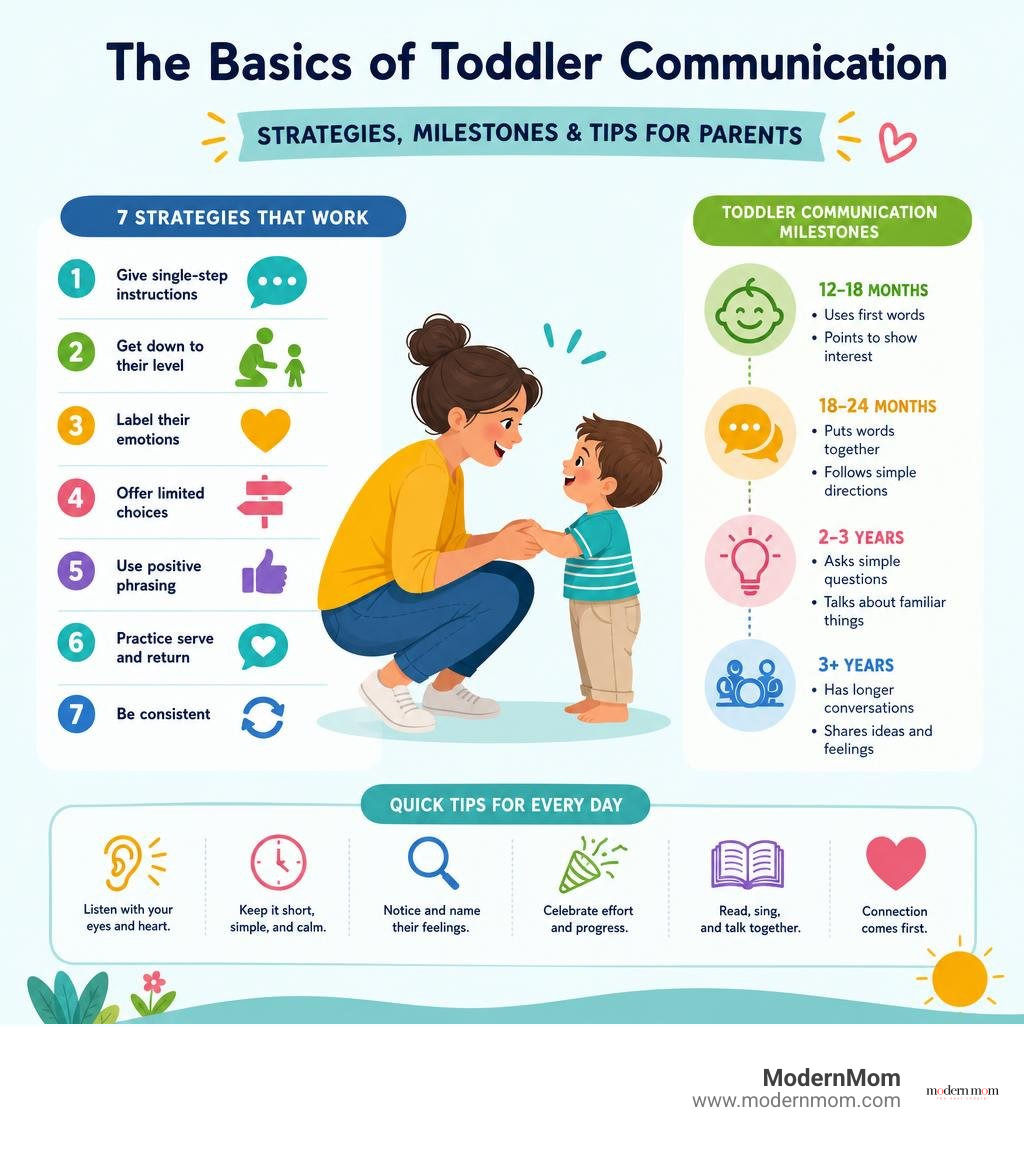
Here’s a quick look at what actually works when communicating with your toddler:
The core strategies for talking to toddlers:
- Give single-step instructions — toddlers can’t process multi-step directions the way adults can
- Get down to their level — eye contact and physical presence matter more than you think
- Label their emotions — saying “I can see you’re frustrated” can stop a tantrum before it spirals
- Offer limited choices — “Do you want the tiger shirt or the dinosaur shirt?” gives them control without chaos
- Use positive phrasing — instead of “don’t run,” say “walking feet, please”
- Practice serve and return — respond to their babbles and gestures like a real conversation
- Be consistent — use the same words, every time, across every caregiver
The truth is, toddler communication isn’t intuitive. What sounds like a simple instruction to you — “put your shoes away” — is actually a complex sequence of steps to a two-year-old. Their brains are still building the wiring needed to follow along, manage emotions, and find words for what they feel.
The good news? You don’t need special tools or a perfect script. You just need to understand how their little minds work — and a few strategies that meet them where they are.
Talking to toddlers further reading:
The Science and Heart of Talking to Toddlers
To understand how to talk to our little ones, we have to look at how their communication systems develop. A baby’s auditory system actually begins forming before birth. They can hear internal sounds like their mother’s heartbeat around 18 weeks gestation, and by 28 to 29 weeks, they can recognize voices and distinguish speech.
Once they enter the world, their language skills grow in rapid, beautiful stages:
- 12 to 15 months: Many babies can say one or two words, but they can understand 25 or more.
- 18 months: A toddler might know and use anywhere from 20 to 100 meaningful words.
- 2 years (24 months): Toddlers start putting 2 to 3 words together, giving us classic phrases like “No ball” or “Me do it.”
- 3 years (36 months): A child can answer more complicated, conditional questions such as, “What do you do when you are hungry?”
According to developmental experts, 90% of a child’s brain growth takes place before they turn 5. Because their brains are wiring themselves so rapidly, consistency and repetition are vital.
When we repeat the same words for everyday objects and routines, we help them map language. To explore toddler communication tips from a U.S.-based child mental health resource, you can read the Child Mind Institute guide on Talking to Toddlers.
Speaking Parentese to Build Confidence
You’ve probably found yourself naturally slipping into a high-pitched, sing-song voice when speaking to your little one. This isn’t just silly “baby talk” — it’s actually a scientifically recognized communication style called “parentese.”
Parentese involves using real words, correct grammar, and an exaggerated, slower pitch. Research shows that this style of speaking stimulates a baby’s brain and helps them pay attention to our facial expressions.
It also encourages conversational turn-taking. When you speak in parentese, pause and wait for your child to respond with a coo, babble, or gesture. This simple back-and-forth interaction builds the neural pathways they need to become confident talkers.
For a fun, visual breakdown of how this works, check out this comic.
The Power of Play and Everyday Routines in Talking to Toddlers
We don’t need to carve out dedicated “lesson times” to teach our kids how to talk. In fact, some of the richest language-learning opportunities happen during our ordinary daily routines.
Mealtimes are perfect for building vocabulary. We can use all five senses to describe what we are doing and eating. For instance, while whipping up our favorite Scrambled Eggs Recipe for Kids, we can talk about the “yellow, warm, fluffy” eggs and use action words like “stirring” and “pouring.”
Getting dressed can also become an interactive game. We can hide their socks in a pillowcase, pull them out dramatically, and name the colors together.
When we pair language with movement, it sticks even better. Incorporating speech into active play, such as playing Movement Games for Preschool, teaches toddlers to link action verbs with physical movement in a natural, joyful way.
Practical Strategies for Cooperation and Clear Directions

Have you ever asked your toddler to “go upstairs, grab your shoes, and put them in the basket,” only to find them playing with a dust bunny five minutes later? It is easy to think they are defying us, but the truth lies in their cognitive capacity.
The prefrontal cortex — the part of the brain responsible for planning and carrying out tasks — is highly immature in toddlers. They simply lack the mental bandwidth to process multi-step instructions.
To help them succeed, we should use single-step instructions. Instead of saying, “Clean up your toys,” try breaking it down: “Please pick up the blocks and put them in this bag.” Once that is done, you can move on to the next step.
Another powerful tool for cooperation is offering choices. Toddlers are tiny, independent people who desperately want a sense of control over their lives. If they had complete control, the world might resemble a Godzilla movie, but we can offer structured autonomy.
Instead of demanding, “Put your shirt on,” try asking, “Do you want to wear your tiger shirt or your dinosaur shirt?” By letting them choose, we respect their independence while still getting the job done.
Using Active Listening to Connect and De-escalate
When a toddler is upset, our natural instinct is often to fix the problem quickly or tell them to stop crying. However, practicing active listening is much more effective for long-term cooperation and emotional health.
To practice active listening, physically get down to your child’s eye level. Make direct eye contact to show them they have your full, undivided attention.
Next, use “reflections.” This means repeating back what they say while gently correcting their grammar or expanding their vocabulary. For example, if your child points and says, “I drawed some sghetti!” you can respond with, “You drew some long spaghetti! That looks beautiful.” This validates their effort without making them feel criticized.
You can also reflect their emotions. If they are crying because a sibling took their toy, say, “It looks like you are really mad that your brother took your block.”
Even if you guess the emotion incorrectly, your toddler will usually correct you, and they will feel comforted knowing you are trying to understand. For more practical exercises on this technique, check out the CDC’s Tips for Active Listening.
Positive Attention and Specific Safety Rules
Toddlers crave our attention. In fact, they crave it so much that they will take negative attention over no attention at all. If we only react with big, dramatic voices when they do something wrong, we can accidentally reward and reinforce that bad behavior.
Instead, we want to focus on positive reinforcement. Catch them being good and praise them immediately. If they are playing quietly, say, “I love how gently you are playing with your trains!”
When it comes to safety, we need to be highly specific. Generic phrases like “Stop!” or “Be careful!” are too vague for a toddler’s brain to quickly translate into action.
Instead, use clear, direct commands. Say “Stay on the sidewalk!” or “Keep your feet on the floor!” This tells them exactly what physical action they need to take. For more ways to keep your home secure, explore these 6 Important Home Safety Lessons to Teach Your Kids.
Navigating Big Emotions, Tantrums, and Parental Mistakes

Toddlerhood is a time of massive, overwhelming feelings. Because their verbal skills are still catching up to their emotional depth, tantrums are a completely normal way for them to express frustration.
During a meltdown, their nervous system is in a state of fight-or-flight. This is not the time to lecture them or expect logic. Instead, they need our co-regulation.
We can help them calm down by staying calm ourselves, using a soothing voice, and validating their feelings: “I know you want that cookie right now. It is hard to wait.”
Sometimes, physical comfort is the best medicine. Offering a favorite stuffed animal or security blanket can work wonders. If you want to know more about why these comfort items are so powerful, read about How Loveys Can Help Comfort Your Child.
What to Do When You Lose Your Patience
Let’s be completely honest: we are not perfect. In 2026, with all the busy demands of modern motherhood, there will be times when we lose our temper, snap, or react out of frustration.
When this happens, try to reframe your mistake not as a failure, but as a perfect teaching moment. Toddlers learn how to handle mistakes by watching how we handle ours.
Once you have calmed down, model emotional repair. Get down on their level, look them in the eyes, and apologize: “Mommy was feeling very tired and I raised my voice. I am sorry. It is not okay for me to yell. Next time, I will take a deep breath.”
By doing this, you teach them that it is okay to make mistakes, how to take responsibility, and how to make amends. Remember to give yourself some grace — parenting is a journey of growth for both of you.
Supporting Late Talkers and Speech Development
Every child develops on their own unique timeline, and there is a wide range of what is considered “normal.” However, it helps to understand the difference between receptive language (what they understand) and expressive language (what they can say).
| Language Type | What It Means | Examples in Toddlers |
|---|---|---|
| Receptive Language | The ability to understand spoken words, directions, and social cues. | Following a command like “bring me the ball” or pointing to a picture when named. |
| Expressive Language | The ability to produce sounds, gestures, and words to communicate. | Saying “mama,” waving goodbye, or putting words together to make sentences. |
If you have a late talker, focusing on “shared attention” is incredibly important. This is the magic window where both you and your child are focused on the exact same object at the exact same time. Words only truly stick in a toddler’s vocabulary when this shared focus occurs.
Another essential strategy is the “discipline of the wait.” When you ask your toddler a question, silently count to five or ten in your head before speaking again. Their developing brains need that extra time to process your words and organize their physical response.
If your child is not babbling or gesturing by 9 months, or if you feel deeply concerned about their progress, trust your motherly instincts and consult your pediatrician or a speech-language pathologist. Early intervention can make a wonderful difference.
Encouraging Language Growth Without Pressure in Talking to Toddlers
The best way to encourage speech is to keep it relaxed and pressure-free. Avoid drilling them with flashcards or demanding, “Say apple! Say it!” This pressure can make them shut down.
Instead, focus on natural “serve and return” communication. When they make a sound or point to something, respond warmly and build on their interest.
We also want to create a quiet, peaceful home environment. Background TV noise, even if no one is actively watching it, acts as a major disruptor to early childhood development because it makes it incredibly hard for their brains to filter out noise and process speech patterns.
Limiting screen time and prioritizing face-to-face connection is key. As they grow and get ready for preschool, you can transition these conversational skills into early reading habits by learning How to Help Your Child Learn Sight Words.
Frequently Asked Questions about Talking to Toddlers
Why doesn’t saying “no” work for toddlers under three?
The developing brain of a child under three cannot reliably process negation. When you say, “Don’t throw the toy,” their brain registers the action word “throw” first.
Instead of telling them what not to do, use positive phrasing to tell them exactly what you want them to do. Swap “Don’t run” for “Please use walking feet,” and swap “Don’t throw that” for “Keep the toy on the table.”
How long should I wait for my toddler to respond during a conversation?
You should pause and wait at least 5 to 10 seconds. It feels like an eternity in adult conversation, but this “wait time” gives their immature prefrontal cortex the critical space it needs to translate your words, decide on a response, and physically produce the speech.
What are the early red flags for a speech delay?
While timelines vary, you should consult your pediatrician if your baby is not smiling, interacting, babbling, or using gestures (like waving or pointing) by 9 months. Other red flags include not responding to their name by 12 months or not using single words by 18 months.
Conclusion
At the end of the day, talking to toddlers is not about using perfect parenting scripts or tracking every single syllable they utter. It is about building a deep, trusting relationship.
By keeping our instructions simple, listening actively, validating their giant emotions, and giving ourselves grace when we make mistakes, we create a safe space for their voices to grow. Trust your maternal instincts, enjoy the funny things they say, and remember that you are doing a wonderful job.
For more parenting tips, developmental guides, and supportive community resources, visit us at the ModernMom Homepage.