

Homework Hero: Discover the Best Math and Chemistry Problem Solvers
When Homework Feels Like a Foreign Language
Is your kitchen table turning into a nightly battleground over chemistry homework? A chemistry equation solver can be your secret weapon for turning those confusing chemical formulas into manageable learning moments.
Top Chemistry Equation Solvers at a Glance:
- Symbolab – Offers step-by-step solutions with AI explanations for chemical reactions
- WebQC.org – Provides multiple balancing methods (inspection, algebraic, oxidation number)
- ChemicalAid.com – Handles complex equations including ionic and half-reactions
- PlanetCalc – Uses systematic algebraic methods perfect for computer solving
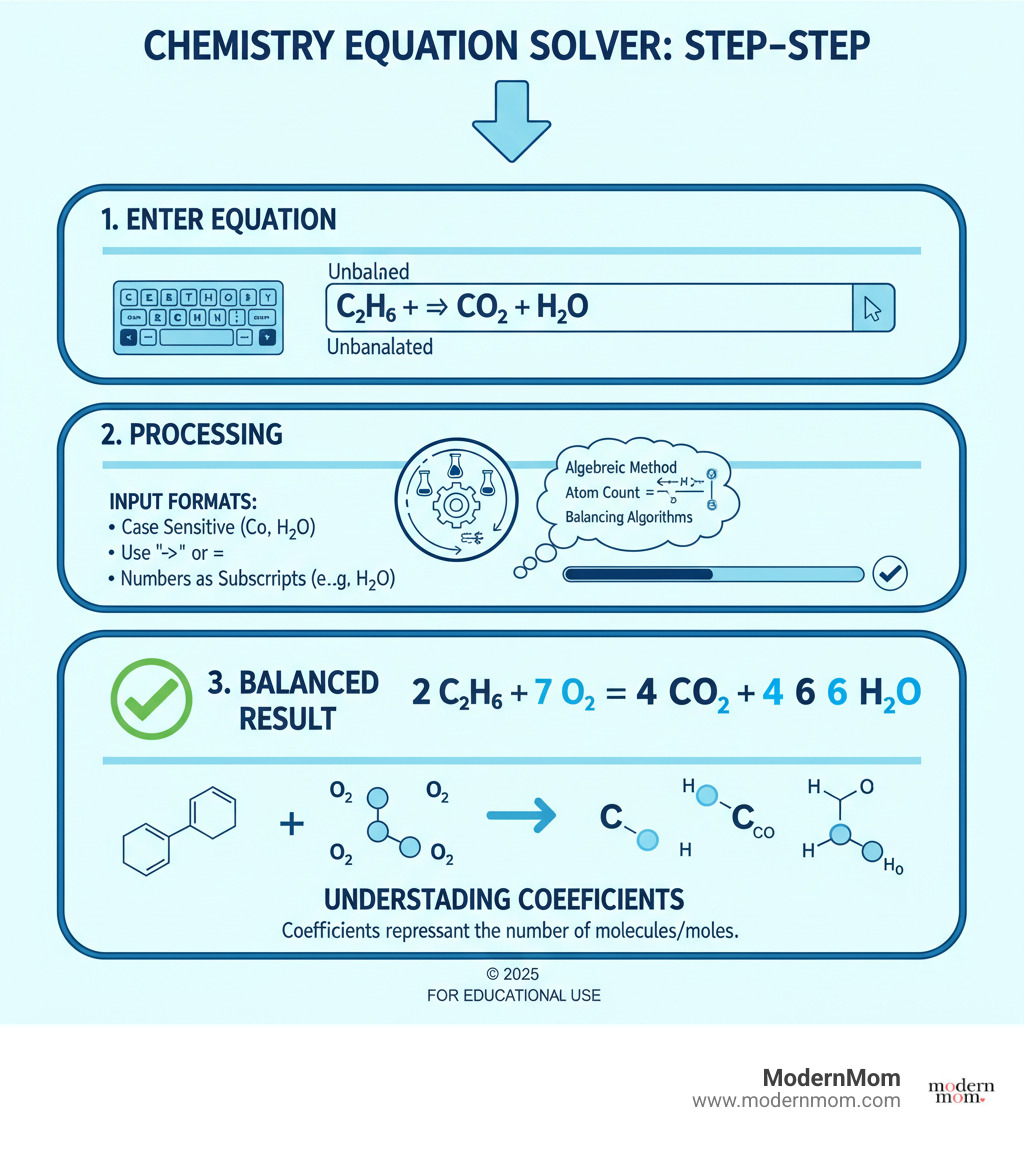
You’re not alone if equations like C₂H₆+O₂⇒CO₂+H₂O make you feel like your high school science class was a lifetime ago. When your teen brings home chemistry homework that looks like a foreign language, it’s tempting to throw in the towel.
But here’s the thing – these tools don’t just give answers. The best chemistry equation solvers teach the how and why behind balancing equations, helping both you and your student understand the process.
These digital helpers follow the Law of Conservation of Mass – basically, what goes in must come out. They use systematic methods like algebraic balancing to solve even the trickiest equations in seconds, freeing up brainpower to focus on understanding concepts rather than getting stuck on arithmetic.
What is a Chemical Equation Balancer and Why Does it Matter?
Picture this: you’re trying to help your teen with chemistry homework, and you’re staring at an equation that looks like hieroglyphics. Here’s where a chemistry equation solver becomes your best friend – it’s basically a smart calculator that makes sure chemical equations follow the rules of science.
Think of a chemical equation like a recipe for chocolate chip cookies. You can’t magically create extra flour out of thin air, and you can’t make chocolate chips disappear into nothing. The Law of Conservation of Mass works the same way – the number of atoms you start with (called reactants) must equal the number of atoms you end with (called products). No atoms get lost or created; they just get rearranged.
A chemical equation balancer does the tricky math to make sure this “recipe” is correct. It adds the right numbers (called coefficients) in front of each molecule so everything balances perfectly. This isn’t just busy work – it’s the foundation that open ups everything from basic reactions to complex stoichiometry problems, which is just a fancy way of figuring out how much stuff you’ll get from a reaction.
Why does this matter so much? Without balanced equations, chemists would be like bakers guessing at ingredient amounts. Sometimes you’d get lucky, but more often you’d end up with a disaster. In real life, this precision helps scientists develop new medicines, design safer products, and even figure out how to clean up environmental problems.
For your student, mastering this skill opens doors to understanding more advanced chemistry concepts. It teaches logical, systematic thinking that goes way beyond just chemistry class.
The Old-School Way vs. The New-School Tool
Remember the “trial and error” method from our school days? You’d plug in random numbers until something finally worked, usually while juggling dinner prep and three other homework subjects. It was time-consuming and honestly pretty frustrating, especially when you were already stretched thin.
Those manual methods work fine for simple equations, but they quickly become a nightmare when reactions get complicated. You’d spend more time wrestling with arithmetic than actually understanding the chemistry concepts.
Modern chemistry equation solvers flip this whole experience. They use systematic approaches like the algebraic method to solve even the most complex equations in seconds. Instead of guessing, they apply mathematical algorithms that guarantee the right answer every time.
This shift changes everything about homework time. Instead of getting bogged down in tedious calculations, you and your teen can focus on the “why” behind the reaction. It’s like having a brilliant math tutor handle the number crunching while you explore the actual science.
The difference is especially noticeable with complex reactions involving multiple elements. What might take 20 minutes of frustrating trial and error can be solved instantly, leaving more time for understanding concepts and maybe even getting to bed at a reasonable hour.
When your child feels stuck or unmotivated by challenging subjects, sometimes the right tools can reignite their curiosity. For more strategies on keeping kids engaged when the going gets tough, check out our guide on How to Motivate an Unmotivated Kid.
How to Use a Chemistry Equation Solver Like a Pro
Ready to become a homework hero? Using a chemistry equation solver is simpler than you might think, and it can transform those overwhelming chemistry sessions into actual learning moments. These tools aren’t just about getting the right answer – they’re designed to show you and your teen the process behind balancing equations.
Think of it this way: instead of watching your student struggle for an hour with trial and error, you can guide them through a systematic approach that builds real understanding. Here’s how to make the most of these digital helpers.
Your Step-by-Step Guide to a Chemistry Equation Solver
The secret to success with any chemistry equation solver starts with getting the input right. It’s like following a recipe – the ingredients need to be measured correctly, or the whole thing falls apart.
Getting the Chemistry Right: The most crucial step is entering your equation correctly. Capitalization matters more than you’d think – it’s Co for cobalt, not co, and Fe for iron, not fe. One wrong letter can throw off the entire calculation. When you’re dealing with compounds like calcium hydroxide, make sure to use parentheses: Ca(OH)₂.
For more advanced problems involving ions, look for solvers that let you specify charges using brackets like {+2} or {-}. Most of the time, you won’t need to worry about states of matter (those little letters in parentheses), but always check your solver’s specific instructions.
The Magic Moment: Once you hit that “balance” button, resist the urge to just copy down the answer. This is where the real learning happens. Sit with your teen and look at what changed. Which numbers did the solver add? Why did certain molecules need coefficients while others didn’t?
The best chemistry equation solvers don’t just give you balanced equations – they walk you through their thinking. Tools like Symbolab are particularly good at showing step-by-step solutions. Take advantage of this feature. It’s like having a patient tutor who never gets frustrated when you ask “but why?” for the tenth time.
Building Confidence: Even with a solver doing the heavy lifting, encourage your teen to double-check by counting atoms on both sides of the equation. It reinforces that fundamental rule about conservation of mass and helps them catch any input errors they might have made.
Tackling Tough Problems with a Chemistry Equation Solver
Here’s where these tools really shine – they can handle the equations that would make even chemistry teachers reach for their calculators. Complex reactions with multiple reactants and products? No problem. Redox reactions that involve electron transfers? They’ve got algorithms for that.
The really sophisticated solvers use something called the algebraic method, which sounds fancy but basically means they set up mathematical equations for each element and solve them all at once. It’s the same systematic approach a computer scientist might use, which is why an explanation of the algebraic method can be fascinating if you’re curious about the math behind the magic.
Ionic equations present their own challenges because you’re not just balancing atoms – you’re balancing electrical charge too. The advanced solvers can handle these beautifully, working with both acidic and basic solutions. Some can even tackle equations with unusual formulas that don’t follow the typical whole-number patterns.
This means your high schooler can confidently approach even AP-level chemistry problems. Instead of spending hours stuck on the arithmetic, they can focus on understanding what the reaction actually means and why it happens. That’s the kind of learning that sticks with them long after the test is over.
Beyond Balancing: More Tools to Master Chemistry
Here’s something that might surprise you: that chemistry equation solver you just found? It’s probably just the tip of the iceberg. Most online platforms that offer equation balancing are actually comprehensive chemistry toolkits designed to support your student through their entire chemistry journey.
Think of it like finding a great pediatrician who also happens to offer family therapy, nutrition counseling, and developmental assessments all under one roof. When you’re already comfortable with one tool, having access to related resources can be a game-changer for homework time.
Molar mass calculations are often the next step after balancing equations. Instead of manually adding up atomic masses from the periodic table (and inevitably making arithmetic errors), these calculators do the heavy lifting instantly. Your teen can focus on understanding what molar mass means rather than getting bogged down in addition.
Once equations are balanced, stoichiometry and limiting reagent calculators tackle the “how much” questions that follow. If you start with a certain amount of one ingredient, how much final product will you get? Which ingredient will run out first? These tools transform abstract balanced equations into real-world applications, helping students see why balancing matters in the first place.
pH solvers are lifesavers when acid-base chemistry enters the picture. These problems often involve multiple steps and complex calculations that can overwhelm even motivated students. Having a dedicated tool that can work through titration calculations or buffer systems means more time understanding concepts and less time wrestling with logarithms.
Many platforms also include gas law calculators, unit converters, and even redox calculators that go beyond basic balancing. It’s like having a complete chemistry lab assistant available 24/7. The best part? Students can verify their manual work, catch mistakes early, and build confidence as they tackle increasingly complex problems.
Just like we prepare our kids for success at school with the right supplies, having access to comprehensive digital chemistry tools can make all the difference in their academic journey.
Frequently Asked Questions about Chemistry Solvers
As moms navigating high school homework, it’s completely natural to have questions about whether tools like a chemistry equation solver are actually helpful—or if we’re somehow doing our kids a disservice by introducing them. Let’s tackle the most common concerns that come up when parents find these digital helpers.
Is using a chemistry equation solver cheating?
This question comes up in every parent group, and here’s the honest answer: not when it’s used as a learning tool! Think of it like using a calculator for complex math or spell-check for writing—these tools free up mental energy so students can focus on understanding concepts rather than getting bogged down in tedious calculations.
The key is in how your teen uses it. Encourage them to try solving the problem manually first. This builds their problem-solving muscles and reinforces what they’ve learned in class. Then, they can use the chemistry equation solver to check their work. If they got stuck or made an error, the step-by-step solutions (like those offered by many modern solvers) become their personal tutor, showing exactly where things went sideways.
This approach transforms what could be a “cheat sheet” into a powerful learning partner. Your student gets immediate feedback, which is crucial for building confidence and catching mistakes before they become habits. Many educational platforms actually encourage this approach—they’re designed specifically for learning and practice, not just getting quick answers.
Can these solvers make mistakes?
Even the most sophisticated chemistry equation solver can sometimes produce unexpected results, but here’s the thing—it’s usually not the tool that’s wrong, it’s the input. These digital helpers are incredibly accurate, but they can only work with what you give them.
The most common culprit? Incorrect input. If chemical formulas are typed wrong (like using CO instead of Co for cobalt, or missing a crucial subscript), the solver processes what it sees, not what you meant. Capitalization matters hugely in chemistry—Na for sodium is correct, but na will throw everything off.
Sometimes the issue is ambiguity in how the equation is written. If a formula can be interpreted multiple ways, the solver might choose a different path than expected. And if you’re using a platform that relies on AI for explanations, those step-by-step breakdowns, while incredibly helpful, come with the usual AI disclaimer that they’re not always 100% perfect.
If you get a weird result, start with the basics: double-check that every chemical formula and symbol was entered exactly right. Nine times out of ten, it’s a simple typo that’s causing the confusion.
Where can I find a good, reliable solver?
Rather than pointing you toward one specific brand, let’s talk about what features make a chemistry equation solver truly worth your time. A great tool should offer step-by-step solutions—this is non-negotiable for learning. You want to see the “how,” not just the “what.”
Look for solvers that can handle various reaction types. Basic equations are one thing, but as your teen progresses, they’ll encounter ionic equations, redox reactions, and complex molecules with multiple brackets. The best tools can tackle all of these systematically.
Clear input instructions are another must-have. The solver should make it obvious how to enter equations correctly, with guidance on capitalization, ion charges, and special notation. A clean, intuitive interface matters too—nobody needs extra confusion when homework time is already stressful.
The real winners are platforms that offer additional chemistry tools beyond just balancing. Think molar mass calculators, stoichiometry helpers, pH solvers, and unit converters. These comprehensive suites become one-stop shops for chemistry homework support.
Finally, keep an eye out for educational resources or community support. Some platforms offer tutorials, articles, or even forums where students can ask questions. This shows they’re committed to actual learning, not just quick fixes. You can find A helpful community forum for chemistry questions where students and educators share knowledge and support each other’s learning journey.
The bottom line? Choose tools that feel like they’re designed to teach, not just to provide answers. Your student—and your sanity during homework time—will thank you.
You’ve Got This, Mom!
Those late-night homework battles don’t have to define your family’s chemistry experience. When you see your teen struggling with equations that look like hieroglyphics, finding the right support isn’t giving up—it’s being smart about modern parenting.
A chemistry equation solver isn’t just a shortcut; it’s a bridge between confusion and confidence. When your student uses these tools thoughtfully, they’re learning to verify their work, understand complex processes, and build problem-solving skills that extend far beyond the chemistry classroom.
Think about it this way: you wouldn’t send your teen on a road trip without GPS, right? These digital tools serve the same purpose for academic journeys. They help steer tricky terrain while teaching valuable lessons about getting from point A to point B.
The real magic happens when frustration transforms into curiosity. Your teen starts asking “why does this work?” instead of “when will this be over?” That shift in mindset is worth celebrating, and you helped make it possible by embracing the tools available to today’s students.
Every small victory matters—whether it’s finally understanding how to balance a redox reaction or feeling confident enough to tackle the next chemistry chapter. These moments build on each other, creating a foundation of academic resilience that will serve them well in college and beyond.
Supporting your child’s education doesn’t mean you need to become a chemistry expert overnight. It means recognizing when to step in with encouragement, when to find helpful resources, and when to celebrate progress, no matter how small it might seem.
Here at ModernMom, we know you’re juggling countless responsibilities while trying to give your kids the best possible foundation for success. That dedication doesn’t go unnoticed, and it’s making a real difference in their lives.
For more tips on helping your student succeed, check out our guide on how to stay organized in high school with the best planners and apps.