

Unlock Your Potential: The Indispensable Role of Clarity in Goal Setting
From “Spinning Your Wheels” to Finding Your Way
Clarity of goals is the difference between wandering aimlessly through your week and knowing exactly where you’re headed—and how to get there. Here’s what you need to know:
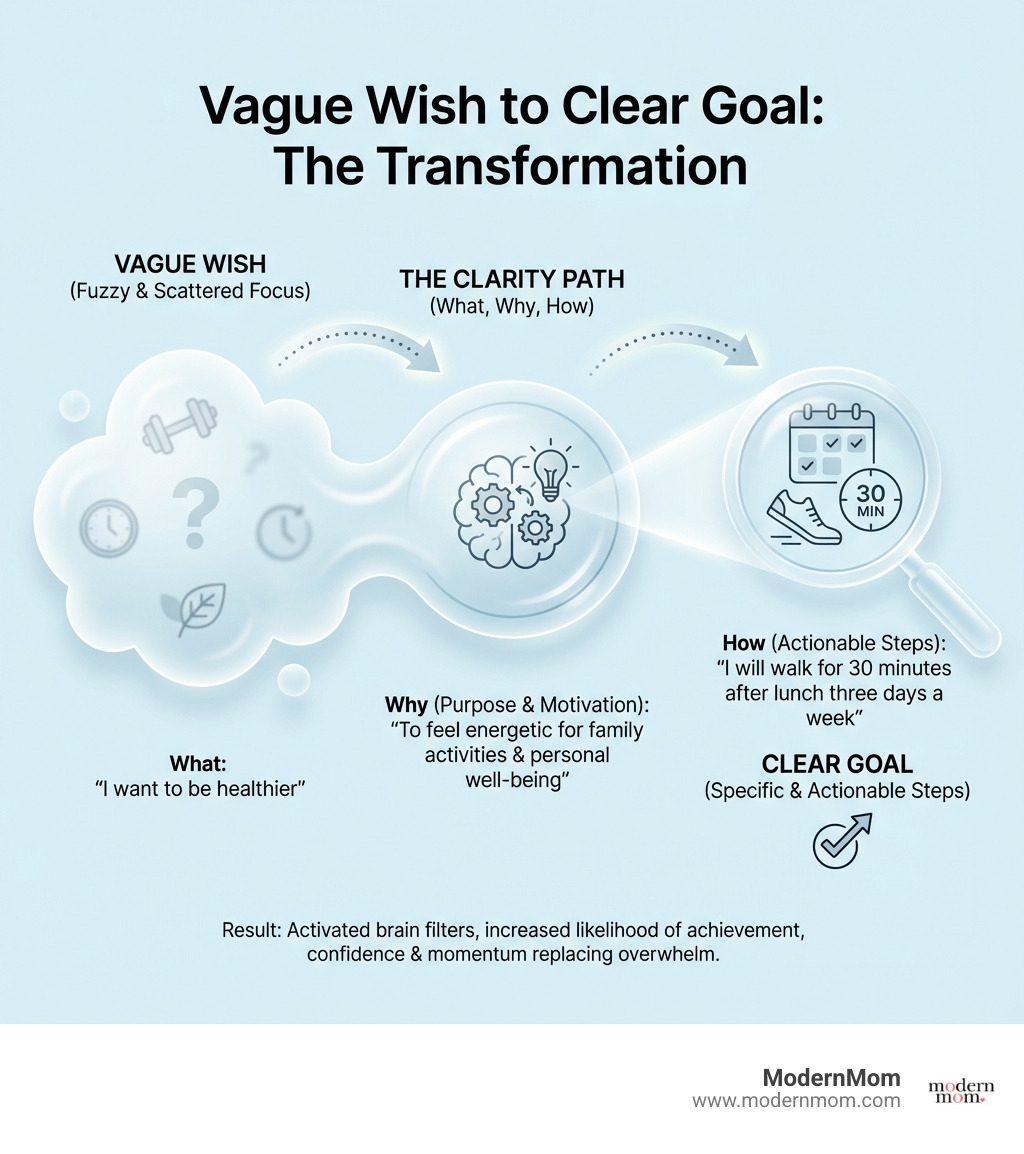
What Goal Clarity Means:
- Knowing what you want to achieve (the specific outcome)
- Understanding why it matters to you (your purpose and motivation)
- Defining how you’ll get there (actionable steps and measurable progress)
Why It Matters:
- Clear goals activate your brain’s filtering system to spot opportunities
- You’re 2-3x more likely to achieve goals when you have a specific plan
- Clarity replaces overwhelm with confidence and forward momentum
The Quick Test:
- Vague wish: “I want to be healthier”
- Clear goal: “I will walk for 30 minutes after lunch three days a week”
Does this sound familiar? You know you’re capable of more. You’ve got dreams tucked away—maybe it’s finally starting that side project, getting back into shape, or simply creating more margin in your overscheduled days. But somewhere between the morning chaos and the bedtime routine, those goals feel more like distant wishes than achievable realities.
You’re not lacking ambition. You’re not lazy. You’re likely just missing clarity.
When your goals are fuzzy, your brain doesn’t know what to focus on. Your energy scatters across a dozen competing priorities. You feel like you’re constantly busy but rarely making meaningful progress on what actually matters to you.
The good news? Clarity is a skill you can learn—and this guide will show you exactly how.
As someone who has built businesses from scratch while juggling family life, I’ve learned that clarity of goals isn’t about doing more—it’s about doing the right things with intention. Whether you’re a new mom trying to reclaim your identity or a seasoned parent navigating your next chapter, achieving clarity of goals starts with understanding what it really means and why it’s been so elusive.
What is Goal Clarity (And Why It Feels So Elusive for Moms)?
At its heart, clarity of goals means having a precise, well-defined understanding of what we want to achieve. It’s about knowing the “what,” “why,” and “how” of our aspirations with undeniable certainty. It provides a sense of purpose, fuels our motivation, sharpens our focus, and helps us prioritize what truly matters.
For moms, this concept can feel particularly elusive. Our days are a whirlwind of needs and demands, often leaving little space for our own grand plans. The mental load we carry—from coordinating schedules to managing household tasks—can make it incredibly difficult to carve out the mental bandwidth needed for deep introspection and goal refinement. Our priorities shift constantly, dictated by everything from a child’s sudden fever to an unexpected school event. This constant flux often pushes our personal goals to the back burner, leaving them vague and unexamined.
Yet, it’s precisely because our lives are so full that clarity of goals becomes even more crucial. When we know exactly what we’re working towards, even amidst the chaos, we can make micro-decisions that align with our deepest desires, ensuring our efforts aren’t scattered but intentionally directed.

The Difference Between a Vague Wish and a Clear Goal
The first step to achieving clarity of goals is understanding the fundamental difference between a vague wish and a truly clear goal. A wish is often a fleeting thought, a “someday” dream that lacks commitment or a plan. It’s “I want to be happier,” or “I wish I had more time for myself.” These are lovely sentiments, but they don’t give our brains any instructions to follow.
A clear goal, on the other hand, is a “day one” commitment. It’s an action-oriented statement that defines what success looks like and outlines the path to get there. For instance, instead of “I want to get in shape,” a clear goal might be: “I will walk for 30 minutes every Monday, Wednesday, and Friday morning before the kids wake up.” This change from a general desire to a specific, actionable plan is where the magic of clarity of goals begins. As experts often say, the difference between a dream and a goal is clarity.
Goals vs. Objectives: Your Roadmap to Success
To truly grasp clarity of goals, it helps to understand the relationship between goals and objectives. Think of your goals as your ultimate destination—the big picture vision of what you want to achieve. These are often broad, inspiring, and may take a year or even several years to accomplish. For example, a goal might be to “Create a thriving family environment where everyone feels supported and heard.”
Objectives, conversely, are the specific, measurable steps or milestones that lead you toward that broader goal. They are the turn-by-turn directions on your roadmap. Objectives are quantifiable outcomes, often with a shorter timeframe (months, or up to a year), and they move you incrementally closer to your larger goal. For our family environment goal, an objective could be: “Implement a weekly family meeting to discuss schedules and feelings every Sunday at 6 PM for the next three months.”
As you can see, both are essential. Goals provide the overarching vision and purpose, while objectives provide the actionable steps and allow us to track progress. Together, they create an incredibly powerful framework for achieving clarity of goals and navigating our path forward. For a deeper dive into this distinction, explore how organizations define their Goals and Objectives.
Is a Lack of Goal Clarity the Real Reason You’re Stuck? 5 Telltale Signs
Have you ever felt like you’re running on a hamster wheel, expending a lot of energy but not actually getting anywhere? This often manifests as chronic procrastination, a nagging lack of motivation, or a pervasive feeling of being overwhelmed. One client described her mind as “a browser with 100 tabs open,” which perfectly captures the mental clutter that stems from unclear goals. If this resonates with you, a lack of clarity of goals might be the culprit.

Here are five telltale signs that your goals might be lacking the clarity needed to propel you forward:
Sign #1: Your Goal Sounds More Like a Dream
If your goal is something like “I want to be more organized,” or “I want to spend more quality time with my family,” it’s likely still living in the field of dreams. While these aspirations are wonderful, they lack the specific details that would allow you to actually do something about them. They’re vague statements that don’t tell your brain what action to take. When we have a wish, we hope for it. When we have a clear goal, we plan for it.
Sign #2: You Feel Overwhelmed and Can’t Start
A common consequence of unclear goals is analysis paralysis. When a goal feels too big or too abstract, our brains get overwhelmed, and we literally don’t know where to begin. “Launch my own business” is a fantastic aspiration, but without breaking it down, it can feel like trying to climb Mount Everest in one leap. This often leads to procrastination because the sheer magnitude of the task feels impossible. We need to break down overwhelming tasks into manageable chunks, as discussed in The WFHWK Life: The Down and Dirty of Working Mom Survival. The power lies in taking that first, tiny step.
Sign #3: You Can’t Measure Your Progress
“You can’t manage what you don’t measure,” is a truth that applies powerfully to our personal goals. If you can’t articulate how you’ll know if you’re making progress or when you’ve achieved your goal, it’s a sign of poor clarity. Without measurable milestones, there’s no finish line, no way to track success, and no sense of accomplishment to keep you motivated. Emma, a client, felt stuck in her fitness goals until a simple tracking system helped her optimize her routine and energy levels. The small, measurable victories release dopamine, reinforcing positive behaviors and skyrocketing motivation. For more on this, consider the insights from Why you can’t manage what you don’t measure.
The Surprising Power of Goal Clarity: How It Rewires Your Brain for Success
When we achieve clarity of goals, something incredible happens: our brains actually rewire themselves to help us succeed. This isn’t just wishful thinking; it’s rooted in neuroscience. The psychological benefits are profound, leading to increased productivity, better decision-making, and a profound sense of purpose that permeates our daily lives.
Activating Your Brain’s ‘GPS’: The Reticular Activating System
Deep in your brainstem sits a powerful filtering system called the Reticular Activating System, or RAS. Think of it as your brain’s personal search engine. It constantly scans your environment for information that matches what you’ve told it is important. When your goals are clear and specific, your RAS locks onto them like radar, helping you spot opportunities, people, and ideas that align with your desired outcome. Ever notice how when you decide to buy a red car, you suddenly start seeing red cars everywhere? That’s your RAS at work!
But here’s the kicker: when your goals are vague or inconsistent, your brain doesn’t know what to filter for. Your focus, motivation, and energy scatter. Instead of a powerful GPS guiding you, you’re left with a fuzzy map and no clear destination. Clarity of goals gives your RAS specific instructions, turning it into a powerful ally in your pursuit of success.
How Clarity Boosts Motivation, Focus, and Decision-Making
With clarity of goals, our motivation isn’t just a fleeting feeling; it’s a sustained fire. When we know what we want and why it matters, we create an internal “why” that provides solidity and continuity, dictating how we show up and motivating us through tough times. This deep connection to purpose fuels consistent action, reducing the need for constant willpower battles.
Our focus also sharpens dramatically. Clear goals eliminate distractions because we can easily identify what aligns with our objectives and what doesn’t. This makes it easier to say “no” to commitments that don’t serve our long-term vision, freeing up precious time and energy.
Furthermore, clarity of goals significantly improves our decision-making. Every choice, big or small, can be filtered through the lens of our goals. Does this decision move me closer to my goal or further away? This simple question becomes a powerful compass, guiding us toward choices that are congruent with our aspirations and leading to more effective outcomes in all areas of our lives.
Your 5-Step Guide to Achieving Crystal-Clear Goals
Ready to stop spinning your wheels and start making real progress? Achieving clarity of goals doesn’t require a complete life overhaul; it simply requires intentionality and a practical framework. Here’s our 5-step guide to help you turn those abstract ideas into concrete plans, designed with busy moms in mind:
Here are some simple tools that can help you on your journey:
- A dedicated journal or notebook
- A digital planner app (like Google Calendar or Notion)
- A vision board (physical or digital)
- Sticky notes for quick reminders
- A trusted accountability partner
Step 1: Find Your ‘Why’ for Lasting Motivation
Before diving into the “how,” we must first uncover our “why.” Your “why” is the deep, underlying purpose that fuels your desire to achieve a goal. It’s the emotional connection that will sustain you when motivation wanes. As Simon Sinek famously asks in his book Start with Why, great leaders and individuals alike are driven by a clear purpose.
For us moms, this means spending time reflecting on what truly matters to us. Ask yourself:
- Why does this goal matter to me right now?
- What would change in my life if I achieved it?
- What would it cost me if I didn’t pursue this?
- How does this align with my values and the kind of mom/woman I want to be?
Connecting your goals to your deepest values provides an internal source of motivation and commitment. It’s the engine that keeps you going. Cultivating gratitude can also help reinforce your “why” and boost your overall satisfaction, as discussed in Want Life Satisfaction? Generate Gratitude: Here’s How!.
Step 2: Make Your Goals SMART, Not Hard
Once you have your “why,” it’s time to translate it into a SMART goal. The SMART goal framework is a classic for a reason: it creates the necessary structure for clarity of goals. Each letter stands for a critical component:
- Specific: What exactly do you want to accomplish? Who is involved? Where will it happen? Which resources are needed? (e.g., “I want to improve my family’s dinner routine.”)
- Measurable: How will you track progress? How will you know when you’ve succeeded? (e.g., “I will plan and cook dinner at home five nights a week.”)
- Achievable: Is this goal realistic given your current circumstances and resources? It should stretch you but still be possible. (e.g., “I will use meal planning services and quick recipes to make this feasible.”)
- Relevant: Does this goal align with your values and long-term vision? Is it the right time for this goal? (e.g., “This aligns with my goal of healthier eating and more family connection time.”)
- Time-bound: When will you achieve this goal? Set a clear deadline. (e.g., “I will consistently plan and cook dinner five nights a week for the next three months.”)
So, “I want a cleaner house” transforms into: “I will spend 15 minutes each evening tidying the main living areas and loading the dishwasher, completing this task before 9 PM daily for the next four weeks.” Studies show you are 2x to 3x more likely to stick to your goals if you make a specific plan for when, where, and how you will perform the behavior.
Step 3: Break It Down into ‘Mom-Sized’ Steps
Large, ambitious goals can feel incredibly overwhelming, especially when we’re already juggling a million things. The key to overcoming this is to break down your big goals into smaller, “mom-sized” steps. These are micro-goals that are so tiny, they almost feel silly not to do. This approach, championed by resources like Atomic Habits, emphasizes the power of small, consistent actions over grand, infrequent efforts.
For example, if your goal is to “write a book,” that can feel paralyzing. But breaking it down into “write 200 words a day” is much more manageable. For our “consistent dinner routine” goal, smaller steps might be: “Research three meal planning apps this week,” “Choose five simple recipes for next week’s dinners,” or “Grocery shop for the week’s meals on Sunday morning.” Each small win builds momentum and confidence, making the larger goal feel less daunting and much more achievable.
Step 4: Write It Down and Visualize Your Win
The act of writing down your goals makes them tangible and real. It moves them from abstract thoughts in your head to concrete statements you can see and touch. Document your goals in a journal, on a whiteboard, or in a planner, and keep them visible. This constant reminder reinforces your commitment and keeps your goals top of mind.
Beyond writing, visualization is a powerful tool for clarity of goals. Create a vision board with images and words that represent your achieved goal and the feelings associated with it. Spend a few minutes each day vividly imagining yourself successfully reaching your goal. What does it look like? What does it feel like? What sounds do you hear? This mental rehearsal programs your subconscious mind for success and strengthens your belief in your ability to achieve it. Tools like The Five Minute Journal can be excellent for integrating daily reflection and visualization into your busy schedule.
Step 5: Find Your Tribe for Feedback and Support
You don’t have to go it alone! Sharing your goals with a trusted friend, partner, mentor, or coach provides invaluable support and accountability. When we articulate our goals to others, we often gain new perspectives and insights that can help us refine and clarify our path. They can offer encouragement, challenge our limiting beliefs, and help us brainstorm solutions when we encounter obstacles.
Seeking feedback is crucial for refining your goals. A fresh pair of eyes can spot potential pitfalls or suggest alternative approaches we might not have considered. This external input helps ensure our goals are not only clear but also robust and well-thought-out. If you’re looking for dedicated support and guidance, consider exploring options like those discussed in I Don’t Want to Be Mothered, I Need a Coach. As one expert suggests, seeking feedback from others can help you truly know what you really want.
Frequently Asked Questions about Clarity of Goals
We know you’ve got questions, and we’ve got answers! Here are some common concerns when it comes to finding clarity of goals as a busy mom:
How do I find time for goal-setting with a chaotic schedule?
We hear you! Finding time for anything beyond the essentials can feel impossible. The trick isn’t finding huge blocks of time, but rather finding pockets of time. Dedicate just 15 minutes a week for reflection and planning. This could be during nap time, after the kids are in bed, or even while waiting for an appointment. Consider it a non-negotiable part of your self-care. Even a short, focused session can yield immense clarity. For more ideas on how to carve out time for yourself, check out Top Ten Ways to Sneak in Some Me Time.
What if my goals or priorities change?
Life as a mom is all about evolution, and so is goal setting! Your goals aren’t set in stone; they’re a living document that should adapt as your family and life circumstances change. Give yourself permission to pivot. Schedule quarterly check-ins to re-evaluate your goals. Are they still relevant? Do they still align with your “why”? It’s perfectly okay to adjust, refine, or even abandon a goal if it no longer serves you. This flexibility is a sign of wisdom, not failure.
How can I help my kids develop clarity of goals?
Modeling goal-setting behavior is one of the best ways to teach your children. Start simple: discuss small, achievable goals like “I want to read one chapter book this week” or “I want to help set the table every night.” Use clear, simple language and focus on the process and effort, not just the outcome. Celebrate their small wins enthusiastically. Setting academic goals together, as discussed in How to Help Your Child Set Goals for the School Year, is a fantastic way to introduce them to the power of clarity of goals from a young age.
Conclusion: Your Journey Starts with a Single, Clear Step
You are capable of incredible things, and achieving your dreams doesn’t have to feel like a constant uphill battle. By embracing clarity of goals, you open up a powerful internal compass that guides your decisions, sharpens your focus, and fuels your motivation. We’ve seen how defining your “why,” making your goals SMART, breaking them into manageable steps, visualizing success, and seeking support can transform vague wishes into tangible realities.
Clarity of goals isn’t a one-time achievement; it’s a skill you cultivate, a muscle you strengthen over time. It’s about giving yourself the gift of direction and purpose, allowing you to move forward with confidence and intention. Your journey starts not with a giant leap, but with a single, clear step.
At ModernMom, we believe in empowering you to live your most fulfilling life. We know you have what it takes. Accept the power of clarity, and watch as your dreams transform into reality.
Ready to get serious about your goals? Find the support you need.