

Why Avoiding College Application Mistakes Matters for Your Family
College application mistakes can derail even the strongest students’ chances at their dream schools. The good news? Most of these errors are completely preventable when you know what to watch for.
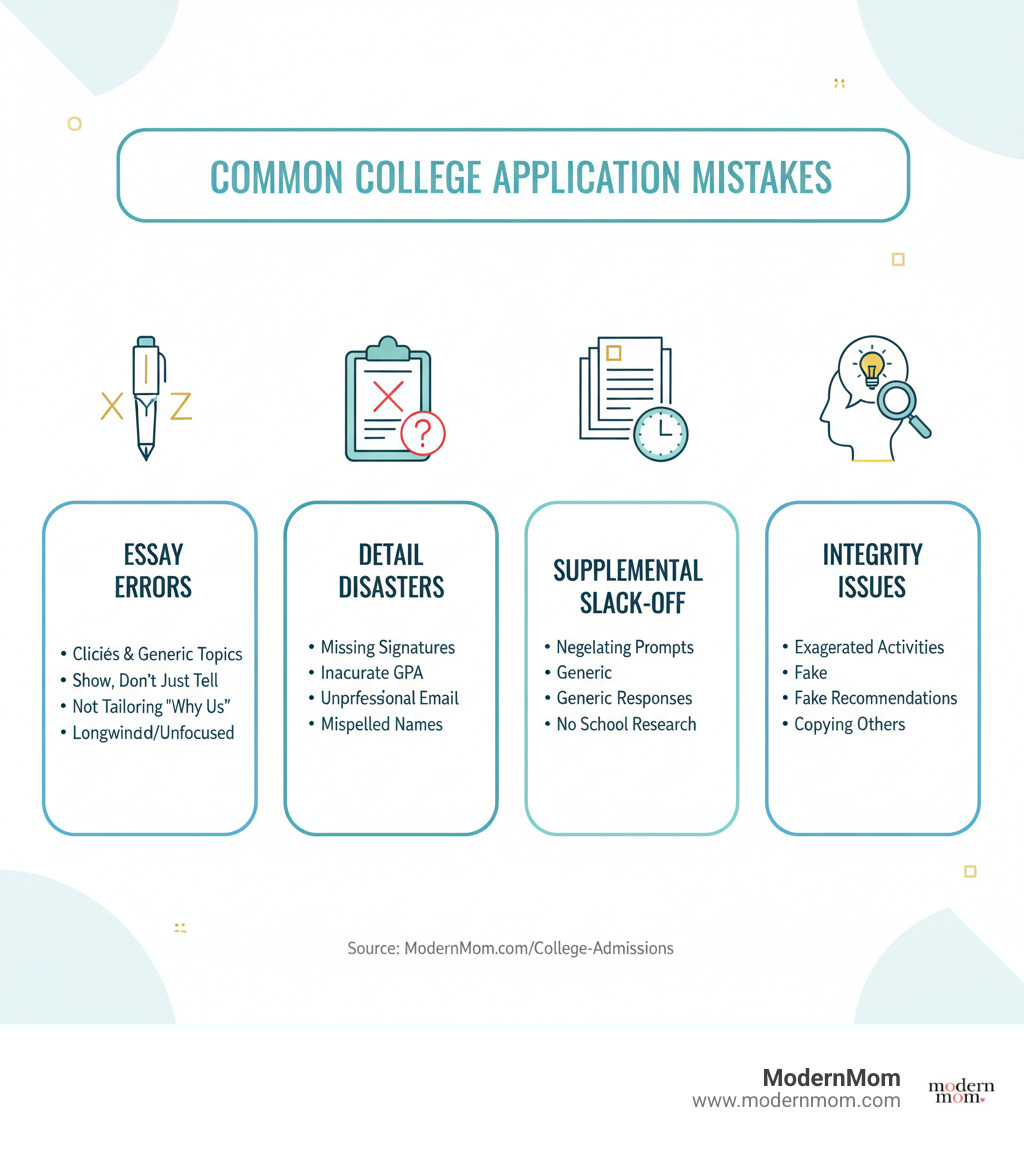
The Most Common College Application Mistakes to Avoid:
- Starting too late – Rushing through essays and missing deadlines
- Generic or clichéd personal statements – Essays that could apply to anyone
- Spelling and grammar errors – Typos that signal carelessness
- Not tailoring applications – Reusing the same \”Why Us?\” essay for every school
- Ignoring supplemental essays – Treating them as less important than main essays
- Inconsistent information – GPA, activities, or achievements that don’t match across sections
- Poor recommender choices – Asking teachers who barely know your teen
- The \”laundry list\” – Listing dozens of activities without showing real impact
- Missing or incomplete documents – Forgetting transcripts, test scores, or signatures
- Exaggerating achievements – Stretching the truth about roles or accomplishments
The college application process has become incredibly competitive. With acceptance rates at highly selective schools dropping to single digits, it’s no wonder 1 in 5 high school students now suffer from anxiety and stress linked to this pressure. As moms, we want to support our teens without adding to that burden.
A 4.0 GPA is often just a starting point for competitive colleges, and application fees alone can cost $50 to $100 per school. At Modern Mom, we’ve gathered insights from admissions officers and families to help your teen avoid the pitfalls that can undermine months of hard work—while keeping your sanity intact.
This guide breaks down the most common mistakes students make, from planning errors to submission oversights. You’ll learn how to help your teen craft essays that showcase their authentic voice, build a balanced college list, and present their achievements honestly and compellingly.
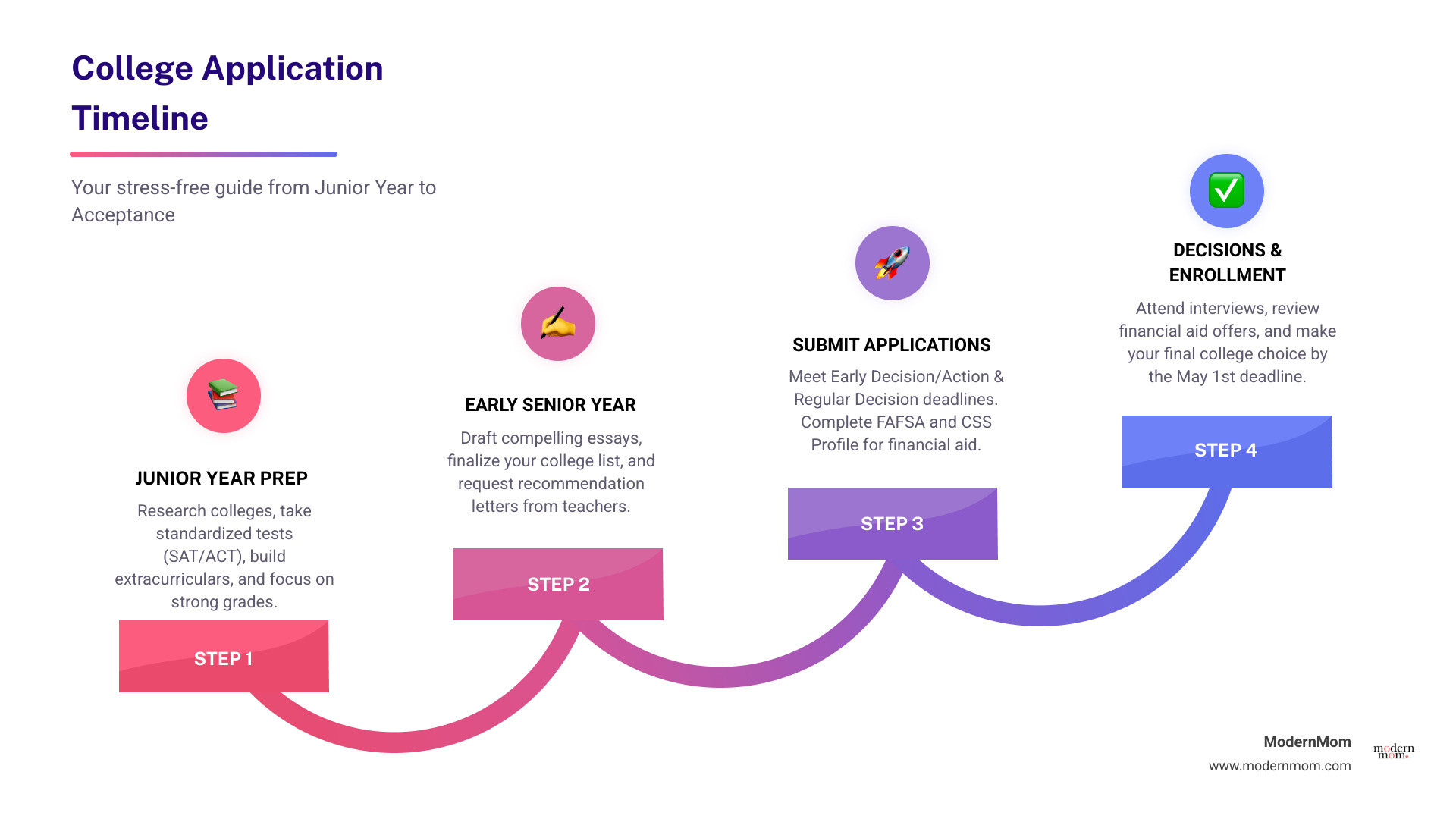
Laying the Groundwork: Foundational & Strategic Errors
Just like you wouldn’t plan a big family vacation the night before, college applications require foresight. Starting early is the single most important thing your teen can do to avoid common college application mistakes and reduce stress.
When students procrastinate, essays get rushed and deadlines get missed. Colleges want to see thoughtful planning and genuine effort. Research even shows that proactive students have a 44% increased probability of getting into their preferred programs. Starting early gives your teen time to reflect, research, and write compelling applications.

To make the process less overwhelming, encourage your teen to use tools like the Common App, which serves over 1,000 universities. For more guidance on getting started, check out our College Planning resources.
Understanding Application Deadlines
If there’s one area where students constantly trip up, it’s deadlines. Each type has its own rules and strategic advantages.
- Early Decision (ED): This is a binding commitment. If your teen is accepted, they must attend. It shows serious interest and can offer an admissions edge, but it’s only for a school they absolutely love.
- Early Action (EA): This is non-binding. Your teen can apply early to multiple EA schools and still have until spring to decide. It’s a great way to get early feedback without being locked in.
- Regular Decision (RD): This is the most common route, with later deadlines (usually in January). It gives families time to compare financial aid offers before the May 1st decision day.
- Rolling Admissions: Colleges review applications as they arrive. Applying early in the cycle improves your teen’s chances, as spots can fill up quickly.
To keep everything straight, help your teen create a master spreadsheet with each college’s deadlines and requirements.
| Deadline Type | Application Submission | Decision Notification | Binding? | Pros | Cons |
|---|---|---|---|---|---|
| Early Decision | Early Fall (e.g., Nov 1) | Mid-December | Yes | Higher acceptance rate, early certainty | Must withdraw other apps, no financial aid comparison |
| Early Action | Early Fall (e.g., Nov 1) | Mid-December | No | Early notification, less stress | No admissions advantage, still need to decide by May 1 |
| Regular Decision | Late Fall/Early Winter (e.g., Jan 1) | Late March/Early April | No | More time to prepare, financial aid comparison | Most competitive, later notification |
| Rolling Admissions | Varies (often starts Aug 1) | Varies (ongoing) | No | Apply at convenience, early decisions possible | Spots fill quickly, apply early for best chance |
Building a Balanced and Realistic College List
One of the biggest college application mistakes is creating an unrealistic or poorly researched college list. Focusing only on \”name brand\” schools is a recipe for heartbreak, especially when schools like Stanford accept just 4% of applicants.
Your teen deserves to find a school where they’ll thrive. That means looking beyond rankings to consider campus culture, specific academic programs, and financial fit.
A balanced list should include:
- Safety schools: Where your teen’s stats are well above average and they’d be happy to attend.
- Match schools: Where their academic profile aligns with the typical admitted student.
- Reach schools: The stretch options where acceptance is a long shot but worth trying for.
Encourage your teen to use net price calculators on college websites for a realistic estimate of what you’ll actually pay. While resources like US News Rankings are a helpful starting point, remember: the \”best\” school is the one that’s best for your teen.
The Heart of the Application: Common College Application Mistakes
Essays are your teen’s chance to show admissions officers who they really are, but they’re also a minefield for avoidable college application mistakes. These slip-ups can make a reviewer question your teen’s seriousness.

Admissions officers say careless spelling and grammar errors are a top frustration. To them, it signals a lack of care. Proofreading is essential—have your teen read their essays aloud to catch awkward phrasing. Similarly, inconsistent information across the application, like conflicting GPAs or timelines, raises red flags.
Also, ensure your teen uses a professional email address for all college correspondence. An address like \”firstname.lastname2025@email.com\” is always a safe bet. For more guidance on these crucial components, visit our College Admissions page.
Avoiding Common College Application Mistakes in Essays
Your teen’s personal essay is their moment to shine, but many students fall into predictable traps like generic topics and overused clichés. Admissions officers read thousands of essays, and the ones that feel formulaic rarely make an impression.
The key is showing, not just telling. Instead of writing \”I learned perseverance,\” your teen should describe a specific moment that demonstrates their growth. These concrete details make essays memorable.
The \”Why Us?\” essay is where many students reuse the same generic response. Admissions officers can spot this immediately. Your teen must dig deeper than \”your beautiful campus\” and mention specific professors, unique programs, or campus organizations that excite them. This proves genuine interest. For more tips, check out the Common App website.
The Devil’s in the Details: Supplemental Essays and Accuracy
While the main essay gets the spotlight, neglecting supplemental essays is a huge mistake. These shorter, school-specific essays are your teen’s chance to show how they fit into that particular community. Treating them as an afterthought sends the wrong message.
Beyond essays, accuracy in every detail is non-negotiable. Missing signatures, blank fields, or incomplete documents can lead to delays or even rejections. When it comes to reporting GPA or class rank, honesty is the only policy. If it’s not on the official transcript, your teen should select \”None\” rather than guessing. Colleges verify this information, and discrepancies raise serious concerns.
Even small errors, like misspelling the name of the college, suggest carelessness. A careful final review can prevent these simple but damaging mistakes.
Painting the Full Picture: Activities, Recommendations, and Integrity
Extracurriculars and recommendations give colleges a window into who your teen is beyond grades. However, this is also where many students make college application mistakes that weaken their profile.

The biggest misstep? A \”laundry list\” of activities with no depth. Colleges prefer meaningful involvement in a few areas over shallow participation in many. Quality beats quantity every time. They look for sustained commitment, leadership, and tangible impact.
For younger students, our guide on Making the Most of a New Year: College Admissions Advice for 9th and 10th Grade Students can help them build a strong foundation early.
Integrity is non-negotiable. Exaggerating achievements or falsifying information is a serious mistake. Colleges take honesty seriously and have ways to verify information. A single lie can lead to immediate rejection or a rescinded offer. It’s not worth the risk.
Choosing and Preparing Your Recommenders
Strong letters of recommendation require planning. Here’s how to get it right:
- Choose wisely: Your teen should ask junior or senior year teachers who know them well as a student and person.
- Ask early: Teachers are busy. Asking at the end of junior year or the start of senior year is ideal.
- Provide a \”brag sheet\”: This document should include a résumé, achievements, goals, and reminders of specific projects or class contributions to help the teacher write a detailed letter.
- Waive viewing rights: Most colleges recommend students waive their right to see the letters. This signals to admissions that the letters are candid and honest.
- Say thank you: A heartfelt thank-you note is a must.
Showcasing Genuine Involvement and Impact
When filling out the activities section, your teen should focus on depth over breadth.
- Use strong action verbs: Instead of \”member of debate club,\” try \”organized weekly debate practices for 12 members.\”
- Quantify achievements: \”Raised $2,500 for a local food bank\” is more powerful than \”participated in charity work.\”
- Highlight sustained commitment: Sticking with an activity for several years shows dedication and passion.
- Show leadership without a title: Did they mentor younger students or start a new initiative? That’s leadership in action.
This section isn’t just a list—it’s a story of your teen’s growth and impact.
Your Role, Mom: Supporting from the Sidelines
Watching your teen steer college applications can be tough. Our instinct is to jump in and fix things, but excessive parental involvement can become a college application mistake.

Admissions officers can spot a parent’s handiwork from a mile away. Over-editing your teen’s essays strips away their authentic voice—the very thing that makes them stand out.
Think of yourself as a guide, not the author. You can help them create a deadline spreadsheet, offer moral support, and celebrate small wins. But the writing, the activity choices, and the communication with colleges must be theirs. This journey is about helping your teen find where they’ll thrive, not about fulfilling our own dreams.
When you feel that knot of worry, your job is to provide a calm, supportive presence, not to micromanage. For more on this, check out our article on College Acceptance and Rejection: What Parents Can Do to Help.
Navigating Financial Aid and Interviews
Putting off financial aid applications and interview prep are two common stumbles that can have big consequences.
Many families delay financial aid, which is a significant college application mistake. The FAFSA (Free Application for Federal Student Aid) has its own deadlines, and missing them can mean losing out on thousands of dollars. Start researching options early and use the net price calculators on college websites to get a realistic idea of the cost.
For colleges that offer interviews, preparation is key. This is your teen’s chance to become more than just a name on a page. Help them practice by asking about their favorite activities or a challenge they’ve overcome. Remind them that showing personality and genuine curiosity matters more than having perfect answers.
Encourage them to prepare thoughtful questions to ask the interviewer about specific programs or campus culture. This shows they’ve done their homework and are genuinely interested in a way that feels like a conversation, not an interrogation.
Frequently Asked Questions about College Application Mistakes
How can my teen ensure their application reflects their authentic voice?
Authenticity comes from ownership. The application, especially the essays, must be in your teen’s own words, reflecting their unique experiences and personality. While you can and should proofread for typos, avoid the temptation to over-edit. Heavy-handed editing strips away the genuine voice that admissions officers want to hear. Encourage your teen to write about topics and stories that only they can tell.
What are the consequences of submitting false or exaggerated information?
This is one of the most serious college application mistakes, and the consequences are severe. If a college finds falsified information, the application will likely be rejected immediately. If the dishonesty is found after acceptance, the admission offer can be rescinded. Colleges value integrity immensely, and they have ways to verify information. Your teen’s genuine achievements are enough.
How can my teen demonstrate genuine interest in a college?
Colleges want to admit students who are excited to be there. A common college application mistake is sending a generic application to every school. Your teen can demonstrate genuine interest in several ways:
- Engage thoughtfully: Participate in virtual information sessions, open emails from the college, and follow their social media.
- Ask specific questions: During interviews or info sessions, asking well-researched questions shows they’ve done their homework.
- Tailor the \”Why Us?\” essay: This is the perfect place to mention specific professors, unique programs, or campus clubs that excite them. This proves their interest is specific to that school.
Conclusion: You’ve Got This!
Take a deep breath, Mom. You and your teen have made it through this guide, and you now have the tools to steer this process with more confidence and less stress.
This process isn’t about chasing the most prestigious name; it’s about finding the right fit—a place where your unique, amazing teen will flourish. The college application mistakes we’ve covered are all preventable. They’re simply common pitfalls you now know how to sidestep.
Your teen’s authentic voice, genuine experiences, and honesty matter more than a “perfect” application. This journey is as much about growth and self-findy as it is about admissions. The skills they’re learning now will serve them for a lifetime.
Through it all, we’re here for you. For more resources to support your family, explore our College Planning section.
You’ve got this, and so does your teen. Now go forth with confidence—and maybe treat yourself to that extra cup of coffee. You’ve earned it.