

Roommate Conflict Resolution: What Every College Mom Needs to Know
Watching your child head off to college is a huge milestone, but it often comes with a side of worry—especially when it comes to their new living situation. Roommate conflict resolution is simply the process of navigating those inevitable disagreements that happen when two people share a tiny dorm room.
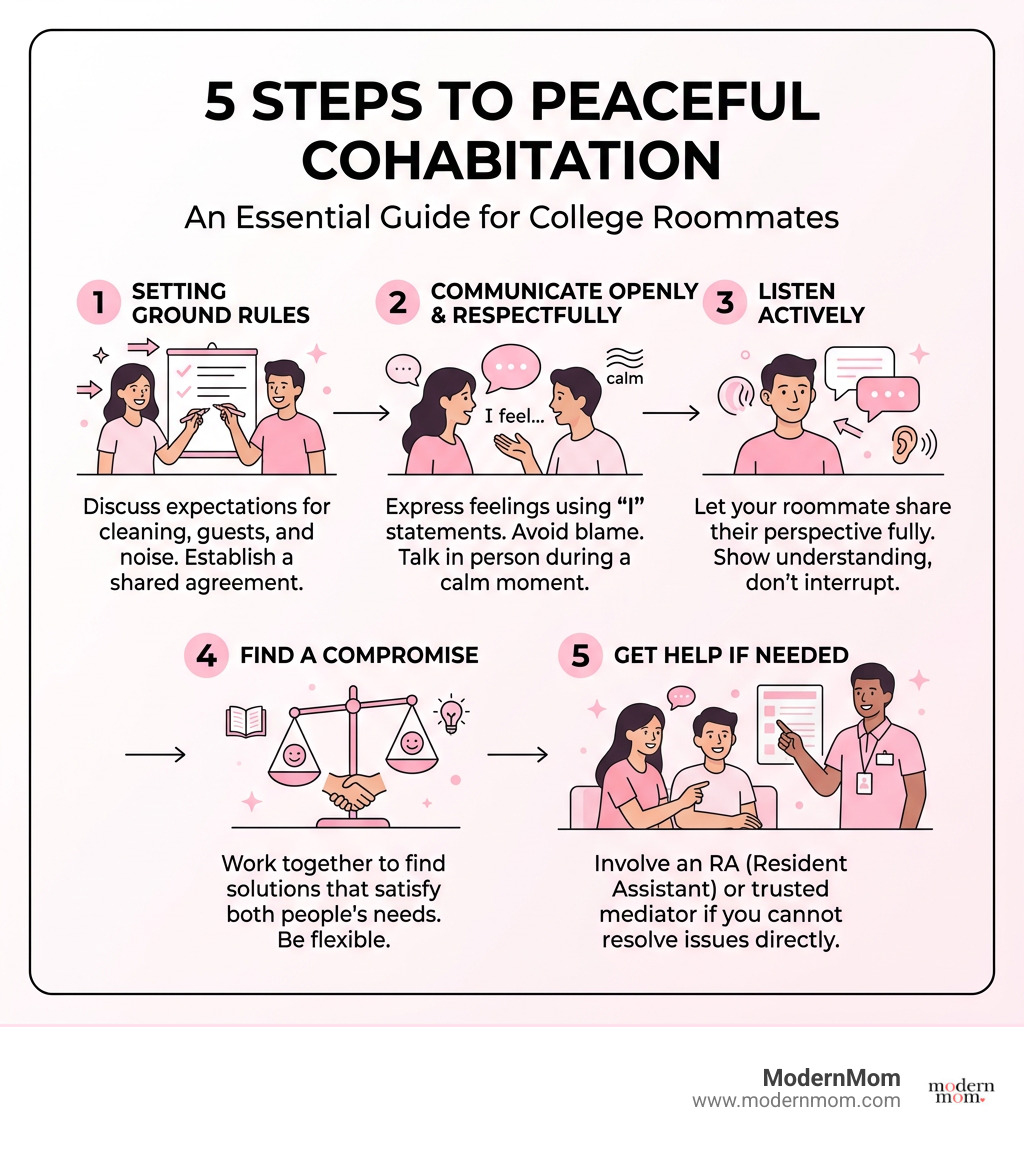
If your student is dealing with a difficult roommate, don’t panic. Here’s a quick roadmap to help them find peace:
- Talk in person — Skip the texts and choose a calm, private moment.
- Use “I” statements — Focus on feelings rather than blame.
- Listen actively — Give the roommate space to share their side.
- Find a compromise — Look for a win-win solution.
- Get help if needed — Don’t be afraid to involve a Resident Assistant (RA).
Whether it’s a messy desk or a guest who stays too long, roommate friction is completely normal. It doesn’t mean the year is ruined; it’s actually a great opportunity for your student to build adult communication skills. This guide offers practical Modern Mom guidance to help your student stop stressing and start problem-solving.
Setting the Stage for Roommate Peace

Think of roommate harmony like fire prevention: it’s much easier to stop a spark than to put out a blaze. Setting clear expectations before the first pile of laundry hits the floor is key. While we often tell our kids to “just be nice,” clarity is actually much kinder than politeness.
Experts say the most successful roommates aren’t always best friends, but they do respect boundaries. Encourage your student to sit down during the first week to draft a Roommate Agreement. Most colleges provide a template, but they can also create their own.
Treat this as a “living document” that can be updated as the semester goes on. If your student is struggling with the transition from home to dorm, you might find more info on managing teen tension helpful for coaching them through these early adult conversations.
Establishing Clear Boundaries Early
To keep the peace, the agreement needs to be specific. Vague rules like “keep it clean” lead to arguments because everyone has a different definition of messy. Suggest they discuss:
- Cleaning Schedules: Who handles the bathroom and when?
- Guest Policies: How many nights can a guest stay? How much notice is needed?
- Quiet Hours: When should the music go off?
- Shared Expenses: How will they split the cost of snacks or cleaning supplies?
- Personal Property: Is the mini-fridge shared or off-limits?
Proactive Communication Strategies
Beyond the rules, roommates should talk about their “social batteries.” One student might need total silence to recharge, while another wants to vent about their day.
Encourage your student to share their sleep schedules and temperature preferences early. If one person likes it cold and the other is shivering, it’s better to find a compromise—like an extra blanket—than to silently seethe while adjusting the thermostat.
Mastering Roommate Conflict Resolution
Even with a great agreement, friction happens. Maybe a roommate “forgot” the dishes again or stayed on the phone until 2:00 AM. When this occurs, the goal is roommate conflict resolution, not winning an argument.
Research shows that using language that acknowledges both perspectives significantly reduces hostility. This is a skill that takes practice, much like resolving sibling-style battles at home.
Encourage your student to talk in person. It’s tempting to send a quick text, but digital messages lack tone and body language. A face-to-face chat allows for a soft tone and empathetic expressions that prevent small issues from exploding.
The Power of ‘I’ Statements
One of the best tools for any relationship is the “I” statement. This technique focuses on the speaker’s feelings rather than the roommate’s mistakes. It’s the difference between a gentle start and a personal attack.
Instead of saying: “You’re so disrespectful when you talk on the phone late,” Try: “I feel frustrated when there’s loud talking after 11:00 PM because I have a hard time falling asleep before my morning exam.”
Using Active Listening
Resolution is a two-way street. After your student expresses their feelings, they need to really listen to the response. This is called active listening.
- Reflective Listening: Paraphrase what the roommate said. “So, you’re saying late night is the only time you can talk to your family?”
- Validation: You don’t have to agree to validate a feeling. “I can see why that’s important to you.”
- The 5:1 Ratio: Experts found that stable relationships usually have five positive interactions for every one negative. Remind your student to say “thanks” for the small things, like taking out the trash.
Navigating Common Living Friction
Most roommate issues fall into a few predictable categories. Knowing how to handle these common friction points can save a lot of heartache for both you and your student.
Handling Noise and Sleep Schedules
This is often the top source of tension. If one roommate is a morning person and the other is a night owl, compromise is the only way forward.
Suggest creative solutions like white noise machines or high-quality earplugs. If one person needs to study late, they might use the library or a common lounge during peak sleep hours to keep the peace.
Managing Guests and Shared Space
Guests can quickly make a small dorm room feel claustrophobic. Some roommates use a signal—like a rubber band on the doorknob—to indicate they need private time or are taking a nap.
| Common Conflict | Creative Solution |
|---|---|
| Messy common areas | Set a “15-minute reset” every Sunday evening. |
| Borrowing items without asking | Use a “borrowing bin” for items that are okay to share. |
| Alarm clocks waking everyone | Use a vibrating wearable alarm (like a Fitbit). |
| Temperature wars | Agree on a “middle” temp; invest in a heated blanket or fan. |
When to Call in the Pros: Mediation and Beyond
Sometimes, despite your student’s best efforts, a conflict hits a stalemate. This is when it’s time to involve a neutral third party. Colleges have these resources for a reason—don’t be afraid to use them!
Experts suggest that sometimes the goal isn’t perfect harmony, but rather the value of agreeing to disagree. A mediator can help roommates reach a point of mutual tolerance.
The Role of the Resident Assistant (RA)
The RA is a student leader trained in roommate conflict resolution. They aren’t there to get anyone in trouble; they’re facilitators. An RA can:
- Host a formal mediation session where both roommates can speak safely.
- Help update the Roommate Agreement.
- Offer conflict coaching to help your student figure out what to say.
Knowing When to Request a Room Change
A room change should usually be the last resort, but it’s sometimes necessary. If there are safety concerns, bullying, or if communication has completely failed, it may be time to move.
Remind your student that a new roommate might bring new challenges, so it’s always worth trying to fix the current situation first. However, your child’s well-being is the top priority.
Frequently Asked Questions about Roommate Conflict Resolution
Why is talking in person better than texting?
Texting is the enemy of nuance. When we text, we lose the tone of voice and facial expressions that signal our true intent. A short text can seem cold or angry even if it wasn’t meant to be. In-person talks prevent these mix-ups and allow for immediate clarification.
How can we prevent conflicts from escalating on social media?
Venting on social media is like pouring gasoline on a fire. It creates “sides” and makes the roommate feel ganged up on. Encourage your student to keep grievances private and address the roommate directly. It’s a key part of adulting!
What is the “Stress Cup” theory?
Think of emotional capacity as a cup. When a student is dealing with midterms and homesickness, their “stress cup” is full. Adding even a tiny roommate issue can cause it to overflow. Timing is everything—don’t bring up a conflict when their stress cup is already at the rim.
Conclusion
At ModernMom, we know that watching your child navigate these hurdles is tough, but it’s also where the most growth happens. Roommate conflict resolution isn’t just about who does the dishes; it’s about learning empathy and setting healthy boundaries.
Some of the best friendships are forged through resolving conflict. By staying calm and knowing when to ask for help, your student can turn a stressful situation into a masterclass in personal growth.
Want more tips on helping your student thrive? Discover more college life and education tips on our site! You’ve got this, Mom—and so do they.