

Why Coping Skills Are Your Superpower
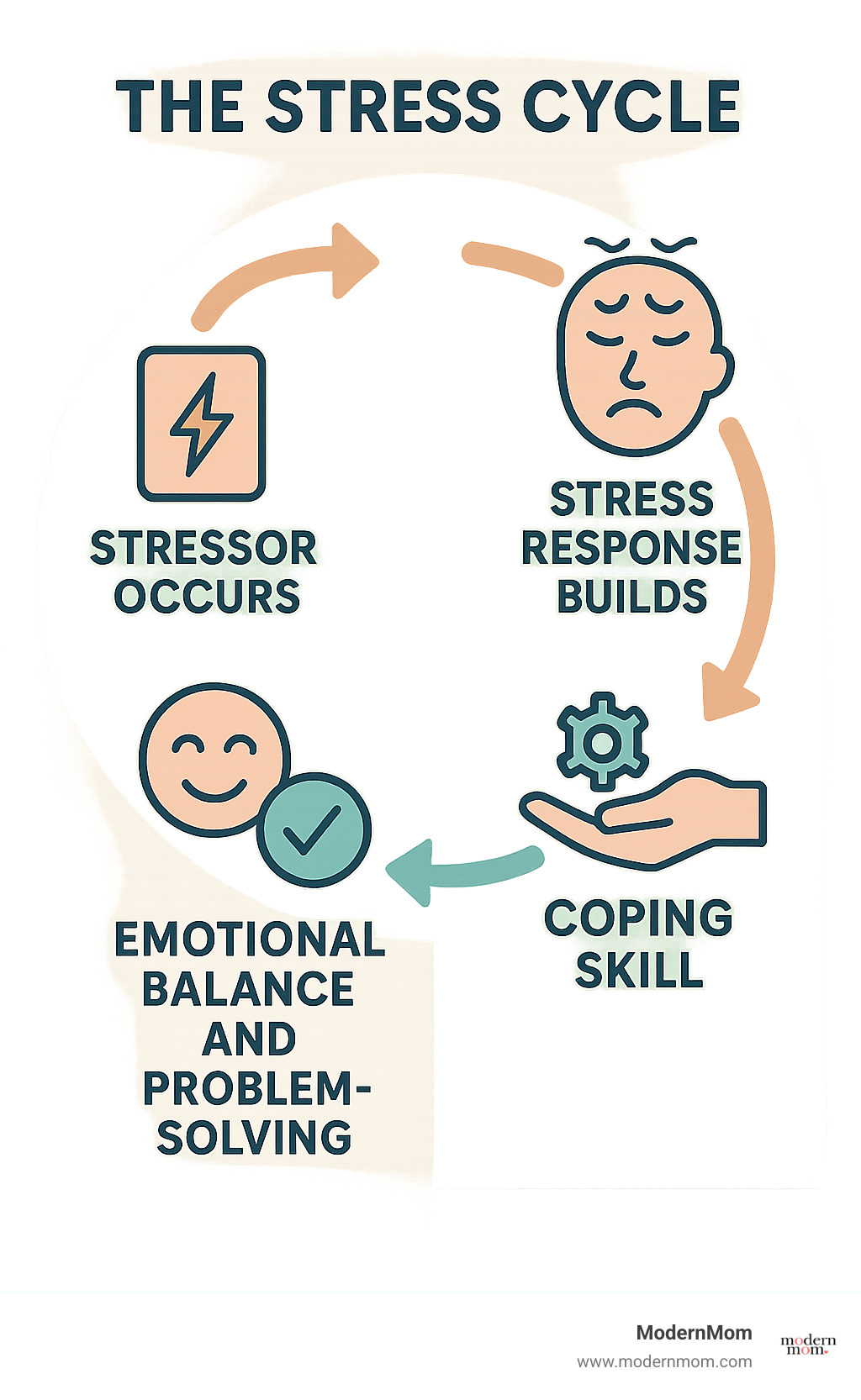
Learning how to develop coping skills is one of the most powerful things you can do as a mom. Here’s what you need to know:
Essential Steps to Develop Coping Skills:
- Identify your stress triggers – Notice what sets you off (toddler meltdowns, work deadlines, partner conflicts)
- Choose your coping style – Problem-focused (make a plan) or emotion-focused (calm yourself first)
- Build a toolkit – Have 3-5 go-to strategies ready (deep breathing, quick walk, call a friend)
- Practice regularly – Use skills during calm moments, not just crises
- Stay flexible – What works for sleepless nights might not work for teen drama
Let’s be honest – some days feel like you’re running a marathon while juggling flaming torches. And that’s just before breakfast.
Research shows that experiencing too many changes in a short time can make us feel out of control, leading to anxiety and even physical illness. Whether it’s positive changes (new baby, promotion) or challenging ones (job loss, family conflict), they all require us to adapt.
The good news? Coping skills aren’t something you’re born with – they’re something you can learn and strengthen. Think of them as your emotional toolkit for handling whatever life throws at you.
When you develop strong coping skills, you’re not just surviving the chaos – you’re modeling resilience for your kids and protecting your own well-being. Plus, you’ll feel more capable and in control, even when your toddler decides the living room wall needs a crayon makeover.
Understanding Your Coping Style: Problem-Solvers vs. Emotion-Soothers
Ever notice how some moms immediately spring into action when chaos hits, while others need a moment to breathe first? Neither approach is wrong – they’re just different coping styles, and understanding yours can be a game-changer.
Coping skills are simply the strategies we use to manage overwhelming thoughts, feelings, and situations. They’re our brain’s toolkit for handling stress while keeping our sanity intact. The best part? There’s no “right” way to cope – it’s all about finding what works for you and your situation.

Experts identify two main coping styles, and most of us naturally lean toward one or the other. Problem-focused coping is all about tackling the source of stress head-on. If you’re the mom who immediately makes a to-do list when overwhelmed or researches solutions the moment your child shows new symptoms, you’re probably a natural problem-solver.
This approach works beautifully when you have control over the situation. Stressed about a work deadline? Break it into smaller tasks. Worried about your toddler’s sleep schedule? Research gentle sleep training methods. It’s about changing the situation itself rather than just managing your feelings about it.
Emotion-focused coping, on the other hand, is about managing your internal response when you can’t immediately fix the problem. Sometimes your teenager is going to slam that door no matter what you do, or your toddler will have a meltdown in Target despite your best efforts. That’s when emotion-focused strategies – like taking deep breaths, calling a friend, or giving yourself permission to feel frustrated – become essential.
The magic happens when you can develop coping skills in both areas and know when to use each. Flexibility is your secret weapon here. Some situations call for immediate action, while others require you to process your emotions first before you can respond effectively.
Think about it this way: if your child has a fever, you might use problem-focused coping (giving medication, calling the doctor) and emotion-focused coping (managing your worry, seeking reassurance from your partner). The most resilient moms switch between approaches as needed.
Why You Need to Develop Coping Skills as a Mom
Let’s be real – motherhood is basically a masterclass in constant adaptation. From sleepless newborn nights to navigating teenage attitudes, we’re constantly adjusting to new challenges. Even the wonderful changes (like watching your baby take first steps) can be surprisingly stressful because they require us to adapt.
When we face too many changes without good coping strategies, our bodies and minds pay the price. Chronic stress doesn’t just feel awful – it can lead to physical illness, anxiety, and that bone-deep exhaustion that no amount of coffee can fix.
But here’s why learning to develop coping skills matters beyond just your own well-being:
Managing daily chaos becomes so much easier when you have go-to strategies. Instead of losing it over spilled juice or forgotten homework, you can pause, breathe, and respond thoughtfully. Your kids notice the difference, and so do you.
Modeling healthy behavior happens naturally when you practice good coping skills. Your children are watching how you handle frustration, disappointment, and stress. When they see you take deep breaths instead of yelling or ask for help instead of suffering in silence, they’re learning invaluable life skills.
Preventing burnout becomes possible when you have tools to recharge and reset. Effective coping strategies help you recognize when you’re running on empty and give you ways to refill your tank before you’re completely depleted.
Adapting to change gets easier with practice. Strong coping skills help you bounce back from setbacks, accept new phases of your children’s development, and find strength even when life feels overwhelming.
Strengthening relationships flows naturally from better self-management. When you’re not constantly operating from a place of stress or overwhelm, you can communicate more clearly with your partner, respond more patiently to your kids, and maintain the friendships that sustain you.
The bottom line? Developing solid coping skills isn’t selfish – it’s one of the most generous things you can do for your family. When you take care of your emotional well-being, everyone benefits.
Your Go-To Toolkit: Healthy Coping Skills for Busy Moms
Picture this: You’re juggling a conference call while your toddler decides the kitchen floor needs a layer of cereal, and your teenager just announced they need a science project tomorrow. Sound familiar? These are the moments when having a reliable toolkit of coping skills can literally save your sanity.
The beauty of developing coping skills is that they don’t require hours of your day. Most effective strategies can be done in under five minutes, making them perfect for busy moms who barely have time to finish a cup of coffee while it’s still hot.
Quick breathing exercises are your first line of defense. Try the 5-5-5 method: breathe in for 5 counts, hold for 5, then out for 5. This simple technique calms your nervous system faster than you’d expect. When you need movement, step outside for a quick walk – even just to your mailbox. Research shows that spending time in nature boosts mental health and reduces stress, even if it’s just a city park or your backyard.
Music can be an instant mood shifter. Put on one favorite song and let yourself really listen. Sometimes simple physical care makes all the difference – grab a glass of water or make that cup of tea. Dehydration often masquerades as emotional overwhelm.
Gentle stretching releases tension you didn’t even know you were holding. Try rolling your shoulders or touching your toes. Physical release techniques like squeezing a stress ball (or honestly, just clenching and releasing your fists) can be surprisingly effective when emotions feel stuck in your body.
Mindful moments don’t require meditation apps or perfect silence. Focus completely on one thing – the warmth of your coffee mug, the scent of your hand lotion, or the texture of your sweater. Quick journaling can be as simple as writing three words about how you’re feeling. Sometimes just naming emotions reduces their power.
Social support is crucial, even if it’s just a quick text to a friend who gets it. And here’s something that works for many moms: tidying one small thing. Making your bed or clearing a counter gives you a sense of control when everything else feels chaotic.
Skills for Immediate Relief
When emotions hit like a tidal wave, you need strategies that work right now. These grounding techniques help you feel more anchored when thoughts or feelings start spiraling out of control.

Temperature changes can instantly shift your emotional state. Splash cold water on your face or hold an ice cube. It sounds too simple to work, but it genuinely interrupts the stress response. Intense movement – even 30 seconds of jumping jacks or running in place – releases pent-up energy and changes your body chemistry.
The 5-4-3-2-1 method pulls your senses into the present moment when your mind is racing. Notice 5 things you can see, 4 you can hear, 3 you can feel, 2 you can smell, and 1 you can taste. This technique grounds you in reality instead of anxious thoughts.
Sometimes the best coping skill is stepping away. If a situation is escalating, give yourself permission to take a bathroom break or step outside for two minutes. You’re not abandoning your responsibilities – you’re preventing yourself from reacting in ways you’ll regret.
Music and movement together create magic. Turn on a song and let yourself sway, dance, or just tap your feet. Your body processes emotions through movement, and this gives feelings somewhere to go.
Paired muscle relaxation works by tensing and then releasing different muscle groups. Start with your shoulders – scrunch them up to your ears, hold for five seconds, then let them drop. The contrast helps your whole body relax.
These aren’t about avoiding problems – they’re about creating space so you can respond thoughtfully instead of reacting impulsively.
Healthy vs. Unhealthy Coping
Not all coping strategies are created equal. Some provide genuine relief and help you move forward, while others might feel good in the moment but create bigger problems down the road.
Healthy coping builds you up. When you talk through problems with a trusted friend, you process emotions and often find solutions. Problem-solving approaches like making action plans or setting boundaries give you a sense of control and actually resolve issues. Self-care practices – prioritizing sleep, eating well, gentle exercise – improve both your physical and mental resilience.
Mindfulness and journaling help you understand your emotions instead of being overwhelmed by them. Seeking professional help when you need it shows strength, not weakness, and gives you tools for complex situations.
Unhealthy coping, on the other hand, often involves avoidance. Excessive venting without seeking solutions keeps you stuck in negativity and can strain relationships. Procrastination and ignoring problems might provide temporary relief, but issues typically get worse, not better.
Using food, sleep, or substances as your primary escape creates physical health problems and often leads to guilt and shame. Denial or toxic positivity – refusing to acknowledge real difficulties – prevents you from processing emotions and growing from challenges.
Constant busyness might seem productive, but when it’s used to avoid dealing with emotions, it leads to burnout and leaves underlying issues unresolved.
Here’s the thing: we all slip into unhealthy patterns sometimes, especially when we’re exhausted or overwhelmed. The goal isn’t perfection – it’s awareness. When you notice yourself relying on strategies that don’t truly help, you can gently redirect toward ones that do.
Even healthy coping strategies can become problematic if they’re used to constantly avoid addressing solvable problems. Balance is key – sometimes you need immediate emotional relief, and sometimes you need to tackle the issue head-on.
How to Develop Coping Skills and Make Them Stick
The secret to mastering your emotional toolkit isn’t about perfection—it’s about preparation. Think of it like having a well-stocked first aid kit. You don’t wait until someone’s bleeding to gather bandages; you prepare ahead of time so you’re ready when life happens.

Proactive coping is one of the most powerful ways to develop coping skills that actually work when you need them. Instead of just reacting to stress after it hits, you’re planning ahead. Maybe you know the dinner hour is always chaotic, so you prep some calming music and deep breathing exercises beforehand. Or perhaps you recognize that Sunday nights bring work anxiety, so you create a soothing bedtime routine to counter it.
Research shows this forward-thinking approach helps with both predictable stressors (like back-to-school season) and unexpected ones (like a child’s sudden illness). When we anticipate challenges and have our strategies ready, we feel more in control and less overwhelmed.
Creating your personal “coping menu” is like building your own emotional restaurant menu—you want options for every appetite. Some days you need quick comfort food (a five-minute breathing exercise), other times you want the full-course meal (a long walk with a friend). Having variety means you’re never stuck with just one option when it’s not working.
The key is practice during the calm moments. Don’t wait for a meltdown (yours or your child’s) to test-drive a new coping skill. Try that grounding technique when you’re already feeling okay. Practice mindful breathing while your coffee brews. This builds what experts call “muscle memory”—your brain learns these patterns when it’s not under stress, making them easier to access when you really need them.
Starting small is crucial for making changes stick. Pick one new coping skill and commit to trying it for a week. Maybe it’s taking three deep breaths before responding to your teenager’s attitude, or stepping outside for two minutes when you feel overwhelmed. Small wins build confidence and create lasting habits.
What works for your neighbor might not work for you—and that’s perfectly normal. Some moms find journaling incredibly soothing, while others prefer physical movement. Some need social connection, while others need quiet solitude. Give yourself permission to experiment and find your unique combination.
Building Resilience for Long-Term Success
Resilience isn’t about being unbreakable—it’s about being bendable. It’s your ability to bounce back from tough times, learn from challenges, and keep moving forward even when life feels overwhelming. The beautiful truth? Resilience is a skill you can develop, not a trait you’re born with or without.
Psychologists have identified four key ingredients that help us build lasting resilience:
Connection forms the foundation of resilience. Having people who truly get you—whether it’s your partner, a close friend, or even an online mom community—creates a safety net for your emotions. These relationships don’t just provide comfort; they actually buffer your body against the physical effects of stress. When you feel supported, your stress hormones stay more balanced, and you recover faster from difficult situations.
Wellness means treating your body and mind like the valuable resources they are. This isn’t about perfect nutrition or marathon running—it’s about consistent, gentle care. Getting enough sleep (even if it’s broken into chunks), eating meals that nourish you, moving your body in ways that feel good, and taking small breaks throughout your day all contribute to your resilience reserves.
Healthy thinking involves nurturing a realistic but positive view of yourself and your capabilities. This means catching those harsh inner critic moments and replacing them with more balanced thoughts. Instead of “I’m terrible at handling stress,” try “I’m learning better ways to manage difficult situations.” It’s about accepting that change and challenges are part of life, not personal failures.
Finding meaning connects you to something bigger than the immediate chaos. This might be your values as a parent, your spiritual beliefs, or simply the knowledge that your daily efforts matter to your family. When you can see purpose in your struggles, they become more bearable and even opportunities for growth.
Building your resilience is an ongoing process, not a destination. Each time you develop coping skills and use them successfully, you’re adding to your resilience bank account.
Simple Steps to Develop Coping Skills That Last
Ready to transform your stress management from reactive to proactive? Here’s how to develop coping skills that will serve you for years to come.
Identify your stressors first. Spend a few days paying attention to what triggers your stress responses. Is it the morning rush? Bedtime battles? Work emails after hours? Maybe it’s that voice in your head that says you’re not doing enough. Write these down—you can’t manage what you don’t acknowledge.
Experiment with different skills like you’re trying on clothes. What feels comfortable and natural for you? Maybe deep breathing makes you feel more anxious, but a quick walk around the block works wonders. Perhaps journaling feels like homework, but talking to a friend instantly lifts your mood. There’s no wrong choice, only what works for your personality and lifestyle.
Schedule practice time just like you would any other important appointment. This might mean setting a phone reminder for a two-minute breathing break at 2 PM, or using your commute time to practice gratitude. Consistency matters more than duration—five minutes daily beats an hour once a week.
Track your progress in whatever way feels manageable. This could be as simple as a thumbs up or thumbs down in your phone notes after trying a coping skill. Notice patterns: What works better in the morning versus evening? What helps with kid-related stress versus work stress? This self-awareness helps you customize your approach.
Be patient with yourself throughout this process. Some days you’ll remember to use your coping skills, other days you’ll react the same old way—and both are normal parts of learning. Progress isn’t linear, and perfectionism is the enemy of lasting change. Celebrate the small victories, learn from the setbacks, and keep moving forward.
The goal isn’t to eliminate stress from your life (impossible!) but to feel more confident and capable when it shows up. With time and practice, these skills become second nature, giving you the emotional stability and strength to handle whatever motherhood throws your way.
Conclusion: You’ve Got This, Mama
Mama, take a moment to recognize just how far you’ve come. Every time you’ve taken a deep breath instead of snapping, every moment you’ve stepped away to collect yourself, every conversation with a friend when you needed support – you’ve been building your emotional toolkit all along.
The journey to develop coping skills isn’t about becoming perfect. It’s about becoming more aware, more prepared, and more compassionate with yourself. Some days, you’ll nail that mindful breathing technique. Other days, you might find yourself stress-eating goldfish crackers in the pantry. Both are part of being human.
Here’s what we know for sure: small steps lead to big changes. That five-minute walk around the block matters. That text to your sister when you’re overwhelmed matters. That moment when you model healthy emotional regulation for your kids – that matters most of all.
You’re not just surviving motherhood; you’re actively building resilience that will serve you through every stage of this wild adventure. When your toddler becomes a teenager, when life throws unexpected curveballs, when the beautiful chaos shifts into new patterns – you’ll have the tools to handle it.
You are not alone in this journey. Every mom struggles with finding balance, managing stress, and figuring out what works for her family. The difference is that now you have concrete strategies to help you steer those challenging moments with more grace and less guilt.
Developing strong coping skills isn’t just about you – though you absolutely deserve that support. It’s about creating a calmer, more connected family environment where everyone can thrive. When you take care of your emotional well-being, everyone benefits.
Keep experimenting with different techniques, keep practicing on the good days, and keep being patient with yourself on the tough ones. Your future self will thank you for every small step you take today.
Find more tips for a balanced life in our living-healthy section.