

From Dream to Done: 45 Goal Setting Activities to Propel Your Progress
Why a Goal Setting Exercise Can Change Everything
A goal setting exercise isn’t just about writing a to-do list — it’s one of the most powerful things you can do for your future. Whether you’re juggling school pickups, deadlines, and dinner, or finally carving out a moment for yourself, having a clear system can be the difference between spinning your wheels and moving forward.
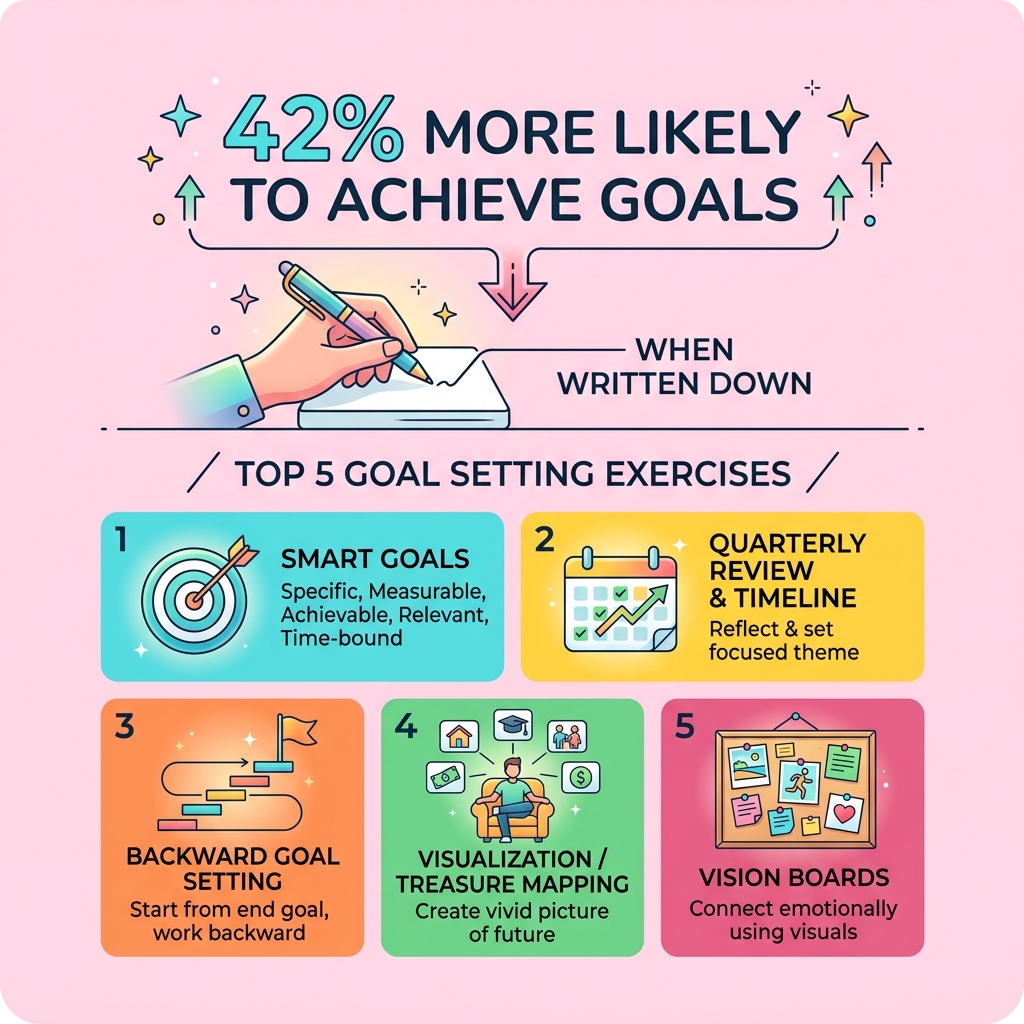
Here’s a quick overview of the most effective goal setting exercises you can start today:
- SMART Goals – Write goals that are Specific, Measurable, Achievable, Relevant, and Time-bound
- Quarterly Review + Timeline – Reflect on the past 90 days, then set a focused theme for the next
- Visualization / Treasure Mapping – Create a vivid picture of your future self using images, writing, or art
- Backward Goal Setting – Start from your end goal and work backward to identify every step
- Vision Boards – Use visuals to connect emotionally with your goals
- Best Possible Future Self Writing – Journal about where you want to be in 1, 5, or 10 years
- Accountability Partnerships – Share goals with a trusted friend or group for built-in support
Studies show that simply writing down your goals makes you 42% more likely to achieve them. Research from King (2001) found that writing about your best possible future self led to a significant increase in feelings of wellbeing. That’s a huge win for busy moms who are often the last ones on their own priority list.
This guide covers 45 goal setting activities designed for real life — for individuals, couples, families, teams, and classrooms. Whether you have 10 minutes or a full day, there’s something here that fits your current season of life. Let’s walk through the tools and strategies that actually work so you can stop dreaming and start doing.
Goal setting exercise glossary:
The Power of the Quarterly Goal Setting Exercise
Have you ever noticed how New Year’s resolutions seem to vanish by Valentine’s Day? We’ve all been there. The problem isn’t our lack of willpower; it’s the timeframe. A year is simply too long for our brains to stay focused without a “reset” button.
By breaking the year into 90-day sprints, we create a sense of urgency and manageable focus. Experts suggest that a dedicated “Quarterly Goal Setting Day” can be life-changing. This involves stepping away from the daily grind—the laundry, the emails, and the endless “Mom, where are my shoes?”—to look at the big picture.
One of the most effective ways to do this is by gathering a couple of close friends who share your passion for growth. Sharing your journey is a form of giving along side of getting, as you support their dreams while they fuel yours. You can even use a structured Goal Setting Worksheet from Gallup to identify how your unique strengths can help you win the next three months.

Why a Quarterly Goal Setting Exercise Works Better Than Annual Resolutions
Annual goals often feel like a heavy mountain we have to climb, but a quarterly goal setting exercise feels like a brisk walk. It allows us to get present and cherish the moments because we aren’t constantly worried about a deadline that is ten months away.
When we check in every 90 days, we can adjust for reality. If your toddler started a new phase or your work project expanded, you can pivot your goals without feeling like you “failed” the whole year. Research shows that making progress on meaningful goals is one of the easy ways to be happy.
Structuring Your Quarterly Goal Setting Day
To make this day truly effective, try getting out of your familiar environment. Drive to a cute coffee shop or a quiet library in a different town. Familiar environments often trap us in familiar thinking, while new scenery encourages bolder dreams.
Start your day with a “What Worked” and “What Didn’t Work” review. Be brutally honest with yourself. Use a SMART Goal-setting worksheet to refine those insights into actionable steps. Finish the session by choosing one “Theme” for the quarter—like “Consistency” or “Rest”—to guide your decisions when things get busy.
10 Proven Team and Group Activities for Work and Home
Goal setting doesn’t have to be a solo sport. In fact, involving others—whether it’s your work team or your family—increases accountability and brings fresh perspectives. If you’re a working mom, these activities are big time savers because they get everyone on the same page quickly.
- Goal-Setting Hot Seat: One person shares a goal, and the group asks constructive questions to help refine it.
- Reverse Goal Setting: Start with the finished result and work backward to today.
- Obstacle Identification: Brainstorm everything that could go wrong and create a “Plan B” for each.
- Success Stories: Share a past win to identify the specific behaviors that led to success.
- Peer Review: Swap goals with a partner to check for clarity and realism.
- Goal Ladders: Draw a ladder where the top is the goal and each rung is a milestone.
- Storytelling: Describe your goal as if it’s a story you’re telling your future grandkids.
- Vision Boarding: Use magazines or Pinterest to create a visual representation of the team’s future.
- The “Five-Minute Freewrite”: Everyone writes non-stop for five minutes about what a “perfect” team win looks like.
- KPI Generation: Identify the specific numbers (Key Performance Indicators) that will prove you’ve succeeded.
The goal is to be kind and be human throughout the process. Not every goal will be met perfectly, and that’s okay.
Using a Collaborative Goal Setting Exercise for Couples and Families
The same principles apply at home. Setting goals with your partner can actually be a way to prevent divorce because it ensures you’re both pulling in the same direction. Try a “FIRE Drill”—not for emergencies, but for your relationship! Discuss: Are we who we want to be in this relationship? How can we support each other better?
For the kids, keep it fun. You might make a parenting pledge to laugh every day or set a goal to improve your child’s math skills through fun games. Use a “Less is More” exercise: ask everyone what they want less of (like screen time) and what they want more of (like bike rides or taco nights).
Facilitating a Goal Setting Workshop
If you’re leading a group, structure is your best friend. Start with an icebreaker to lower defenses and provide a SMART Goal-setting worksheet so everyone has a physical takeaway.
A great workshop game is “Mine Field.” Place “obstacles” (paper cups) on the floor and have partners guide each other through the “field” using only verbal cues. It’s a powerful metaphor for how we need communication and trust to navigate the obstacles between us and our goals.
Visualizing Your Best Possible Future Self
Visualization isn’t just “woo-woo” magic; it’s backed by science. When we visualize, we prime our brains to recognize opportunities that align with our desires. Research by King (2001) showed that writing about your “Best Possible Future Self” for 20 minutes a day can significantly boost your mood and sense of agency.
Try the “10-Year Plan” goal setting exercise. Imagine your life a decade from now. Don’t just think about your job—think about the sensory details. What does your bed feel like? How many pets are curled up at your feet? What does your morning coffee smell like?
This “lucid hallucination” helps you unleash your inner goddess and see a version of yourself that is confident and capable. “Treasure Mapping” is a more artistic version of a vision board. Instead of just “stuff” you want to buy, you map out the path to your treasure.
If you want your teenage daughter to grow into a confident woman, include things you want her to know as milestones on that map. Use mental contrasting: imagine the wonderful future, but then immediately identify the biggest obstacle in your way right now. This prevents visualization from becoming just a daydream and turns it into a strategic plan.
As we learn from those around us, even a special needs nephew can teach us about confidence—it’s about the courage to keep moving toward that vision. Your goals will only stick if they align with your core values. If you value sustainability, a goal to minimize waste with baby clothes will feel much more rewarding than a generic “get organized” goal.
Try these three quick self-discovery prompts:
- The Winning Lottery Ticket: If you won $50 million today, what would you still do tomorrow? That’s your true passion.
- The Retirement Party: What do you want people to say about your character at your 80th birthday party?
- Six Months Left: If you only had half a year to live, what would you stop doing immediately?
Practical Tools and Strategies for Daily Success
Once the big dreaming is done, we need the “boots on the ground” tools to make it happen. Whether you prefer digital apps or a physical journal, the key is consistency.
| Tool Type | Best For | Examples |
|---|---|---|
| Digital Apps | Tracking habits & data on the go | HabitNow, Strides, Coach.me |
| Paper Journals | Deep reflection & digital detox | Bullet Journal, Ziglar Journal |
| Worksheets | Structured planning & workshops | SMART Goal PDF, Gallup Worksheet |
Effective goal setting also means controlling your environment—a concept called “Choice Architecture.” If your goal is to prep your holiday budget, don’t leave retail apps on your home screen! Similarly, if you want to join the moms who won big bucks for losing weight, keep healthy snacks at eye level in the pantry.
Don’t forget the basics: sleep and time management. You can’t achieve big goals if you’re exhausted. Utilizing time savers for moms ensures you have the energy to actually work on your dreams.
We’ve mentioned it a few times, but let’s break down the gold standard of any goal setting exercise: the SMART framework. Use this Developing SMART Goals Worksheet to ensure your goals aren’t just “wishes.”
- Specific: Instead of “get healthy,” try “walk for 30 minutes.”
- Measurable: Add a number. “Walk 3 times a week.”
- Achievable: Is it realistic? Don’t plan a marathon if you haven’t walked a mile yet.
- Relevant: Does this actually matter to your life right now?
- Time-bound: Set a deadline. “By the end of March.”
The “messy middle” is where most goals go to die. This is where self-compassion is vital. If you miss a week, don’t throw in the towel. Just get back on the horse.
Surround yourself with social support—an accountability partner who will text you to ask if you did your “one thing” today. Resilience is built through small wins. Celebrate every milestone, no matter how tiny. Finding 8 easy ways to be happy during the process makes the journey just as rewarding as the destination.
Frequently Asked Questions about Goal Setting
Why is writing down goals so effective?
Writing things down moves them from the “abstract” part of your brain to the “logical” part. It creates a physical commitment. Research shows you are 42% more likely to achieve a goal just by putting pen to paper.
How do I choose a quarterly theme?
Look at your biggest pain point or your biggest dream for the next 90 days. If you’re feeling overwhelmed, your theme might be “simplify.” If you’re looking to grow your side hustle, it might be “Visibility.”
What is backward goal setting?
It’s a goal setting exercise where you imagine the goal is already done. You then ask, “What was the very last thing I did before I finished?” and keep working backward until you reach today. It often reveals steps you might have missed when planning forward.
Conclusion
At ModernMom, we know that your time is precious and your energy is often spread thin. But investing in a regular goal setting exercise isn’t selfish—it’s the foundation for a more purposeful, joyful life for you and your family.
Start small. Pick one activity from this list—maybe it’s a 10-minute vision board or a quick SMART goal for the week. Give yourself grace, stay consistent, and remember that you are capable of turning those dreams into your “done” list.
For more encouragement on personal growth and everyday mindset shifts, read 8 Easy Ways to Be Happy. Small changes can make a big difference.