

Why College Budget Tips Matter More Than Ever in 2026
Helping a college student manage money can feel overwhelming fast. Between tuition, groceries, textbooks, and all the little extras, it’s easy to wonder where the money went — and how to make it last.
The good news? A simple budget can take a huge amount of pressure off. With the right college budget tips, students and families can make smarter choices, avoid common money mistakes, and feel more in control month by month.
Here’s the quick-start version if you need help right now:
The 6 Most Important College Budget Tips:
- Know your real income — add up all sources: jobs, aid, family support, scholarships
- List every expense — rent, food, textbooks, subscriptions, and yes, that daily coffee
- Split your budget — use the 50/30/20 rule (needs / wants / savings) or zero-based budgeting
- Turn lump-sum aid into monthly money — divide refunds by the number of months in the semester
- Build a small emergency fund — even $500 can make a stressful surprise much easier to handle
- Review your budget monthly — adjust when income or expenses shift
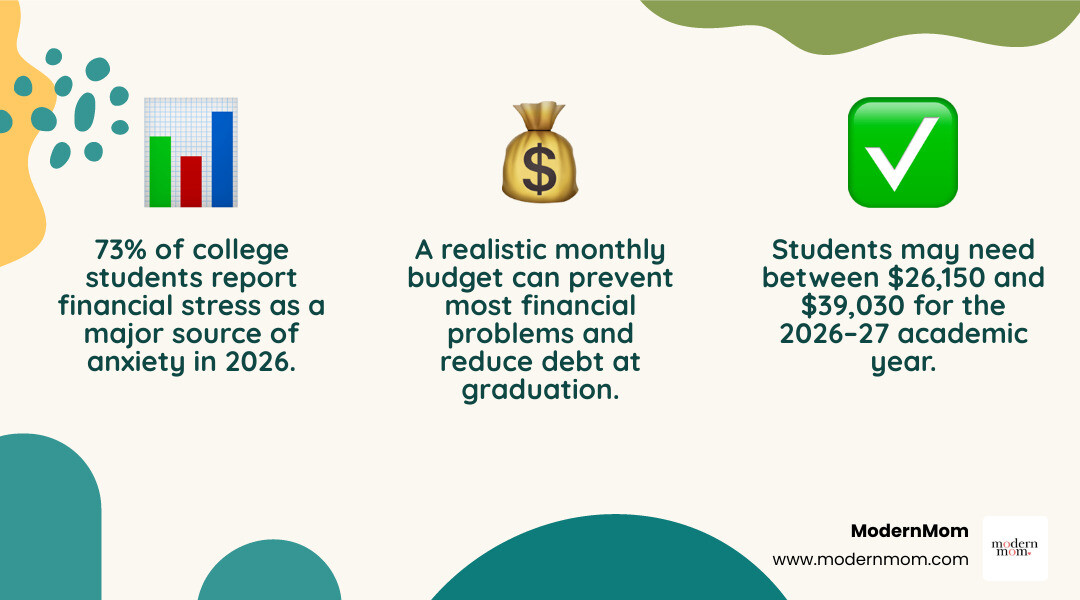
Studies show financial stress is a major source of anxiety for college students. And with students potentially needing between $26,150 and $39,030 for the 2026–27 academic year, a realistic spending plan matters more than ever.
Whether you’re a mom helping your teen get ready for campus life, a student figuring it out on your own, or a family trying to stretch every dollar, these tips can help you create a plan that actually works.
More college budget tips:
College Budget Tips That Actually Work in 2026
Navigating the financial landscape of 2026 requires more than just a piggy bank. With the average federal student loan balance hovering around $39,100, students are entering a world where credit card debt averages $3,280 even before graduation. To stay ahead, we need to look at the full picture of 2026 costs, including those sneaky tech fees and rising grocery prices.

Start with your real income, not your ideal income
The first rule of college budget tips is honesty. We often count on “maybe” money, but your budget should be built on what’s actually hitting your bank account.
- Wages: If you have a part-time job or work-study position, use your net pay (what you take home after taxes).
- Family Support: Have an open, collaborative conversation about what parents can realistically contribute.
- Scholarships and Grants: These are “free money” and should be your first line of defense.
- Side Hustles: Whether it’s virtual tutoring or social media management, keep these estimates conservative.
List every expense before the month begins
It’s the “spending leaks” that sink the ship. Beyond rent and tuition, 2026 students face unique costs like digital access codes and hybrid learning tech fees.
- Fixed Costs: Rent, phone bills, and insurance.
- Variable Needs: Groceries and transportation.
- Wants: Dining out (the average American spent $4,000 on this in 2024!), entertainment, and those 4.7 recurring subscriptions the average Gen Z student now carries.
Turn semester money into a monthly number
Financial aid refunds often arrive as one big “lump sum.” It feels like winning the lottery, but that money has to last four to five months. Divide that refund by the number of months in the semester immediately. If you get $2,000 back and the semester is 4 months long, you only have $500 a month. Put the rest in a separate account so you aren’t tempted to spend it all by midterms.
How to Build a Realistic College Budget Step by Step
Creating a budget is like using a toothbrush—everyone needs one, and things get nasty if you ignore it! Here is how we recommend creating a realistic budget that sticks.
College budget tips for tracking income and expenses
Spend one month tracking every single penny. Use your bank app or a simple notebook. Categorize them into:
- Fixed Needs: Things that don’t change (rent).
- Variable Needs: Things you need but can control (groceries).
- Wants: Things that make life fun but aren’t vital (concerts).
- Savings/Debt: Your future self’s fund.
Best budgeting methods for students: 50/30/20, zero-based, and 60/25/15
There’s no one-size-fits-all, but these three are the gold standard:
- 50/30/20 Rule: 50% for needs, 30% for wants, and 20% for savings or debt.
- Zero-Based Budgeting: Every dollar is assigned a “job” until your income minus expenses equals exactly zero. This is great for those with very limited income.
- 60/25/15 Rule: Many experts now suggest this for students because “needs” (like high rent) often take up more than 50% of a student’s small paycheck.
| Method | Needs | Wants | Savings/Debt | Best For |
|---|---|---|---|---|
| 50/30/20 | 50% | 30% | 20% | Balanced lifestyles |
| Zero-Based | Varies | Varies | Varies | Maximum control |
| 60/25/15 | 60% | 25% | 15% | High-cost living areas |
How often to review and adjust your budget
A budget isn’t a “set it and forget it” tool. We recommend a 15-minute weekly check-in. Did you spend too much on tacos Tuesday? Adjust your “wants” for the weekend. A monthly reset is also vital to account for new grants, schedule changes, or seasonal expenses like winter gear.
College Budget Tips for Saving on Textbooks, Food, Housing, and Fun
You don’t have to live on ramen to save money. Smart substitutions can save you thousands of dollars a year.

Cut textbook costs without hurting your grades
Textbooks are a notorious racket. Don’t buy them at the campus bookstore before the first day of class—requirements often change! Instead, learn how to budget for books by:
- Checking the Library Reserve: Many professors keep a copy there for free use.
- Using OER (Open Educational Resources): Look for free, legal digital versions.
- Renting or buying used from sites like Chegg or AbeBooks (where international editions can be 80% cheaper).
Lower food and housing costs in realistic ways
Food is often the biggest “leak.” Meal prepping can save a student over $1,500 a year. Try batch cooking on Sundays—your Tuesday-night self will thank you. For housing, consider becoming a Resident Assistant (RA) for free room and board, or share a room to cut rent by 50%.
Spend less on entertainment, subscriptions, and everyday extras
Always ask, “Is there a student discount?” From Spotify to Amazon to local movie theaters, your student ID is a golden ticket. Audit your subscriptions; if you haven’t watched that streaming service in a month, cancel it.
Smart Ways to Save More, Handle Irregular Income, and Avoid Debt
Building a safety net is the ultimate form of self-care. It’s the difference between a car breakdown being a “bad day” and a “total disaster.”
Build a starter emergency fund even on a small income
Don’t aim for $10,000 yet. Aim for $500. Even saving $20 a week will get you there in one semester. This fund is for the “unthinkables”—a broken laptop, a medical co-pay, or an emergency flight home.
Handle irregular income without blowing your budget
If you work a gig job where pay varies, use “income averaging.” Look at your last three months of pay and use the lowest month as your budget baseline. Anything extra goes straight to savings.
Avoid credit card trouble and use debt carefully
The average student credit card debt is $3,280, and with interest rates near 22%, it grows fast. Expert tip: Put one small, recurring bill (like your phone) on a credit card, set it to autopay from your checking account, and then hide the card. This builds your credit score safely without the risk of overspending.
Tools, Templates, and Free Money Opportunities Students Should Use
You don’t have to do this with a pen and paper unless you want to. There are incredible tools for college budgeting available for free.
Best apps and templates for a college budget
- YNAB (You Need A Budget): Offers a free year for college students!
- EveryDollar: Great for zero-based budgeting.
- PocketGuard: Simple interface that shows you exactly how much “spending money” you have left.
- Spreadsheets: Download a template if you prefer total customization.
Scholarships, grants, and discounts too many students miss
Never stop applying for scholarships. Many are available for students already enrolled, not just freshmen. Check your departmental office—often, small $500–$1,000 grants go unawarded because no one applied!
Campus resources that can stretch your budget further
Your tuition pays for more than just classes. Take advantage of:
- Campus Gyms: Skip the $50/month membership.
- Career Offices: Free resume help and job leads.
- Counseling Centers: Mental health support is often included.
- Food Pantries: Many campuses now offer these to help students stay nourished.
Frequently Asked Questions About College Budget Tips
What’s a realistic monthly budget for a college student?
It depends on your location. A student living at home might need $700–$900, while someone in a high-cost city like New York or SF might need $2,000+ per month beyond tuition.
How much should a student keep in an emergency fund?
Start with a $500 to $1,000 cushion. Once you graduate, you can aim for the traditional three to six months of expenses.
What should students do with extra money in the budget?
If you have a surplus, the smartest move is to borrow less. If you have a $500 surplus, ask your financial aid office to reduce your student loan by that amount. It saves you thousands in interest later!
Conclusion: Small Money Habits Now Can Mean Less Stress Later
Learning to manage your money in college is a rite of passage. It builds a level of maturity and confidence that stays with you long after you toss your cap in the air. By using these college budget tips, you aren’t just surviving the semester—you’re setting yourself up for a lifetime of financial freedom.
For more help navigating the transition to adulthood, check out our College Application Tips Guide or explore if a college degree helps you get a better job in today’s market. You can also calculate the economic value of college degrees to ensure your investment pays off.
Want more expert advice? Visit our Education section for more tips on navigating student life!