

Why Reconnecting Relationships Matters More Than You Think
Reconnecting relationships can feel overwhelming, but the path forward is simpler than you might think. Whether you’re feeling like roommates with your partner, distant from an old friend, or disconnected from family, the key is small, consistent actions—not grand gestures.
Quick ways to start reconnecting today:
- Ask open-ended questions about your partner’s current worries, hopes, and dreams
- Turn toward “bids” for connection—those small moments when someone asks for attention or support
- Schedule 10 minutes daily for distraction-free conversation
- Express gratitude for the little things they do
- Plan a weekly date or shared activity (even at home)
- Practice forgiveness and let go of scorekeeping
Maybe you’ve noticed the signs: less conversation, minimal affection, or that hollow feeling of being together but still alone. Research shows that about 90% of couples feel less happy after having kids, and around half of young adults break up and later reconcile. The good news? You’re not alone, and this is fixable.
The truth is, relationships drift for understandable reasons—life transitions, busy schedules, unresolved conflicts, or the sheer exhaustion of managing work, kids, and everything else. But studies also reveal something hopeful: when families have strong bonds, everyone benefits. Kids score higher on well-being measures, couples feel more satisfied, and even your own sense of purpose improves.
What really matters isn’t expensive vacations or dramatic apologies. It’s the micro-moments. Dr. John Gottman’s research found that couples who stayed together turned toward each other’s bids for connection 86% of the time, while those who divorced only did so 33% of the time. That means small, everyday interactions—like really listening when your partner asks about milk at the grocery store—build the foundation for lasting love.
Here at Modern Mom, we understand the unique challenges of maintaining strong relationships while juggling the demands of motherhood, career, and self-care. Our team has helped countless women steer the complexities of reconnecting relationships through practical, research-backed guidance that fits into real life. This guide will walk you through exactly how to rebuild connection—whether it’s with your partner, your kids, old friends, or extended family—using strategies that actually work when time is tight and energy is low.
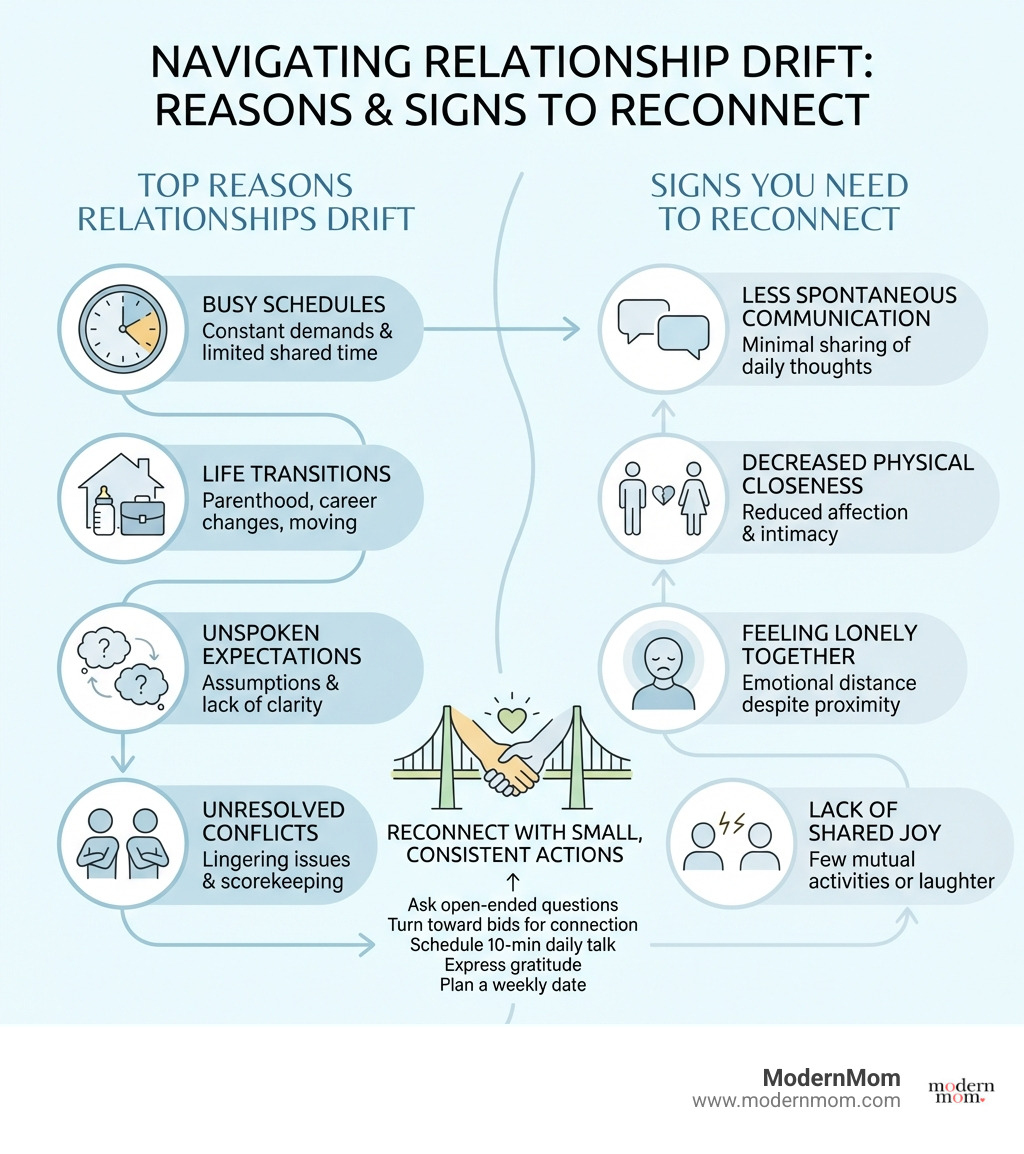
Why Relationships Drift and How to Spot the Signs
It’s easy for relationships to become disconnected, especially with the whirlwind of modern life. Life transitions, like having children, can significantly impact a couple’s dynamic, with studies showing a decrease in relationship satisfaction for many new parents. Unspoken expectations, busy work schedules, and the constant demands of family life can all contribute to a gradual drifting apart. When we’re caught up in the daily grind, we often stop making the “cognitive room” for our partner’s inner world, which is crucial for maintaining connection.
So, how do we know if we’re drifting? The signs can be subtle at first. You might notice less spontaneous communication, a decrease in physical closeness, or that uncomfortable feeling of being together but still lonely. Frequent small arguments, or even just a lack of shared joy, can be red flags. The important thing is to recognize these signals early so we can start working on reconnecting relationships before the distance becomes too great. Learn more about the effect of the transition to parenthood on relationship quality.
Are We Just Roommates? Recognizing the Red Flags
Have you ever felt like you and your partner are just coexisting, sharing household responsibilities and kids, but little else? This “roommate” feeling is a common and painful sign of emotional distance. It often manifests as a lack of shared joy, minimal affection, and living parallel lives where your paths rarely truly intersect. When everything else—work, kids, hobbies—seems to come before your partner, it’s a clear indication that your relationship needs attention.
It’s vital to acknowledge these red flags without judgment. They’re not failures, but rather signals that it’s time to invest in your connection. While we’re focusing on partner relationships here, the importance of healthy communication extends to all family dynamics. For insights into navigating difficult family conversations, you can find more info about common fights with your teen.
The “I Love You, But I’m Not In Love With You” Feeling
Hearing or feeling “I love you, but I’m not in love with you” can be terrifying. This painful sentiment often means the romantic spark, the passion, and the deep emotional intimacy have faded, leaving behind affection and care but not that exhilarating “in love” feeling. It’s a common phase many couples experience, especially after years together, and it’s not necessarily a death sentence for your relationship.
Instead, view it as a wake-up call, a signal that your relationship needs a conscious, intentional effort to rekindle that lost connection. The good news is that this feeling can often be made better quickly by implementing strategies for reconnecting relationships. It’s about refinding each other and nurturing the emotional bond that once thrived.
The Blueprint for Reconnection: Communication, Empathy, and Forgiveness

At the heart of reconnecting relationships lies effective communication, genuine empathy, and the willingness to forgive. Open and honest dialogue is the lifeblood of any lasting connection, allowing us to understand each other’s needs and concerns. However, true communication goes beyond just talking; it involves deep listening, seeking to understand rather than to respond.
We also need to address our individual issues that impact the relationship. This means reflecting on our own patterns, healing past traumas, and understanding how our attachment styles influence our interactions. When it comes to past hurts, acknowledging them and practicing forgiveness is crucial for moving forward. There can be no true repair without accountability, but holding onto resentment only poisons the present. Even during the reconnection phase, conflicts will arise. Navigating these disagreements requires using “I feel” statements, validating each other’s feelings, and focusing on understanding rather than defensiveness.
Mastering the Language of Connection
In every interaction, we make “bids” for connection—small attempts to get attention, affection, or support from our partner. These can be as simple as asking “Do we need milk?” or sighing after a tough day. Dr. John Gottman’s research highlights the profound impact of how we respond to these bids. Couples who stayed together consistently “turned towards” each other’s bids, responding positively, while those who divorced frequently “turned away.” Each positive response makes a deposit into what Gottman calls our “Emotional Bank Account,” building trust and intimacy.
To truly master the language of connection, we must also avoid the “Four Horsemen” of relationship apocalypse: criticism, contempt, defensiveness, and stonewalling. Criticism, for example, is often the first of these destructive patterns. Instead, focus on using “I feel” statements to express your needs without blame, such as “I feel overwhelmed when the dishes pile up” instead of “You never do the dishes.” This approach helps foster understanding and minimizes defensiveness. Learning to truly listen is also key, as discussed in The Importance of Listening. For more on common pitfalls, explore the Four Horsemen of criticism.
Rebuilding Your Foundation with “Love Maps”
One of the most powerful tools for reconnecting relationships is building “Love Maps,” a concept developed by Dr. John Gottman. A Love Map is essentially a detailed understanding of your partner’s inner world—their history, concerns, preferences, dreams, and current life events. In the early stages of love, we naturally build these maps, but over time, due to busyness or conflict, we often stop exploring.
Making space for your partner’s inner world means intentionally continuing this process of findy. It’s about asking open-ended questions and genuinely listening to the answers. This isn’t just about recalling old memories, but about understanding their current worries, hopes, and aspirations. By actively seeking to know your partner as they are now, you can re-establish that deep sense of being seen and understood.
Here are 5 simple “Love Map” questions to ask tonight:
- What’s one thing you’re most looking forward to this week?
- What’s been on your mind lately that you haven’t had a chance to talk about?
- What’s a small way I could support you better right now?
- What’s one of your favorite memories from early in our relationship?
- What’s a dream or goal you have for yourself in the next year?
These questions can help you refind each other and deepen your understanding, forming a solid foundation for Gottman’s Love Maps.
Acknowledging Past Hurts to Move Forward
When working on reconnecting relationships, we must inevitably confront past hurts. There can be no true repair without accountability. This means owning our part in the disconnection, even if it feels small. A genuine apology involves humility and no expectation of a specific outcome. It’s about expressing sincere regret and a willingness to understand the impact of our actions.
The process of forgiveness is equally vital. This doesn’t mean condoning hurtful behavior, but rather releasing the hold of resentment on our own well-being. Holding onto a “conflict-saturated story” about your relationship makes it incredibly difficult to move forward. Sometimes, this means agreeing to leave past conflicts in the past, setting boundaries around discussing them, and focusing on building a new, healthier future. It’s a conscious decision to forgive yourself and your partner for the ways you’ve both fallen short, allowing space for healing and growth.
Actionable Steps for Reconnecting Relationships

Now that we’ve laid the groundwork of communication and understanding, it’s time to move from ideas to action. Reconnecting relationships isn’t just about talking; it’s about doing. Shared activities and creating new experiences together are incredibly important for rebuilding bonds. They create opportunities for positive interactions, foster teamwork, and fill your relationship with fresh, happy memories. Whether it’s a simple chore or a new adventure, working together as a team reminds us why we fell in love in the first place.
Simple Exercises for Reconnecting Relationships
Here are some practical exercises you can start today to inject new life into your relationships:
- The 10-Minute Daily Check-in: Schedule a dedicated 10 minutes each night for a face-to-face talk with your partner. Put away phones, turn off the TV, and truly listen. Discuss your day, your concerns, your emotions—anything that comes to mind. This consistent micro-moment of connection can make a huge difference.
- The “Happy Memories” Box: Find a small box and fill it with mementos of good times—photos, ticket stubs, love notes, or small gifts. When you’re feeling distant or need a reminder of your shared history, pull something out and reminisce together. This can be a powerful tool to cope with difficult periods.
- Practicing “Relationship Enhancing Thoughts” (RETs): Spend just two minutes daily thinking about happy times, good feelings, or important moments that make you feel closer to your partner. This simple mental exercise helps you focus on the positive aspects of your relationship, fostering loving feelings.
- Creating a Shared Relationship Mantra Board: Collaborate with your partner to create a visual board of quotes, words, or images that represent your shared values and relationship goals. It serves as a beautiful reminder of what you’re building together. You can find inspiration on a Relationship Mantra Board Tip.
- The “Hallmark Moment” Exercise: Verbally express sentiments you might find in a mushy Hallmark card to your partner. It might feel silly at first, but saying things like, “I appreciate you, and I’m here for you,” or “Don’t worry, you’re safe with me, I really love you and I’ll never let you down,” can significantly boost feelings of security and affection.
Reigniting the Spark: Shared Activities and New Experiences
Beyond communication, shared experiences are vital for reconnecting relationships and rekindling that passionate spark.
- Scheduling Date Nights (Even at Home): Don’t let parenthood mean the end of romance. Prioritize date nights, even if it’s just a low-key movie night after the kids are asleep. The goal is to make the night about the two of you, not the kids.
- Doing Chores as a Team: It might sound unromantic, but tackling chores together can be a powerful bonding experience. As Dr. Gottman’s work suggests, helping with household tasks can do more for a relationship than a long vacation, fostering teamwork and appreciation.
- Volunteering Together: Find a cause you both care about and volunteer your time. Research shows that giving back makes us happier and more grateful, and doing it together can create a shared sense of purpose and connection.
- Starting a New Hobby or Project: Whether it’s learning a new language, taking a cooking class, or working on a DIY project around the house, a shared goal can bring you closer. Even something like researching your family genealogy can lead to fascinating conversations and findies.
- The Power of Physical Touch: Physical intimacy is a crucial component of many relationships. When both partners are ready, prioritize physical touch, whether it’s holding hands, cuddling, or sexual intimacy. Studies have shown that couples who have sex weekly are happiest, finding more relationship satisfaction than those who do it less often. Emotional closeness often paves the way for physical closeness, so nurture both. For more on how teamwork impacts your relationship, read Building a Strong Marriage: How Teamwork and Communication Help Us Thrive Off the Court.
Strengthening All Your Bonds for the Long Haul
The principles for reconnecting relationships with your partner are often transferable to your other important connections—friends and family. Whether it’s a temporary break or a longer period of disconnection, the core elements of communication, empathy, and shared effort remain.
When it comes to technology and social media, they can be a double-edged sword. While they offer convenient ways to initiate contact with old friends, they can also become a distraction from genuine, in-person connections. The key is to use technology as a bridge, not a substitute, for real interaction.
Maintaining a reconnected relationship requires ongoing effort. It’s about making connection a habit, not a one-time project. Regular check-ins and continuing to “date” your partner are vital. And knowing when to seek external support, like therapy or counseling, is a sign of strength, not weakness. Professional guidance can provide invaluable tools and insights for navigating complex emotional landscapes.
Tips for Reconnecting Relationships with Friends and Family
Reconnecting relationships with friends and family often presents unique dynamics compared to a romantic partner. With friends, the bond is often more voluntary, while family ties can be complex due to shared history and expectations.
- Reaching Out After Losing Touch: Don’t let awkwardness stop you. People often resist contacting old friends because it feels strange, like talking to a stranger. However, research suggests we consistently underestimate how much people appreciate our outreach. A simple text like, “Something reminded me of you, just wanted to say hi!” can open the door. Start with “baby steps” and move towards in-person “friend dates” when possible.
- Overcoming Awkwardness: Acknowledge that it might feel a little strange at first, but push through. People typically respond well to hearing from an old friend, perhaps even more so when the interaction is unexpected. Sending that text or making that call is an opportunity to make someone’s day.
- Setting Healthy Boundaries: Especially with family, setting boundaries is crucial. This might mean agreeing not to discuss past conflicts or limiting contact if a relationship is consistently toxic. Your well-being comes first.
For more insights into the impact of reaching out, studies show we underestimate how much people appreciate outreach. And for those looking to strengthen sisterly bonds, check out More info on unbreakable sister bonds.
How to Maintain Your Reconnected Relationship
Reconnecting relationships is a fantastic achievement, but maintaining that connection is the long game. It’s about making connection a daily habit, not just a repair project.
- Scheduled Check-ins: Just like you schedule appointments, schedule time for each other. This could be your 10-minute nightly chat, a weekly family meeting, or a monthly “friend date.” Consistency is key.
- Continue to “Date” Your Partner: Never stop actively pursuing and choosing your partner. Plan dates, big or small, to keep the romance alive and show them they are valued.
- Spot Early Signs of Drift: Pay attention to those subtle red flags we discussed earlier—less communication, increased irritability, or a feeling of distance. Address them proactively before they escalate.
- Seek External Support: It’s okay to ask for help! If you find yourselves falling back into old patterns, or if one partner is struggling more than the other, external support can be invaluable. Therapy or counseling offers a safe space to explore issues, learn new communication skills, and get guidance. For more on improving social well-being, explore information on improving social connectedness.
Frequently Asked Questions about Reconnecting Relationships
How long does it take to reconnect in a relationship?
There’s no fixed timeline for reconnecting relationships. It truly depends on how far you’ve drifted, the complexity of the issues, and the commitment of everyone involved. Consistency matters more than intensity; small, daily efforts add up over time. Some couples might feel a shift in weeks, while others need months or even longer to rebuild deep trust and intimacy. Focus on progress, not perfection, and celebrate the small wins along the way.
What if my partner isn’t interested in reconnecting?
This can be incredibly disheartening. You can only control your own actions and reactions. Start by focusing on your own growth and well-being. Model the connection and positive communication you wish to see in the relationship. Share your feelings and desires for reconnection without blame or accusation, using “I feel” statements. If your partner remains unwilling to engage, it might be beneficial to seek individual therapy to help you steer your feelings and determine the best path forward for yourself.
Can a relationship be stronger after a period of disconnection?
Absolutely! Many couples find that their relationships emerge stronger and more resilient after actively working through a period of disconnection. The intentional effort to reconnect often leads to deeper understanding, greater self-awareness, and a renewed commitment to each other. Overcoming challenges together can build a profound sense of shared history and resilience, making the bond more robust than before. You learn what truly matters and how to actively nurture your connection, leading to a more intentional and fulfilling partnership.
Conclusion: Your Relationship is Worth the Effort
Reconnecting relationships is a journey, not a destination or a one-time fix. It requires consistent effort, empathy, and a willingness to be vulnerable. But as we’ve explored, the benefits—for you, your partner, your children, and your overall well-being—are immeasurable.
Small, consistent actions, like turning towards bids for connection, practicing Love Maps, and engaging in shared activities, can make a monumental difference. You are not alone in experiencing periods of disconnection, and it is entirely possible to find your way back to each other, often emerging with a stronger, more intentional bond.
Here at Modern Mom, we believe your relationships are worth the effort. We’re here to support you with practical, relatable advice every step of the way. If you’re ready to dive deeper into strengthening your marital bond, learn more about how to make a marriage work.