

What Does Your College Student Actually Need for a Dorm Room (Without Overpacking)
What does your college student actually need for a dorm room is one of the most stressful questions parents face every summer — and the answer is almost always: less than the internet tells you.
Here’s the short version, so you can shop with confidence right now:
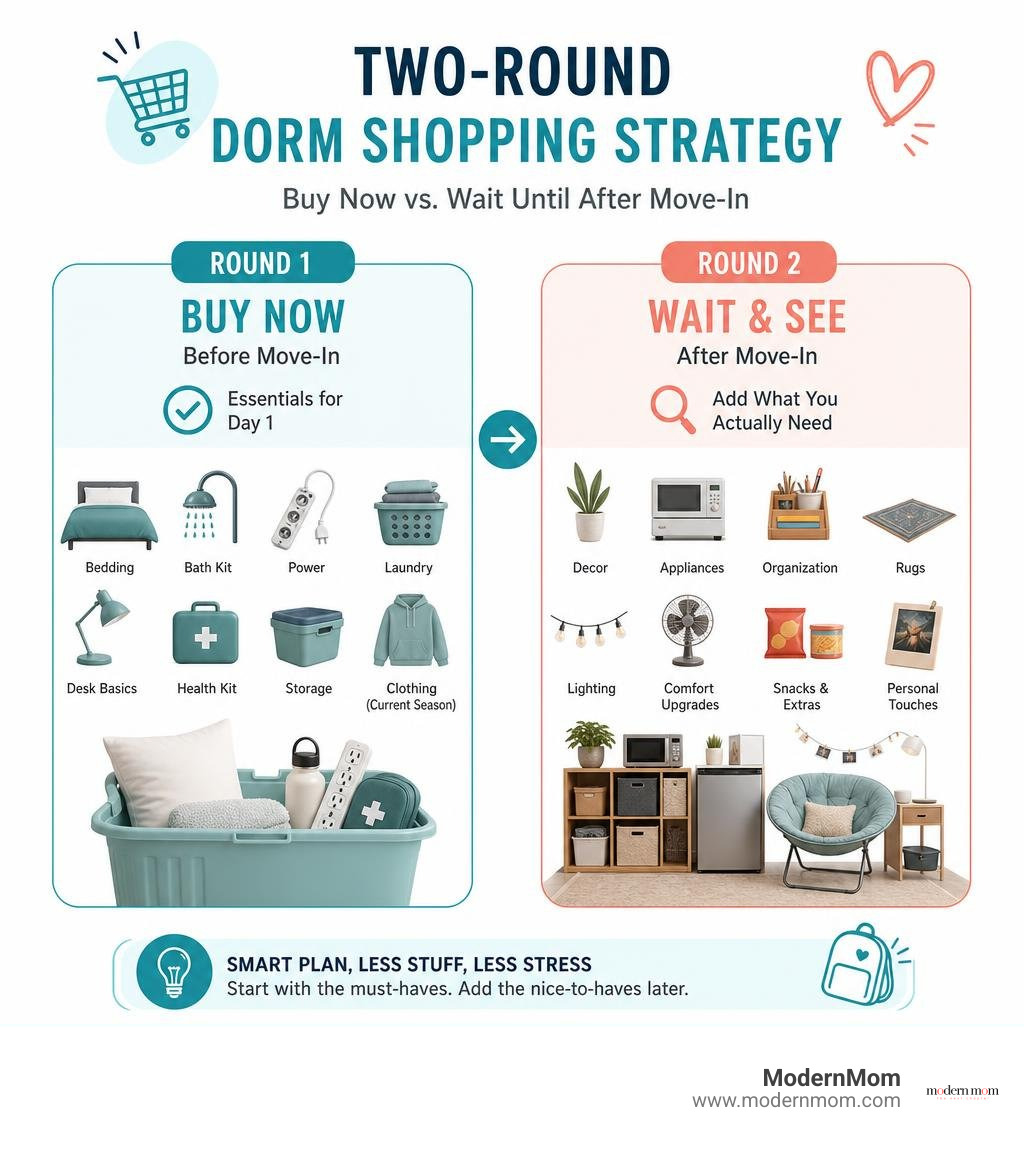
The true dorm room essentials, by priority:
- Bedding – sheets, mattress topper, mattress encasement, pillow (check with your specific dorm on bed sizing)
- Bath kit – shower caddy, flip-flops, microfiber towels
- Power – UL-listed surge protector (not an extension cord), extra-long phone cord
- Laundry – hamper, detergent pods, mesh laundry bag (we like this laundry backpack)
- Desk basics – LED lamp, noise-canceling headphones
- Health kit – thermometer, pain relievers, cold medicine, feminine hygien products
- Storage – Command hooks, under-bed bins, collapsible bags
- Clothing – pack for the current season only
- Kitchen: if your dorm includes a small kitchenette, bring microwave-safe dishes, utensils, a mug, reusable food containers, dish soap, a sponge and a small drying mat.
Everything else? It can wait until your student actually sees the room.
Here’s the reality no one warns you about: the average college dorm room is just 150 to 200 square feet shared between two people. That’s roughly the size of a large walk-in closet. And yet, families routinely spend $150 to $400 more than necessary by making one big, unplanned Target run and grabbing everything that looks useful on a shelf.
Students themselves figure this out quickly. Most pack half as much for sophomore year as they did for freshman year. The stuff that doesn’t fit? It ends up right back in your living room.
This guide helps you skip that lesson the easy way — by buying only what truly matters on Day 1, and waiting on everything else.
Basic What Does Your College Student Actually Need for a Dorm Room glossary:
The Reality of Dorm Living: Space, Rules, and Budgets
We’ve all seen those gorgeous, heavily styled dorm rooms on social media. They look like boutique hotel rooms, complete with plush headboards, custom curtains, and matching neon signs. But as moms, we need to look past the aesthetic filter and focus on the spatial reality.
With typical dorm rooms measuring between 150 and 200 square feet, space is at an absolute premium. Before you buy a single decorative pillow, you and your student need to establish a game plan.
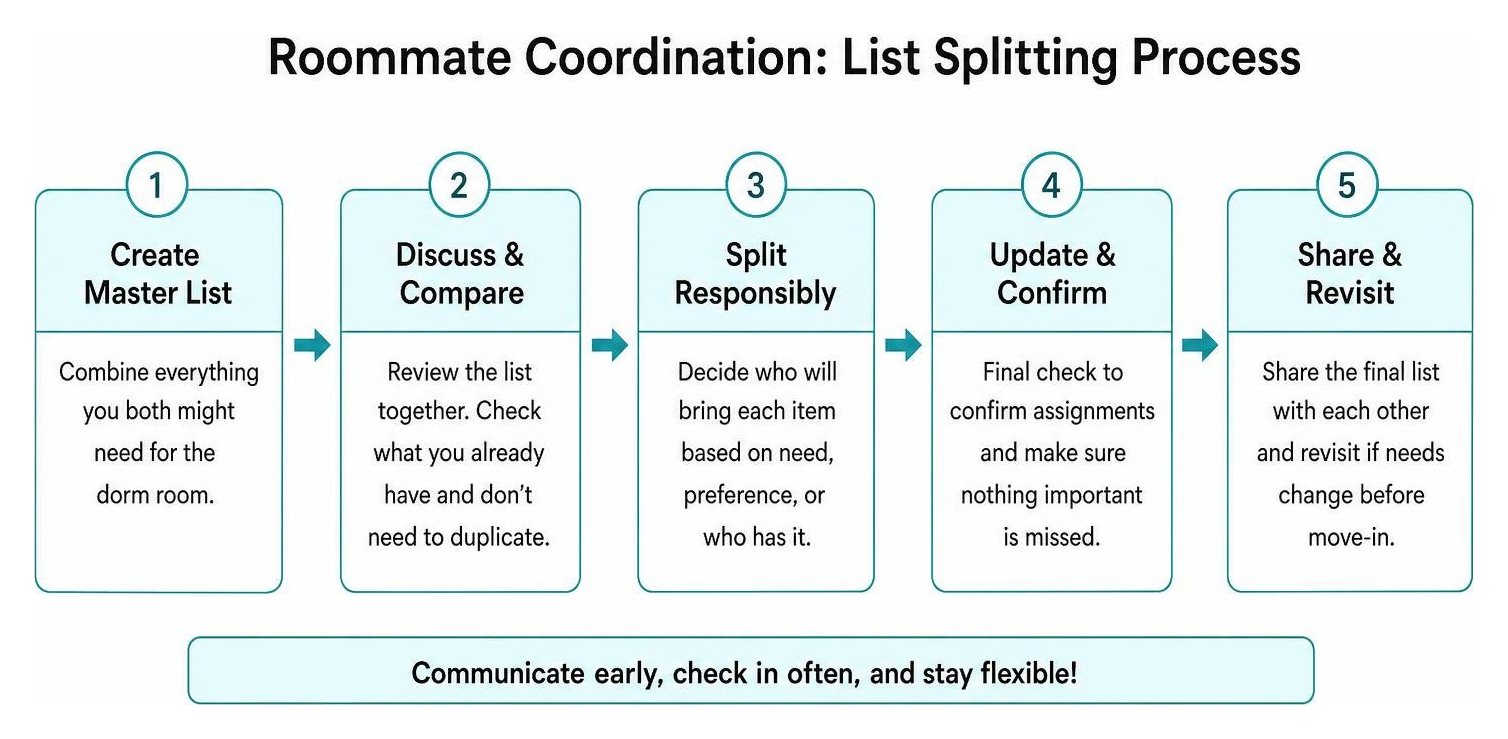
The first step is coordinating with the assigned roommate. Most universities release roommate contact information by early July. Reaching out early helps prevent the nightmare of moving in only to find two mini-fridges, two microwaves, and zero walking space.
Budgeting is another area where things can quickly spiral out of control. It’s incredibly easy to get swept up in the emotion of this major life milestone and overspend. On average, families spend close to $1,000 outfitting their students, but you can significantly cut this down with a smart strategy.
We recommend sitting down in June or July to establish clear financial boundaries. Decide who is paying for what, and focus on repurposing items you already own. For a deep dive into managing these expenses without breaking the bank, check out this guide on Dorm Room Budgeting: How Much to Spend (and Where to Save).
Additionally, always check your specific university’s housing guidelines. Safety rules are incredibly strict these days. For instance, 100 percent of analyzed universities ban hot plates, and 90 percent ban air fryers. Bringing prohibited items will only result in them being confiscated on move-in day.
Navigating this transition is as much about emotional preparation as it is about shopping. If you’re feeling the pre-college panic, our guide on How to Raise a Teenager Without Losing Your Mind offers wonderful, practical sanity-saving tips for this exact phase of motherhood.
What Does Your College Student Actually Need for a Dorm Room: Bedding and Bath

When it comes to the absolute essentials, sleep and hygiene take the crown. If your student isn’t sleeping well or feels uncomfortable in the communal bathroom, their academic performance and mental health will suffer.
According to returning students, investing in high-quality comfort basics is much more valuable than buying trendy decor. For a comprehensive look at the bare-minimum essentials, you can review the Ultimate Dorm Room Shopping List.
Why Twin XL Bedding is a Non-Negotiable
Dorm beds are typically not standard twins. Almost all college dorms feature Twin XL mattresses, which measure 80 inches long by 36 inches wide—five inches longer than a regular twin. Standard twin sheets will constantly slip off the corners, causing endless frustration.
Beyond sheets, you must protect your student from whatever (and whoever) lived on that mattress before them. If not already provided by your dorm, a waterproof, zippered mattress encasement is a must-have. It seals out dust mites, bed bugs, and allergens, providing a clean slate before you layer on the comfort.
And a quick word of maternal advice: you do not need to buy three or four sets of sheets. One or two sets are more than enough. I regret to inform you that having extra sheets will not increase the likelihood of your student actually changing them!
The Mattress Topper: A Sleep Quality Game Changer
Most dorm mattresses are roughly four inches thick and feel about as soft as a concrete slab. A high-quality mattress topper is the single best investment you can make for your student’s physical health and academic success.
Spending $50 to $100 on a memory foam or natural latex topper measurably improves sleep quality. This is the one item where returning students consistently say: do not skimp. It turns a sterile, uncomfortable bed into a cozy sanctuary where they can rest and recharge.
The Shower Kit: Caddy and Flip-Flops
If your student is sharing a communal bathroom down the hall, preparation is key. First and foremost, you need shower shoes or rubber flip-flops. Shared shower floors are breeding grounds for bacteria, and this is a non-negotiable health barrier.
Instead of a bulky plastic bucket that pools water, opt for a quick-drying mesh shower caddy. It allows water to drain easily, preventing mold and mildew.
Finally, swap out heavy cotton bath towels for quick-drying microfiber towels. Dorm rooms lack good ventilation, and a thick, damp cotton towel will quickly start to smell musty.
Power, Tech, and Smart Storage Solutions
Modern college students travel with an incredible amount of technology, but older dorm buildings are notoriously short on electrical outlets. Keeping devices charged while maximizing every square inch of a tiny room requires a strategic approach.
To help keep the rest of their space tidy, you can also check out our favorite Home Organization Hacks for inspiration that easily translates to small-space living.
Surge Protectors vs. Banned Extension Cords
Standard, cheap extension cords are a major fire hazard and are banned by almost all university housing departments. Instead, you must purchase UL-approved surge protectors with built-in internal circuit breakers.
Look for a surge protector that features at least six outlets and several built-in USB ports. We also highly recommend packing a 10-foot phone charger cable. Because dorm outlets are often poorly placed—sometimes hidden behind heavy, immovable wooden desks—a long cord ensures they can comfortably use their phone in bed.
Maximizing Vertical Space with Command Strips
Because dorm rooms typically feature solid concrete or cinder-block walls, drilling or nailing is completely out of the question. This is where Command damage-free hooks and strips become your best friend.
Use heavy-duty adhesive hooks to hang damp towels, heavy winter coats, and backpack straps off the floor. You can also use them to mount lightweight wall organizers and frames, instantly personalizing the space without risking a hefty wall-damage fee at the end of the year.
Collapsible Bags and Under-Bed Bins
One of the biggest moving day mistakes is packing everything in rigid plastic bins or hard suitcases. Once unpacked, those bulky containers take up massive amounts of valuable floor space.
Instead, pack everything in heavy-duty, collapsible zippered totes (like the famous blue Ikea bags). Once empty, they fold completely flat and can slide under the bed or sit at the bottom of a closet.
To make the most of the space under the bed, look for shallow, wheeled plastic storage bins or a storage ottoman that doubles as a step-stool to reach high, lofted beds.
Kitchenette Basics for Dorms That Allow Simple Cooking
If your student’s dorm includes a small kitchenette, keep the kitchen setup practical, compact, and roommate-approved. Start with a couple of microwave-safe plates and bowls, two mugs, a reusable water bottle, a small set of utensils, dish soap, a sponge, paper towels, and a compact drying mat. A few reusable food containers are also helpful for leftovers, snacks, and quick breakfasts.
Before buying any appliances, check the residence hall rules carefully. Many dorms restrict hot plates, air fryers, toaster ovens, and other plug-in cooking tools, even when a kitchenette is available. If cooking appliances are allowed, coordinate with the roommate so you do not end up with duplicates and make sure you get smaller individual (not family) appliances. The goal is not to build a full apartment kitchen — it is to make simple meals and late-night snacks easier without crowding the room.
What to Skip: Overhyped Items to Leave at Home
It is incredibly easy to fall victim to marketing campaigns designed to make you feel like your student needs every gadget on the shelf. But packing light is a gift to your student (and your back on move-in day).
Before you start adding items to your cart, cross-reference your list with this realistic College packing list: 50+ essentials to keep your expectations grounded.
Why You Can Skip the Personal Printer
In 2026, a personal printer is almost entirely obsolete. Nearly every professor requires digital assignments submitted through online portals like Canvas or Blackboard.
If your student does need to print a physical syllabus or lab sheet, campus libraries and dorm lobbies are equipped with high-speed, cheap printing hubs. A personal printer simply wastes valuable desk space and creates unnecessary paper clutter.
The Truth About Excessive Clothing and Decor
Your student does not need their entire wardrobe at college. Space is tight, and a crowded closet makes finding clothes and doing laundry twice as hard.
Encourage your teen to pack seasonally. Bring lightweight summer and early fall clothes in August, and swap them out for heavy winter coats during Thanksgiving or fall break. Aim for a minimalist count: 10 to 12 t-shirts, 5 to 6 pairs of pants, and a couple of comfortable sweatpants.
The same rule applies to decor. Those matching sets of decorative throw pillows look lovely on social media, but in reality, they will be tossed on the floor every single night and stepped on every morning. Keep the vibes simple and functional.
Frequently Asked Questions About Dorm Shopping
What Does Your College Student Actually Need for a Dorm Room on Day One?
On the chaotic morning of move-in day, the last thing you want to do is rummage through ten different taped-up boxes to find a trash bag or a roll of toilet paper.
We highly recommend packing a designated “First-Day Access Bag.” This should be a clear tote or a specific backpack containing:
- Disinfecting cleaning wipes (to wipe down dusty, pre-furnished surfaces)
- A roll of paper towels and trash bags
- Your Twin XL sheets, mattress pad, and pillow
- Your shower caddy, towel, and a change of clothes
- A surge protector and phone charger
Having these essentials immediately accessible means your student can quickly wipe down the room, make their bed, and take a refreshing shower without unpacking a single cardboard box.
What Does Your College Student Actually Need for a Dorm Room to Stay Safe?
When our kids leave home, we worry about their safety and physical well-being. One of the most important things you can send with them is a fully stocked “sick kit.”
It is an inevitable rite of passage: college students will catch what they affectionately call the “frat-flu.” Having medicine on hand before they get sick prevents a miserable, late-night walk to a campus convenience store.
Your sick kit should include a digital thermometer, pain relievers (ibuprofen and acetaminophen), cough drops, cold and flu relief medicine, and a simple first-aid kit. For a list of medical basics to keep on hand, take a look at our guide on Essential First Aid Tools Every Mom Should Keep at Home.
Additionally, consider purchasing a small, portable lockbox or safe. This keeps sensitive items like passports, physical social security cards, emergency cash, and prescription medications secure in a shared living space.
How do we coordinate shared items with a roommate?
The golden rule of roommate coordination is simple: split the list, not the cost.
Instead of buying a mini-fridge together and trying to figure out who owns it—or Venmoing money back and forth—at the end of the year, have one roommate bring the fridge and the other bring the microwave. Clearly label each appliance, cord and other shared-space item with the owner’s name using small rectangle labels like these ones from Mabel’s Labels. This keeps move-out clean, simple and conflict-free.
What kitchen items should students bring for a dorm with a kitchenette?
If your student is lucky enough to have a small kitchenette, keep the setup simple and roommate-approved. A few practical basics are usually enough: one microwave-safe plate and bowl, a mug, a reusable water bottle, a small set of utensils, dish soap, a sponge, a roll of paper towels, and a compact drying mat. If the dorm allows cooking appliances, consider a small skillet, saucepan, cutting board, and basic food-storage containers — but check the housing rules first, because many residence halls restrict hot plates, air fryers, toaster ovens, and other plug-in appliances. The goal is not to build a full apartment kitchen; it is to make quick breakfasts, leftovers, snacks, and late-night tea easier without crowding the room.
Conclusion
At the end of the day, sending your child off to college is a beautiful, emotional, and monumental milestone. It’s natural to want to buy them everything under the sun to make their transition comfortable, but a minimalist mindset is truly the best gift you can give them.
By focusing on high-quality sleep essentials, smart power solutions, and basic health tools, you are setting them up for a successful, independent freshman year. The rest of the details will fall into place once they arrive.
For more supportive parenting advice, transition tips, and educational resources as you navigate this new chapter of motherhood, explore our Education category. We are right here with you every step of the way. Happy packing!