

How Can AI Solve the “What’s for Dinner?” Crisis?
The daily dread of hearing “What’s for dinner?” is a major driver of maternal decision fatigue. When we are mentally depleted by 5:00 p.m., it is incredibly easy to give up and order takeout. In fact, decision fatigue around daily meal planning is one of the primary reasons families overspend on spontaneous food delivery.
By letting AI handle the cognitive heavy lifting of meal planning, one parent saved approximately $200 per month on takeout. AI can instantly look at what you already have in your kitchen and generate a customized, budget-friendly weekly meal plan. This means you spend less time staring blankly into the fridge and less money on last-minute delivery fees.
Once the AI generates your weekly dinner menu, you can ask it to instantly turn that plan into an aisle-sorted, categorized grocery list. This makes your grocery run incredibly efficient and prevents the impulse buying that happens when you shop without a clear plan. You can even copy and paste this list directly into grocery delivery or pickup apps to save even more time. For extra inspiration on keeping your kitchen running smoothly, check out our favorite Pantry Organization Tips and these 5 Ultra Healthy Recipes To Start Your New Year Off Right.
The Copy-and-Paste Meal Planning Prompt
To get the best results, you need to give the AI specific constraints. Copy and paste this prompt into ChatGPT, Claude, or Google Gemini, and customize the bracketed details to fit your family:
“Act as a realistic family nutrition expert. I need a 7-day dinner plan for a family of [number of adults] and [number of kids] kids aged [insert ages]. Each meal must be nutritious, kid-friendly, and take less than 30 minutes to prepare. Please utilize time-saving shortcuts like frozen vegetables, pre-cooked proteins, or sheet-pan meals. Do not suggest complicated recipes. After creating the menu, generate a categorized grocery list organized by supermarket aisles (e.g., Produce, Pantry, Meat, Dairy).”
Strategies for Picky Eaters and Food Allergies
If you have a child with food sensitivities or highly selective tastes, meal planning can feel like a minefield. Instead of cooking entirely separate meals, you can prompt the AI to find clever, low-effort solutions. Try asking:
“Modify this meal plan to accommodate a child who has a [insert allergy, e.g., gluten intolerance] and is highly sensitive to mixed textures. Suggest simple, deconstructed versions of each dinner so I only have to cook once.”
For more support on navigating family meals during busy seasons, read our guide on 6 Tips To Make It Through The Holidays When You Have Food Allergies Or Intolerances.
How Do You Use AI to Build Meltdown-Proof Family Routines?

When it comes to getting kids through morning transitions or bedtime routines, predictability beats verbal nagging every single time. When children know exactly what to expect, power struggles naturally decrease. AI is incredibly effective at designing highly structured, realistic routines tailored to your child’s developmental age.
Instead of falling down a late-night “Pinterest rabbit hole” searching for elaborate chore charts, you can use AI to generate simple, screen-free independent play ideas using items you already own. This keeps your kids engaged while you get ready or prep meals. To help get your family’s schedule back on track, dive into The School Day Routine Survival Guide For Tired Parents and learn Back To School How To Get Sleep Back On Track.
The Meltdown-Proof Morning Prompt
If mornings in your house feel chaotic, use this prompt to build a calm, step-by-step flow that keeps everyone moving without you having to yell:
“Act as a child behavior expert. Help me design a minute-by-minute morning routine for my [insert ages of children] kids. We need to leave the house by [insert target departure time]. My biggest hurdle is [insert struggle, e.g., wardrobe power struggles and putting on shoes]. Provide a low-stress schedule and suggest two playful, non-verbal cues (like song timers) I can use to transition them between tasks without nagging.”
Gentle Sleep and Bedtime Solutions
Bedtime is often when a parent’s patience is at its absolute lowest. If you are struggling with bedtime resistance, AI can help you troubleshoot.
Take the real-world case of one frustrated mother who was dealing with a stressful, three-hour bedtime routine with her high-energy toddler. She explained the situation to ChatGPT, which suggested a counterintuitive approach: instead of forcing immediate quiet time, let the child burn off physical energy with a structured “active play” window right before starting the quiet wind-down. By implementing this simple shift, the toddler was asleep within five minutes of hitting the pillow.
How Can Parents Automate Scheduling and Household Coordination?
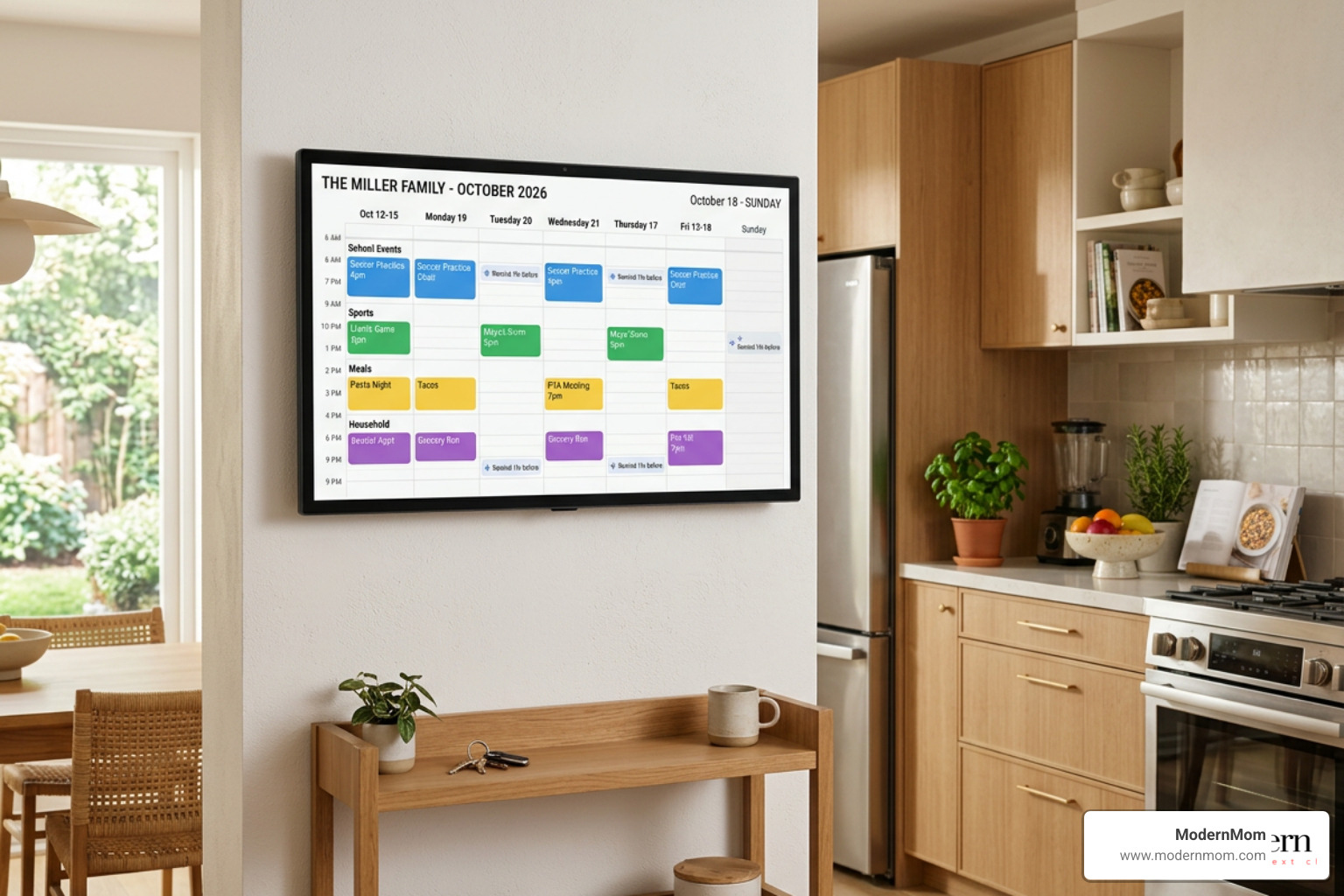
The mental load of tracking school events, sports practices, doctor appointments, and permission slips is incredibly heavy. It is easy for things to slip through the cracks when you are trying to remember everything yourself.
Using technology to streamline these logistics can make a massive difference. In fact, one busy parent saved 2 hours per week simply by using an automated kid schedule manager to organize practices and games.
Another incredibly powerful hack is using voice-to-text dictation to empty your brain. When a task pops into your head while you are cooking or driving, do not try to hold onto it. Record a quick, unstructured voice memo on your phone and run it through an AI transcription tool with this prompt: “Organize this chaotic brain-dump into a prioritized, structured to-do list with clear action steps.” This simple habit saves parents an average of 30 minutes of mental energy per day.
To make these tasks visible to the whole family, we recommend setting up a shared “digital command center” (like a shared Google Calendar or a wall-mounted family display) so household management does not fall solely on your shoulders. For more home organization inspiration, check out our Cleaning And Decluttering Hacks and our Diy Organization Hacks Complete Guide.
The “Family Ops” Shared Account Strategy
To prevent the AI helper from becoming “Mom’s new job,” household coordination must be equitable. We recommend setting up a shared AI account with your partner or older teenagers.
Pin a “family ops” prompt thread to the top of the app where you keep your family’s preferences, routines, and dietary needs saved. Rotate ownership of running the weekly prompts — such as generating the grocery list or scheduling carpools — so that both partners are actively involved in the digital management of the home.
Drafting Stress-Free School and Personal Emails
Drafting emails to teachers, pediatricians, or extended family members often carries a heavy emotional load. We tend to overthink our tone, agonizing over how to sound polite but firm.
AI writing assistants can eliminate this emotional friction. You can prompt an AI to draft these messages in under three minutes:
“Draft a warm, polite, and concise email to my child’s teacher asking for a brief check-in regarding their progress in math. Keep the tone collaborative and under 150 words.”
This strategy is also incredibly helpful for managing delicate family boundaries. If you need help handling tricky conversations, read our tips on Money Talks How To Handle Nosy Relatives Without Losing Your Cool.
Can AI Help Moms Manage Emotional Stress and Burnout?
Parental burnout is a deep, chronic state of physical and emotional exhaustion. It is characterized by three main symptoms: chronic fatigue, emotional distancing from your children (feeling like you are just “going through the motions”), and a sense of ineffectiveness.
While AI cannot solve the systemic reasons behind mom burnout, it can act as a powerful sanity-saving tool. Zurich mom and corporate brand strategist Lilian Schmidt reported that her mental load got 97% lighter after she began delegating her daily household logistics to AI. By offloading these repetitive administrative tasks, you can clear small, precious pockets of restorative time to actually practice self-care.
Furthermore, AI can serve as a compassionate, nonjudgmental sounding board. When you are feeling overwhelmed by a tough parenting day or a toddler tantrum, you can use AI to vent your frustrations and organize your thoughts without fear of criticism. For a deeper look at this approach, read How I Use ChatGPT to Offload the Mental Load as a Working Mom of Two – Kee To Wellness and explore our guide on How To Actually Practice Self Care As A New Mother.
The “Decompress and Vent” Prompt
If you have had an exhausting day and need to process your emotions, try typing this into your AI assistant:
“I have had an incredibly hard parenting day and my patience is completely depleted. I need to vent. Please act as an empathetic, nonjudgmental friend and listening ear. Do not try to solve my problems or give me advice right away. Just validate my feelings, help me organize my chaotic thoughts, and offer a calm, supportive perspective.”
When to Step Away: The Limits of AI Support
While AI is an excellent tool for organization and emotional decompression, we must establish clear boundaries for using it safely.
- Never use AI as a substitute for professional support. AI cannot replace professional therapy, medical diagnoses, or pediatric advice.
- Always do a human gut-check. Treat every AI output as a rough draft. If an AI suggests a parenting strategy or schedule that does not align with your values or your child’s unique personality, trust your maternal instincts and discard it.
What Are the Pitfalls of AI in Parenting and How Do We Set Boundaries?
As helpful as artificial intelligence can be, there is a real risk of over-relying on technology. If we are not careful, we can let screens and digital organization tools replace genuine, face-to-face human connection.
To prevent this, families must set strict technology boundaries. We recommend establishing completely unplugged times of the day — such as during dinner or the hour before bedtime — where all devices are put away. This ensures that technology remains a tool that supports your life, rather than a distraction that pulls you away from your kids.
Protecting your family’s digital safety is also crucial. Practice strict “data hygiene” by never inputting personally identifiable information into public AI models. Never use your children’s full names, school locations, home addresses, or private medical details in your prompts. Keep your queries completely anonymous.
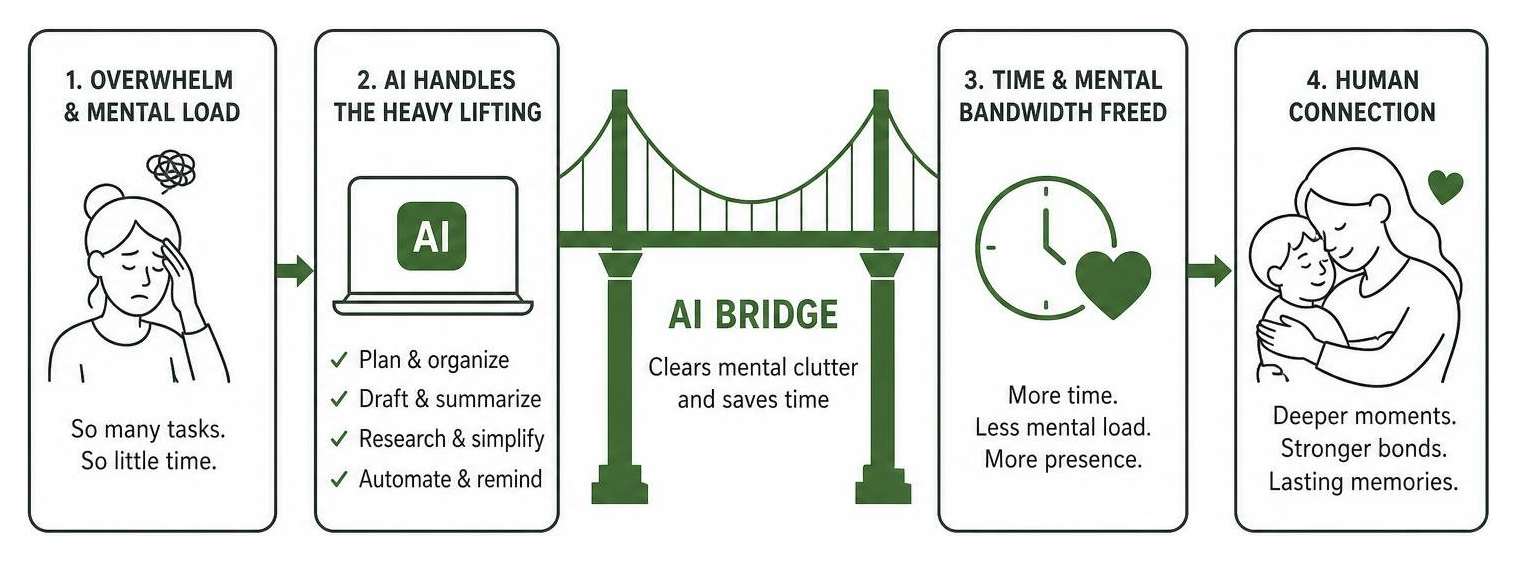
The goal of using AI is to handle the repetitive, invisible logistics of running a home so that you can show up fully present for the hugs, stories, and deep emotional connections that only a parent can provide. For more on building strong family foundations, read How To Teach Your Kids Empathy and review our Back To School Safety Tips For Parents.
Keeping the Heart of Parenting Human
When your children grow up, they will not remember whether you designed a perfect, AI-optimized weekly schedule or wrote flawless emails to their teachers. They will remember your presence, your laughter, your emotional warmth, and how safe they felt in your care.
Use AI as a digital bridge to clear away administrative clutter, freeing up the time and energy you need to build a deep, lasting bond with your kids.
Teaching Kids Healthy Tech Boundaries
Children learn how to interact with technology by watching their parents. By using AI intentionally and setting clear boundaries around your device use, you model a healthy relationship with digital tools.
As your kids grow older, you can introduce them to AI as a conceptual learning tool rather than a shortcut for homework. Show them how to ask AI for helpful analogies to explain difficult school subjects (e.g., “Explain photosynthesis like a factory”), teaching them to use technology for deep understanding rather than quick answers.
Frequently Asked Questions About AI for Moms
Is it safe to use AI to manage my family’s schedule and routines?
Yes, using AI for everyday planning, brainstorming, and organizing is highly effective and safe, provided you protect your family’s private information. Never input highly sensitive data — such as your children’s full names, home address, school names, passwords, or medical records — into public AI models. Treat the AI as a helpful, anonymous assistant.
Do I need to pay for expensive AI tools to get these benefits?
Not at all! Busy moms can access incredible relief using the free tiers of mainstream, chat-style AI tools like ChatGPT, Google Gemini, or Claude. You do not need a complicated, expensive, or highly technical setup to start saving hours of mental energy every week.
Can AI replace my natural instincts as a mother?
Absolutely not. AI is a tool to handle cognitive clutter and administrative logistics, but it can never replace your intuition, values, love, and deep knowledge of your unique child. Always treat AI suggestions as rough drafts, and let your maternal instincts make the final decision.
Conclusion
Motherhood is a beautiful journey, but you do not have to carry the invisible weight of running a household all on your own. Embracing modern, free tools like AI to manage daily logistics is not “cheating” at parenting — it is a smart, loving strategy that protects your mental health, prevents burnout, and fosters a calmer, happier home.
By letting technology handle the administrative noise, you can reclaim your time and show up as the present, loving mother you want to be. We invite you to explore our extensive library of parenting resources, home systems, and supportive community spaces at ModernMom and check out our practical ModernMom Guide on How to Manage a Large Family.