
Why Every Busy Mom Needs Mindful Parenting Tips Right Now
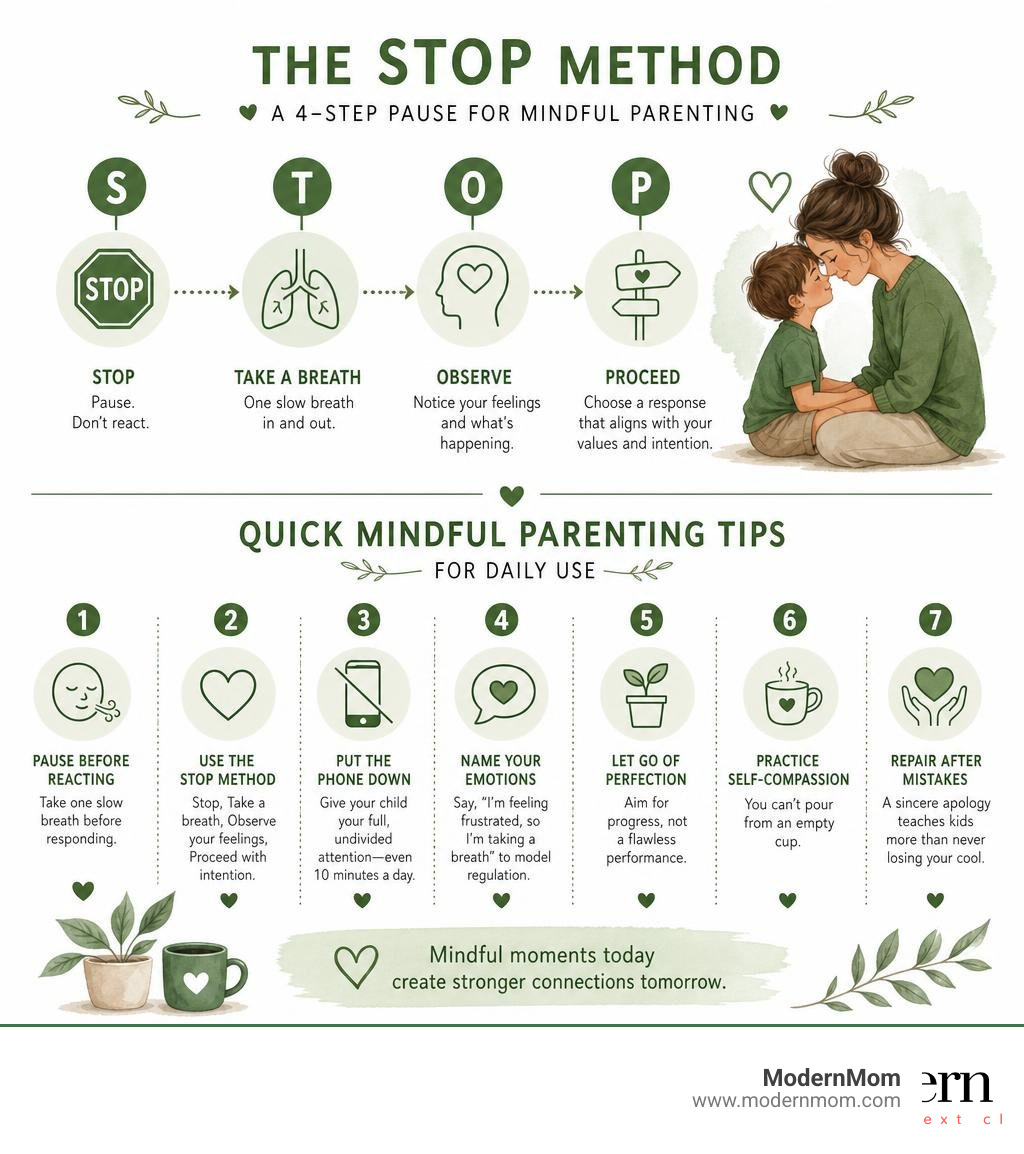
Mindful parenting tips can make an immediate difference, even on your most chaotic days. Here’s a quick look at the most effective ones:
- Pause before reacting — take one slow breath before responding to your child
- Use the STOP method — Stop, Take a breath, Observe your feelings, Proceed with intention
- Put the phone down — give your child your full, undivided attention for even 10 minutes a day
- Name your emotions out loud — say “I’m feeling frustrated, so I’m taking a breath” to model regulation
- Let go of perfection — aim for progress, not a flawless parenting performance
- Practice self-compassion — you can’t pour from an empty cup
- Repair after mistakes — a sincere apology teaches kids more than never losing your cool
Some days, parenting feels like a full-contact sport. You’re managing school drop-offs, work deadlines, sibling fights, and dinner — all before 6 p.m. It’s exhausting. And in the middle of all that noise, someone tells you to be more present. Easy to say, harder to do.
Here’s the thing: mindful parenting isn’t about achieving a zen-like calm or meditating for an hour before sunrise. It’s about small, intentional moments. It’s pausing for one breath before you snap. It’s putting your phone face-down during snack time. It’s noticing what your child actually needs beneath the tantrum.
And the research backs this up. Studies show that parental stress is actually the biggest source of stress for kids — bigger than school pressure, peer conflict, or extracurricular overload. When you’re overwhelmed, your kids feel it too. The good news? Even small shifts in how you respond can ripple out into calmer kids, stronger bonds, and a home that feels less like a battle zone.
More mindful parenting tips:
What is Mindful Parenting?
At its core, mindful parenting is about bringing our conscious attention to what is happening right now, rather than getting hijacked by our immediate emotional reactions. It applies the classic mindfulness definition coined by Jon Kabat-Zinn—paying attention on purpose, in the present moment, and non-judgmentally—directly to our interactions with our kids.
Instead of trying to be a perfect parent, we focus on five core dimensions: listening with full attention, non-judgmental acceptance of ourselves and our children, emotional awareness of our own states, self-regulation before we respond, and deep compassion. When we practice this, we are choosing our responses rather than defaulting to old, reactive habits.
To help you visualize this shift, here is how mindful parenting differs from traditional reactive parenting:
| Reactive Parenting | Mindful Parenting |
|---|---|
| Reacting immediately based on anger, fear, or embarrassment | Pausing, taking a breath, and choosing an intentional response |
| Multitasking and feeling distracted during interactions | Giving full, undivided attention to the child in the moment |
| Expecting rapid compliance and perfection | Accepting the child’s developmental stage and emotions without judgment |
| Suppressing emotions or letting them build up into an explosion | Noticing physical tension and emotional cues early on |
If you are looking to build these habits, exploring 7 Tips to Help You Be a Better Parent is a wonderful place to start. For a deeper dive into the psychology behind this approach, check out the resources at What Is Mindful Parenting and Can It Help You? .
The Science-Backed Benefits of Mindful Parenting
We all want the best for our kids, but did you know that managing our own stress is one of the greatest gifts we can give them? Because stress is contagious, a parent’s internal state directly impacts a child’s emotional health.
According to a landmark 2019 meta-analysis of 17 randomized controlled trials, mindfulness-based parenting programs significantly reduce parenting stress, harsh and coercive behaviors, child behavioral problems, and parental anxiety and depression. A subsequent 2020 review found particularly strong positive effects for parents of children facing developmental and behavioral challenges, such as ADHD.
When we practice mindful parenting tips, we help our kids build emotional resilience and secure attachments. Research shows that parents who practice mindfulness demonstrate less negative emotion and share more positive emotions in conversations with their children. These positive interactions have long-term benefits; for instance, studies have linked higher levels of shared positive emotions to decreased substance use as children grow into adolescence.

Often, our stress comes from trying to do too much too quickly. If you feel caught in the cycle of rushing, read our thoughts on Why Are We Rushing Our Kids? to help you slow down the daily pace. For more on the clinical science behind these benefits, take a look at Mindfulness for Parents: Reduce Stress and Be More Present With Your Kids | Simply Psychology .
Essential Mindful Parenting Tips for Daily Life
Becoming a more mindful parent does not require you to spend hours on a meditation cushion. It starts with small, daily intentions. Here are the three core qualities to focus on:
- Awareness and Attention: Notice your thoughts, physical sensations, and emotions as they arise in the middle of a busy day.
- Intentionality: Make a conscious choice to respond to your child with empathy rather than reacting out of frustration.
- Nonjudgmental Acceptance: Accept your child’s feelings—and your own—without harsh self-criticism.
One of the most powerful habits we can build is full attention listening. This means putting down your phone, making eye contact, and listening without planning your next lecture or trying to “fix” the problem immediately.

When we let go of the pressure to do it all perfectly, we open up space for genuine connection. If you are ready to declutter your parenting expectations, explore our list of 15 Things You Should Give Up to Be a Happy Parent.
Micro-Practices: Quick Mindful Parenting Tips for Hectic Mornings
Mornings can be a battlefield of lost shoes, unfinished homework, and ticking clocks. Instead of rushing, we can use quick micro-practices to keep everyone calm.
- The STOP Method: When you feel your stress rising, remember this acronym:
- Stop: Pause what you are doing.
- Take a breath: Inhale for four counts, hold for four, and exhale slowly.
- Observe: Notice the physical tension in your shoulders or jaw without judgment.
- Proceed: Move forward with a calmer, more intentional response.
- The PBR Technique: Pause, Breathe, and Respond. Just a 5-second pause can prevent an emotional reaction.
- Slowing Down Routines: Wake up 15 minutes earlier to give your family a buffer, and use visual schedules so your kids know exactly what to expect.
- Transition Warnings: Give clear, respectful time warnings before changing activities to help kids transition smoothly.
If screens are adding to your morning distractions, ask yourself these Five Questions to Ask Yourself About Your Child’s Engagement with Tech to find a healthier balance.
Age-by-Age Mindful Parenting Tips for Toddlers to Teens
Mindful parenting looks different at every stage of your child’s development:
- Toddlers (Ages 1–4): When a toddler has a tantrum, their prefrontal cortex is offline. Help them regulate by getting down to eye level, narrating their feelings (“You are really sad that we have to leave”), and practicing simple breathing like “smell the flower, blow out the candle.”
- School-Aged Kids (Ages 5–12): Create connection rituals after school. Instead of asking “How was your day?” right away, give them a few minutes to unwind, then ask open-ended questions during a shared snack.
- Teens (Ages 13+): Respect their growing need for autonomy. Practice active listening without immediate judgment, especially when they share difficult experiences.
As our kids grow, they face complex social dynamics. For tips on guiding older kids through modern challenges, see our guide on Teaching My Daughters to Be Upstanders on Social Media.
Overcoming Common Mindful Parenting Obstacles
Let’s be honest: practicing mindfulness is incredibly hard when you are exhausted and running on empty. Burnout, digital distractions, and unrealistic expectations are real challenges that every mom faces.
We also have physical “hot spots”—times of day like bedtime or the dinner rush when we are most vulnerable to losing our temper. When a child’s behavior activates an emotional trigger from our own childhood, our amygdala can mistake a spilled glass of milk for a real danger, causing us to yell.
When you feel your anger rising, try a Self-Compassion Reset:
- Acknowledge that this moment is hard.
- Remind yourself that all parents struggle with these feelings (common humanity).
- Offer yourself a kind thought, like “I am doing the best I can.”
If you do lose your cool, repair is actually a powerful tool for secure attachment. Take a 60-second pause, offer a sincere apology (“I shouted, and I am sorry. Next time, I will take a deep breath”), and reconnect.
Parenting challenges can feel overwhelming, especially during major life transitions. If you are navigating a family transition and worrying about its impact, you might find comfort in our article, Will Divorce Screw Up My Kids?.
Creating a Family Culture of Mindfulness
The best way to teach mindfulness to our kids is to model it ourselves. When our children see us take a deep breath instead of slamming a door, they learn how to handle their own big emotions.
Here are a few simple ways to weave mindfulness into your family’s daily rhythm:
- Family Gratitude Journal: Keep a notebook on the kitchen counter and write down three things you are grateful for each day.
- Mindful Eating: Enjoy at least one distraction-free meal a week together, focusing on the taste, texture, and conversation.
- Bedtime Rituals: Close the day with a quiet moment, a gentle back rub, or a few deep breaths together.
- Screen-Free Zones: Designate the dinner table and bedrooms as screen-free spaces to encourage real connection.
- Collaborative Problem-Solving: Sit down together to co-create family routines, giving everyone a voice in how the household runs.
When we create a supportive, mindful home, we give our kids the stable foundation they need to chase their goals. Learn more about encouraging your children’s passions in our guide on Moms Helping Kids Pursue Dreams.
Frequently Asked Questions about Mindful Parenting
Do I need meditation experience to practice mindful parenting?
Not at all! Mindful parenting is about practical, everyday habits—like pausing before you speak, listening fully, and noticing your physical reactions. You do not need formal training or a meditation practice to start bringing presence to your parenting today.
How is mindful parenting different from gentle parenting?
While they overlap, they are not quite the same. Gentle parenting is a discipline philosophy focused on positive, respectful boundaries. Mindful parenting focuses on the parent’s internal awareness, emotional regulation, and state of mind, which serves as the foundation for any positive discipline style.
What should I do when I lose my temper?
Give yourself a 60-second pause to calm your nervous system. Once you are regulated, offer your child a sincere, honest apology without making excuses. This models accountability and shows your kids that relationships are strong enough to recover from mistakes.
Conclusion
At ModernMom, we know that parenting is a journey of progress, not perfection. Mindful parenting is not about never getting angry; it is about noticing when we are triggered and choosing a path of compassion and repair. By taking care of your own emotional health, you are building a legacy of resilience for your kids.
For more resources on staying healthy and balanced through all stages of motherhood, check out our Living Healthy Health & Fitness section, or visit us at ModernMom for daily support and inspiration.