

Why Goal Setting in Time Management Changes Everything
If your days feel like a nonstop loop of school drop-offs, work pings, appointments, and “Where did the time go?” moments—you’re not failing. You’re carrying a lot.
Goal setting in time management is what turns that mental swirl into a simple plan: clear priorities, realistic time, and progress you can actually feel.
Quick Answer: How to Use Goal Setting for Better Time Management
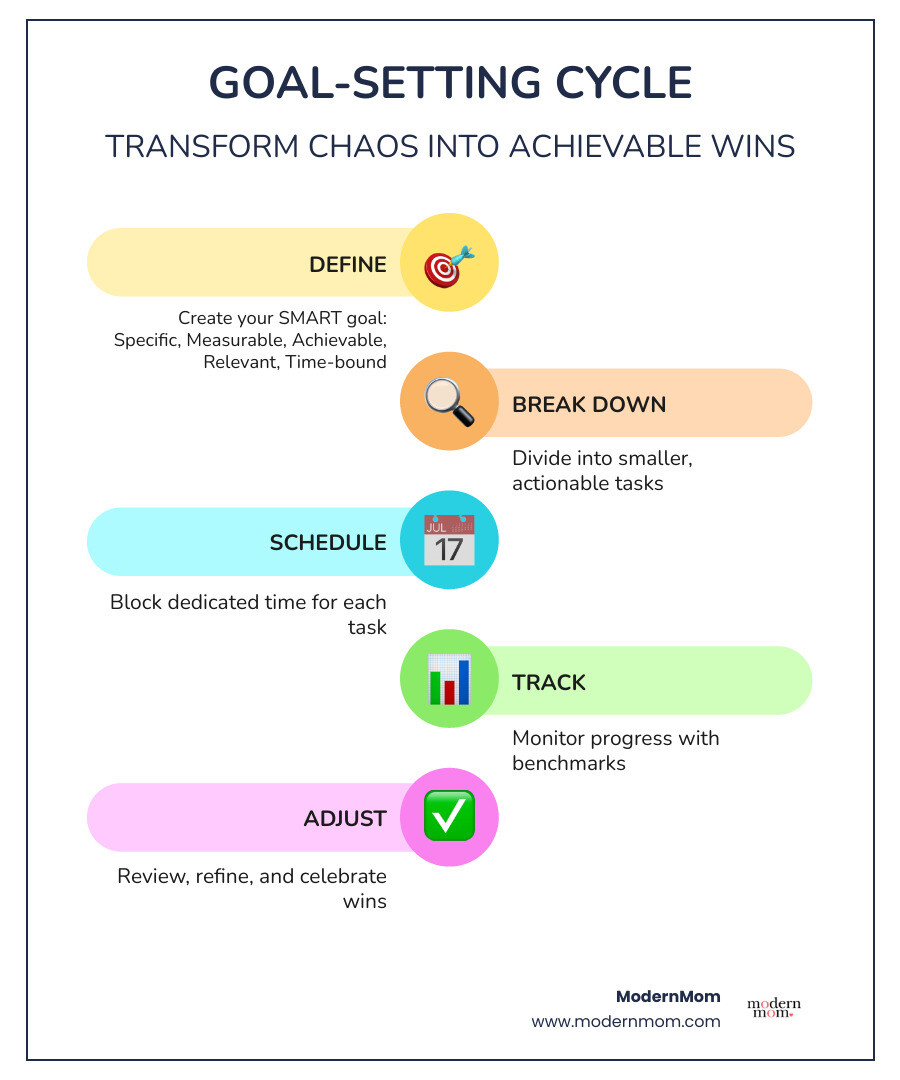
- Set SMART goals — Specific, Measurable, Achievable, Relevant, and Time-bound
- Prioritize ruthlessly — choose the few tasks that truly move the needle
- Block time — put your priorities on the calendar (not just the to-do list)
- Track progress — quick check-ins keep you from drifting
- Adjust as needed — goals should flex with real life, not break you
You’ve probably heard the quote: “If you want to make God laugh, tell him your plans.”
But here’s the twist—vague plans are the ones that fall apart.
When you’re juggling kids (or teens), a partner’s schedule, aging parents, or a demanding job, time can feel like it’s slipping through your fingers. The mental load is real. And the stress is, too: 84% of Americans report feeling stressed at least once a week, with 15% stressed every single day.
The difference between drowning in your to-do list and making steady progress usually isn’t motivation—it’s structure. Studies show people who set goals perform at higher levels than those who don’t, and many people say SMART goals help them follow through more often.
Modern Mom’s take: this isn’t about doing more. It’s about doing what matters—on purpose—so you can breathe again.
Goal setting in time management vocab explained:
What are SMART Goals and Why Do They Matter?
We’ve all been there: Monday morning arrives, and we tell ourselves, “I’m going to be more productive this week.” By Wednesday, the laundry is piled high, three emails are still sitting in drafts, and we’re wondering where the time went. The problem isn’t our willpower; it’s the vagueness of the goal.
SMART goals are the antidote to that “floating” feeling. The term was first coined in 1981 by George T. Doran in an issue of Management Review. He realized that for management—and for us at home—goals needed to be more than just wishes.
The SMART framework stands for:
- Specific: Clear and well-defined.
- Measurable: You can track your progress with numbers or milestones.
- Achievable: Realistic based on your current resources and time.
- Relevant: It actually matters to your long-term vision.
- Time-bound: There is a definitive deadline.
Experts like Peter Drucker, often associated with “Management by Objectives,” paved the way for this structured thinking. When we use using SMART goals to manage exams effectively, for example, we see that students who define exactly what they need to learn and by when consistently outperform those who just “study hard.”
The History of the SMART Framework
While George T. Doran officially introduced the acronym, the concept is deeply rooted in industrial psychology. Professor Robert S. Rubin has highlighted how these goals provide the clarity needed to motivate human effort. It’s about more than just checking boxes; it’s about how our brains respond to clear targets. When a goal is SMART, our focus sharpens because the “how” and “when” are already decided.
Why Vague Plans Fail
Vague plans like “I want to get organized” fail because they lack a finish line. Without a deadline, Parkinson’s Law kicks in—the idea that work expands to fill the time available. If you give yourself “all day” to clean the kitchen, it will take all day.
Ambiguity is the enemy of progress. This is why we encourage you to think-tiny-goals-for-big-long-term-impact. By breaking a massive, vague ambition into tiny, SMART steps, you stop God from laughing at your plans and start making Him proud of your progress.
The Symbiotic Link: Goal Setting in Time Management
Think of goal setting as your compass and time management as your vehicle. A vehicle without a compass drives in circles; a compass without a vehicle gets nowhere. Goal setting in time management creates a powerful synergy.
| Vague Intention | SMART Time Management Goal |
|---|---|
| “I need to work on my side business.” | “I will spend 60 minutes every Tuesday and Thursday at 7 PM drafting three product descriptions.” |
| “I want to exercise more.” | “I will complete a 20-minute yoga video three mornings a week before the kids wake up for the next month.” |
| “I’ll clean the house today.” | “I will set a 30-minute timer at 10 AM to declutter the mudroom and fold one load of laundry.” |
When you set clear goals, prioritization becomes natural. You no longer ask, “What should I do?” You ask, “Which task gets me closer to my goal?” This clarity boosts focus and productivity because you aren’t wasting mental energy on decision fatigue.
Why Goal Setting in Time Management Reduces Stress
Stress is often the result of feeling out of control. According to the American Institute of Stress, 55% of Americans feel stressed during the workday. When we don’t have clear goals, every interruption feels like a crisis.
By implementing structured goals, you actually reduce cortisol levels. You know that even if the toddler spills juice, you have a “timebox” later to finish your work. Research shows that stress at work highly influences and decreases your performance, but having a plan acts as a buffer, preventing the “fight or flight” response from taking over your afternoon.
Actionable Examples of Goal Setting in Time Management
Let’s look at how this applies to different areas of a mom’s life:
- Professional: “I will earn my Project Management certification by studying 5 hours a week for the next 12 weeks to qualify for a promotion.” (Check out our career-boosting-resolutions-moms for more ideas).
- Academic: If you’re a mom heading back to school, a SMART goal might be: “I will maintain an 85% average by attending every lecture and starting assignments 48 hours before the deadline.”
- Personal: “I will drink 64 ounces of water daily for the next two weeks to improve my energy levels.”
How to Write and Implement Your SMART Goals
Ready to build your own? Start by writing it down—paper, Notes app, sticky note on the fridge. Studies show you’re more likely to follow through when your goal is written down, because it stops living only in your head.
Here’s a simple, mom-friendly way to set goals that actually fit real life:
Start with your “why.” Is this about more patience at home? More income security? More energy? Your “why” helps you stay consistent when the week gets messy.
Make the next step tiny. If your goal is big (like finishing a certification or reorganizing the house), choose one small action you can do this week.
Set benchmarks you can see. Example: If you want to write a book in six months, a one-month benchmark might be completing your outline and drafting two chapters.
Do a weekly check-in (10 minutes max). Pick a day—Sunday evening or Monday morning—and ask:
- What worked last week?
- What got in the way?
- What’s the next right step?
Integrating Techniques Like Time Blocking and Prioritization
Once you have a SMART goal, give it a home in your schedule.
- Time blocking: Put it on your calendar like an appointment. Even 20–30 minutes counts.
- The Eisenhower Matrix: Sort tasks by Urgent vs. Important. Aim to spend more time on Important-but-not-Urgent so you’re not always putting out fires.
- Batch tasking: Group similar tasks (emails, calls, errands) so they don’t nibble your whole day.
- Single-tasking: Multitasking feels necessary, but it often slows you down. Pick one task, finish it, then move on.
If you’re not sure where your time is going, a time-tracking tool can be eye-opening. You can start your free trial to see patterns—then adjust without guesswork.
Tools to Support Your Success
You don’t have to white-knuckle your way through this.
- Memtime (time tracking): Helps you see what’s eating up your day—automatically.
- Stickk (accountability): Adds motivation by letting you wager money or set accountability rules.
- Body doubling: Work alongside someone (in person or virtually). It’s especially helpful for ADHD brains, postpartum fog, or seasons of caregiver overwhelm.
Different season, different strategy: a new mom might aim for micro-goals (like a 10-minute reset), while a sandwich-generation caregiver may need tighter boundaries and stronger calendar blocks. Either way, the goal is the same—make progress without sacrificing your sanity.
Beating Procrastination and Preventing Burnout
Procrastination is often a symptom of a goal being too big or too scary. Today, 20-30% of people consider themselves chronic procrastinators, a huge jump from the 1970s. We’re surrounded by distractions (looking at you, Instagram).
To beat the slump, try these expert-backed tips:
- “Swallow the Frog”: Do your most dreaded task first thing in the morning. Once it’s done, the rest of the day feels easy.
- Find Your Golden Hour: Are you a night owl or a morning bird? Schedule your hardest SMART goal tasks during your peak energy time.
- Strategic Quitting: It’s okay to stop doing things that no longer serve your goals. If a volunteer commitment is draining you without adding value, quit.
Common Mistakes to Avoid
One of the biggest traps for moms is over-scheduling. We think we can do it all, but an over-packed calendar is a recipe for burnout. Avoid setting unrealistic deadlines that don’t account for “life” (like a sick kid or a broken dishwasher).
Also, your personal brand and well-being matter. If you’re feeling the pinch, learn how-to-invest-in-your-personal-brand-when-finances-are-tight rather than just working more hours.
Long-Term Success and Work-Life Balance
Success breeds success. When you achieve a small SMART goal, your brain releases dopamine, which motivates you to tackle the next one. This momentum is what creates long-term change.
Time management isn’t about doing more work; it’s about making space for what you love. Whether that’s weight-training-routines-for-home-workouts or just sitting on the porch with a coffee, your goals should serve your life, not the other way around.
Frequently Asked Questions about Goal Setting
What is the most important part of a SMART goal?
While all five components matter, Specificity is usually the linchpin. If you aren’t specific about what you want, you can’t measure it, and you won’t know which actions to take.
How do I stay motivated when I miss a deadline?
Don’t beat yourself up! Perfection is the enemy of progress. Simply treat it as “data.” Ask yourself: Was the goal too ambitious? Did I have an unexpected obstacle? Adjust the “Time-bound” element and start again tomorrow.
Can I use SMART goals for my kids’ schedules?
Absolutely! Teaching children the language of goal setting helps them develop independence. Use analogies like “scoring a goal in soccer” to explain the concept. For example: “I want to read one chapter book by the end of the month.”
Conclusion
At ModernMom, we know your time is precious—and often spoken for before you even sit down. But with goal setting in time management, you can move from reacting all day to choosing what matters most.
Start small: pick one SMART goal and give it a realistic time block this week. Then do a quick check-in and adjust—because real life will always be part of the plan.
If you’re feeling stuck or stretched thin, you’re not alone. Sometimes the most productive move is getting support, and that can look like resources, accountability, or a coach. If you’re thinking, I need a coach, we’re here to help you find a path that fits.
One step. One block of time. One doable goal. That’s how it gets lighter.