
Why Quick Decluttering Hacks Are the Secret Weapon Every Busy Mom Needs
If you’ve been searching for quick decluttering hacks that actually fit into a packed schedule, here’s the short answer:
The fastest ways to declutter right now:
- Set a 15-minute timer and collect obvious trash first
- Try the 27 Fling Boogie — find 27 items to toss or donate in one session
- Use the 12-12-12 Challenge — 12 items to throw away, 12 to donate, 12 to relocate
- Grab an “Elsewhere” basket — sweep misplaced items off surfaces without leaving the room
- Do a one-surface reset — pick one counter, clear it completely, only return what belongs
- Use black trash bags for donations — so you’re not tempted to second-guess yourself
- Create a tote bag drop zone — hang it on a door handle and sort it once a week
You don’t need a free weekend or a perfectly labeled bin system to start. Studies show that 91% of people say clutter negatively affects their mood or stress levels — and yet most of us are stuck in the cycle of meaning to deal with it “someday.”
Here’s the truth: someday is costing you more than you think. The average person loses 55 minutes every day looking for misplaced items. That adds up fast — especially when you’re already juggling work, kids, and everything in between.
The good news? Small, focused bursts of decluttering can make a real difference. A 15-minute daily habit adds up to over 90 hours of decluttering a year — without ever sacrificing a full Saturday.
This guide is for the mom who wants a calmer home without making decluttering her part-time job. These tips are fast, realistic, and — most importantly — they actually work.
Renee Kemper is a creative problem solver and Digital Marketing Director at Element Associates, where she helps brands grow through smart strategy and storytelling. As someone who’s built a business from scratch and knows how little time busy women actually have, Renee brings a no-nonsense, practical lens to quick decluttering hacks that work in real life — not just on Pinterest.
More quick decluttering hacks:
Why Your Brain Resists Tidying (and How Micro-Sprints Help)
Have you ever stood in the middle of a messy room and felt completely paralyzed? You aren’t alone, and it isn’t a character flaw.
Our brains naturally resist decluttering because of “decision fatigue.” Every single item we look at forces our brain to make a micro-decision: Should we keep this? Where does it go? Do we still need it?
When we try to tackle an entire room at once, our cognitive energy drains rapidly. To make matters worse, studies show that women who describe their homes as “cluttered” are 60% more likely to feel depressed and stressed than those who describe their homes as “restful.”
Additionally, about 80% of the clutter in most homes is actually due to disorganization rather than a lack of actual space. When we use short, timed micro-sprints, we bypass that overwhelming mental block.
Micro-sprints trigger a psychological phenomenon called behavioral activation. By taking a tiny action—like setting a timer for just 10 or 15 minutes—we get a quick hit of dopamine from seeing instant progress. This momentum carries us forward without draining our willpower.
To help us keep our sanity, we need to understand the difference between cleaning, organizing, and decluttering. They aren’t the same thing, and mixing them up is why we often end up with half-sorted piles on our bedroom floors.
| Task | What It Actually Means | Why It Matters |
|---|---|---|
| Decluttering | Deciding what to keep and removing the excess. | This must always come first! You can’t organize trash. |
| Organizing | Giving a permanent, logical home to the items you keep. | Makes finding your daily essentials fast and easy. |
| Cleaning | Removing dirt, dust, and grime from your physical surfaces. | Keeps your home healthy, hygienic, and fresh. |
5 Quick Decluttering Hacks You Can Do in 15 Minutes or Less

When we’re short on time, we need highly tactical shortcuts. These five high-impact quick decluttering hacks can be done in 15 minutes or less, giving us instant visual calm.
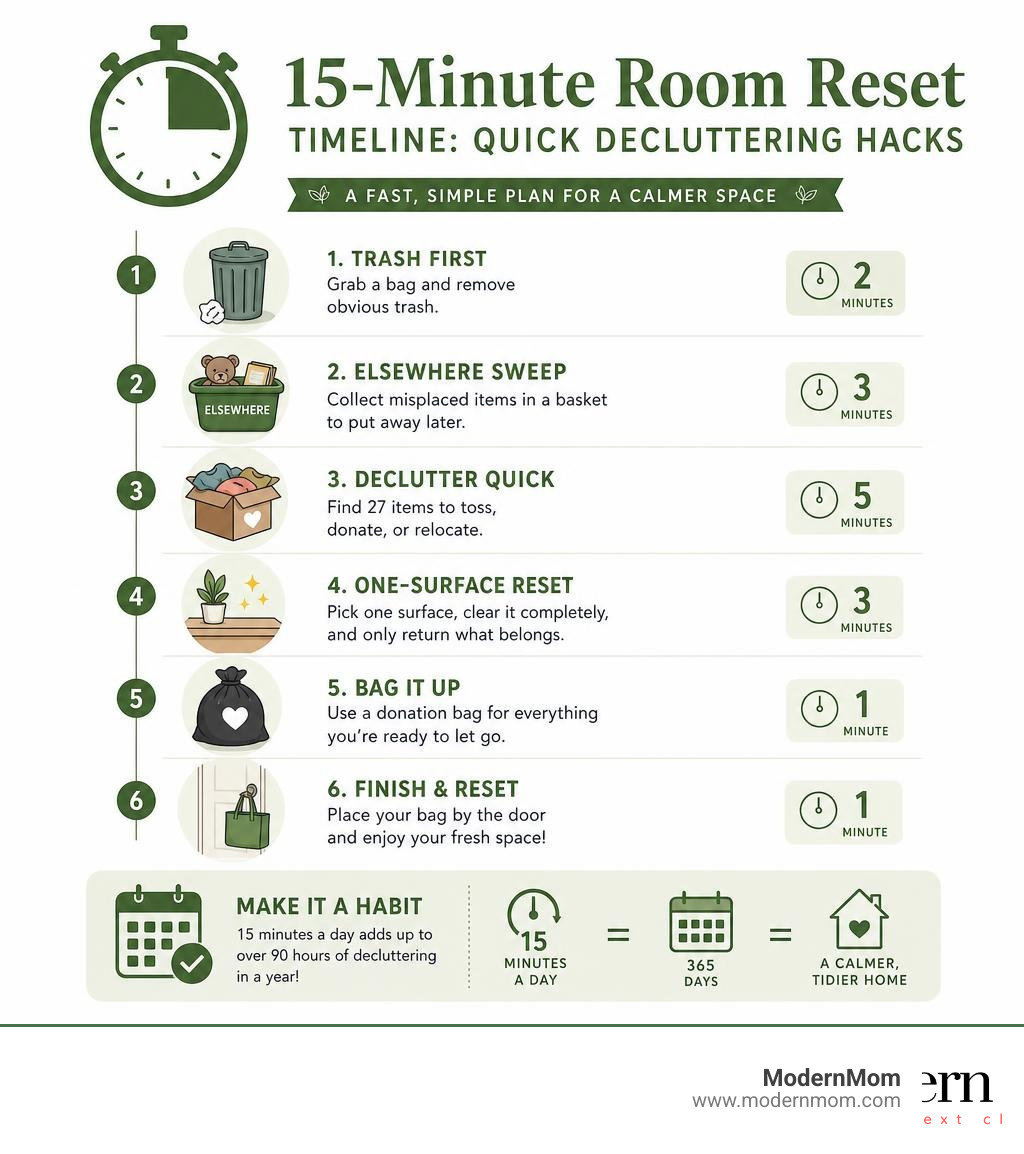
- The 15-Minute Room Reset: Grab a trash bag and a laundry basket. Set your timer and spend the first two minutes collecting obvious garbage. Use the next four minutes to sweep any items that don’t belong in the room into your basket. Spend the remaining time straightening surfaces and wiping down the cleared areas.
- The “Elsewhere” Basket: One of the biggest time-wasters is walking back and forth between rooms to put things away. Instead, keep an “Elsewhere” basket with you. If you find a toy in the kitchen, drop it in the basket and keep moving. Only distribute the items to their proper rooms once your timer rings.
- The Black Trash Bag Trick: When donating items, always use thick, black contractor bags instead of clear bags. This simple psychological trick prevents us (and our kids!) from peek-testing our decisions and pulling items back out of the donation pile.
- The “Maybe” Box: If you’re stuck on an item, don’t let it stall your progress. Put it in a designated “Maybe” box, write a date 30 days from now on the top, and store it out of sight. If you don’t look for it in a month, you can safely donate the entire box without looking inside.
- The One-Surface Reset: Don’t try to clear the whole kitchen. Pick just one flat surface—like the island or a single nightstand—and clear it completely. Visual noise on flat surfaces makes our homes feel much messier than they actually are. Clearing just one spot creates an immediate sense of peace.
If you’re looking for more inspiration to jumpstart your week, check out these Fifteen 5-Minute Decluttering Tasks You Can Do Today or follow this handy Declutter a Room in 30 Minutes: Step-by-Step Guide to keep your momentum going strong.
Structured Methods That Actually Work: From the Snowball to the 27 Fling Boogie

Sometimes we need a structured rulebook to follow so we don’t have to think. Quota-based systems are fantastic because they give us a clear, satisfying finish line.
A great example is the 12-12-12 Challenge. In this challenge, your goal is to find exactly 12 items to throw away, 12 to donate, and 12 to return to their proper homes. It turns decluttering into a treasure hunt.
If you are having a low-energy evening, you can easily adapt this to a quick 6-6-6 version. For larger seasonal transitions, push yourself to a 24-24-24 challenge.
Using these structured rules helps us make rapid-fire decisions. If you want to expand your timed sessions, you can learn How To Declutter A Room In One Hour to get even deeper results without burning out.
How the Snowball Method Simplifies Quick Decluttering Hacks
The Snowball Method is all about building momentum through easy, effortless wins. Instead of starting with a high-stakes area like our sentimental photos, we start with something that requires zero emotional attachment—like the junk drawer or the entryway shoe pile.
To use this method, choose one simple item to declutter (like an expired bottle of lotion). Identify why you are letting it go, and then immediately look for similar items nearby with those same characteristics.
Before you know it, you’ve cleared out the entire under-sink cabinet. This gradual build-up sharpens our decision-making skills and makes tackling larger areas feel like a breeze.
The 27 Fling Boogie: Gamifying Quick Decluttering Hacks for Families
Created by Marla Cilley (famously known as the FlyLady), the 27 Fling Boogie is a legendary speed-decluttering game. The rules are beautifully simple: grab a bag, set a timer for 15 minutes, and move through your home as fast as possible to collect exactly 27 items to discard or donate.
Because it’s timed and gamified, it’s the perfect way to get the whole family involved. You can easily create a kid-friendly version by asking your little ones to find “10 things to fling” from their toy bins.
By turning the chore into a race, we keep the mood light and teach our kids healthy habits without the usual pre-dinner power struggles.
Overcoming Emotional Hurdles and the “Just in Case” Trap
The hardest part of decluttering is dealing with the “just in case” items. We hold onto old cords, half-used craft supplies, and clothes that don’t fit because we fear we might need them someday.
To break free from this trap, ask yourself this powerful question: “If I needed this item and didn’t have it, what are five alternative things I could do instead?”
Usually, we realize we could easily borrow it, substitute it with something we already own, or buy a cheap replacement if the emergency actually arises.
It also helps to state the tradeoffs of keeping an item out loud. For example, say: “Keeping this unused treadmill costs me the physical space to do yoga in my bedroom.”
Every item we own has a hidden cost in time, energy, and mental space. By shifting our focus toward creating room for things that bring us joy and support our daily lives, letting go of the physical excess becomes much easier.
Daily Micro-Habits to Keep Your Home Calm and Clutter-Free
The secret to a permanently tidy home isn’t an annual deep clean. It’s the daily micro-habits that prevent clutter from creeping back in the first place.
- Morning Trash Walks: Spend just two minutes every morning walking through the main living areas with a trash bag to discard junk mail, broken toys, and food wrappers.
- The Sunday Handbag Reset: Take 10 minutes every Sunday afternoon to empty your purse, discard old receipts, toss lint-covered mints, and restock your daily essentials.
- The Tote Bag on the Door: Hang a stylish tote bag on a high-traffic door handle. Throughout the week, drop out-of-place items or outgrown kids’ clothes into the bag. Once a week, take 10 minutes to process and donate the contents.
- The One-In, One-Out Rule: For every new item that enters your home—whether it’s a new mug, a pair of shoes, or a toy—one older item must be donated or recycled.
These tiny habits save us an incredible amount of time. In fact, maintaining a consistent daily decluttering routine can save us over 90 hours of cleaning and searching for lost items every single year!
Frequently Asked Questions about Quick Decluttering
Should I buy organizing bins before I start decluttering?
No! This is one of the most common mistakes people make. Buying beautiful baskets before you know what you’re keeping often leads to wasted money and extra clutter. Always declutter first, group your remaining items, and then measure and buy storage solutions that fit your actual needs.
How do I handle sentimental items when I only have a few minutes?
Avoid them during speed sessions! Sentimental items require deep emotional energy and will instantly stall your momentum. If you stumble across an old photo album or keepsake, place it in a designated “to sort later” box and keep moving. Save those items for a dedicated, slow-paced afternoon.
What is the easiest room to start decluttering when overwhelmed?
The bathroom vanity or the entryway floor are excellent places to start. They are small, highly functional areas with very few sentimental items. Clearing these spots gives you immediate, highly visible daily wins that will inspire you to keep going.
Conclusion
At ModernMom, we believe that managing a home shouldn’t feel like an endless uphill battle. Decluttering isn’t about striving for minimalist perfection; it’s a form of self-care that gives us back our precious time and mental peace.
By embracing these simple, stress-free quick decluttering hacks, we can easily maintain a restful environment that supports our busy lives.
Ready to make a change today? Start tidying while your morning coffee brews! You’ll be amazed at how much lighter your home—and your mind—will feel in just a few short minutes.