

When Staying Home Feels Like Running on Empty
Stay-at-home mom stress relief isn’t a luxury — it’s something you genuinely need to keep going.
If you’re exhausted, touched-out, and quietly fantasizing about a solo trip to literally anywhere, here’s what actually helps:
- Breathe first — box breathing (inhale 4 counts, hold 4, exhale 4, hold 4) calms your nervous system in under 60 seconds
- Name one task to drop today — lower the bar; cereal for dinner counts as dinner
- Ask for something specific — not “I need help,” but “Can you handle bath and bedtime on Tuesday?”
- Take a 10-minute break that’s actually yours — outside, alone, phone down
- Talk to someone — a friend, another mom, or a therapist if things feel unmanageable
You don’t have to fix everything today. Start with one.
Being a stay-at-home mom is one of the most demanding jobs that exists — and one of the least recognized. You’re the caregiver, the scheduler, the chef, the cleaner, the emotional anchor, and the on-call everything. There’s no clock-out time. No sick days. No performance review that tells you you’re doing a good job.
It makes sense that you’re running low.
Research confirms what so many moms already feel in their bones: mothers carry roughly 71% of the household mental load — the invisible work of remembering, planning, and organizing that never shows up on a to-do list but never stops running in the background either.
And when that load goes unacknowledged long enough, it doesn’t just feel stressful. It becomes burnout — a chronic state of physical, emotional, and mental depletion that’s very different from just having a hard week.
The good news? There are real, practical ways to get relief — not bubble-bath advice, but actual strategies that fit into a chaotic Tuesday with small kids underfoot. That’s exactly what this guide covers.
Discover more about stay at home mom stress relief:
Understanding Stay-at-Home Mom Stress Relief and Burnout
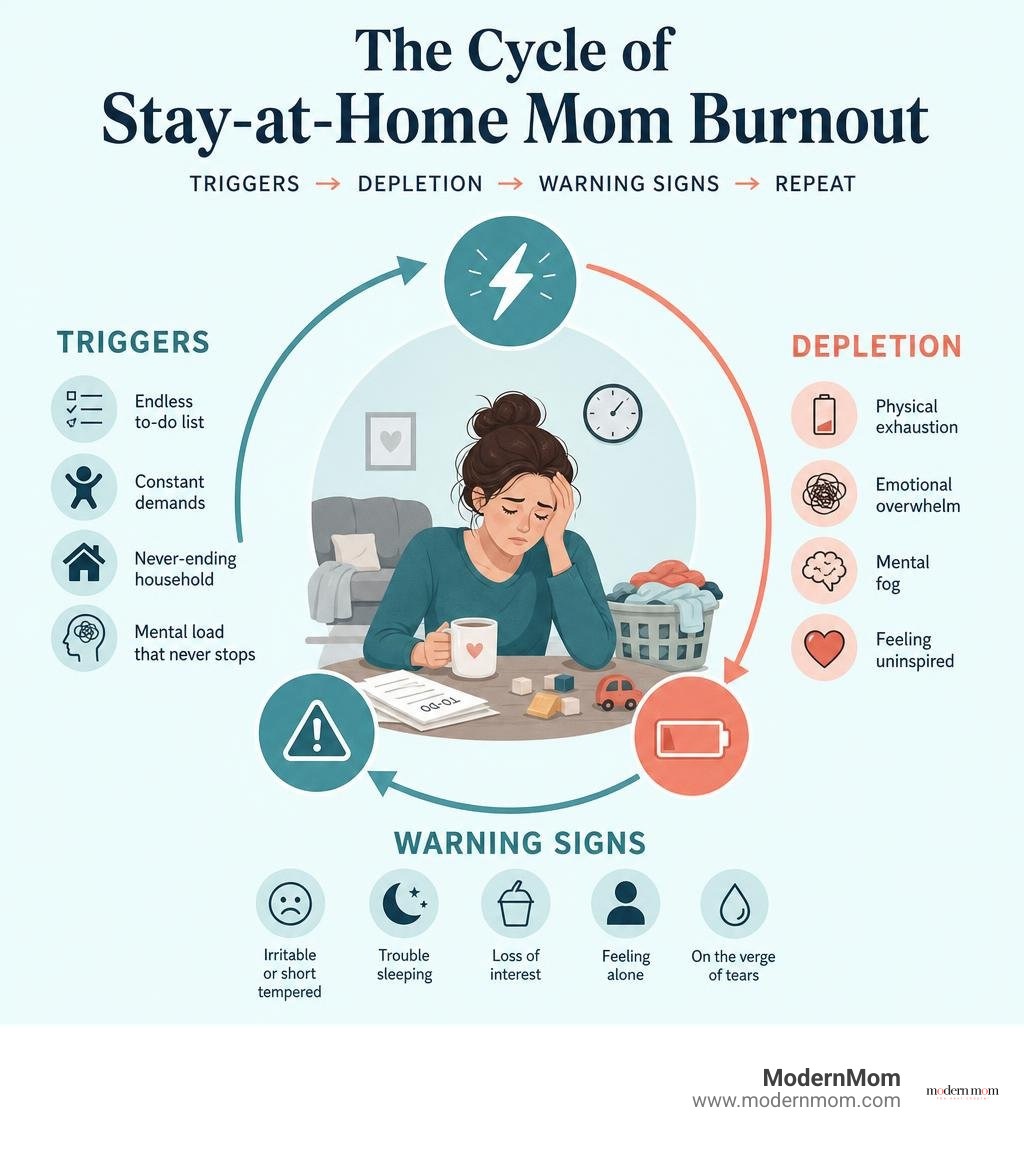
We often use the word “stressed” to describe a chaotic afternoon, but parental burnout is a completely different beast. While stress is temporary, burnout is a chronic, deep-seated state of depletion. It leaves you feeling like you have absolutely nothing left to give, yet the demands keep coming.
Researchers define parental burnout by three main features: overwhelming physical and mental exhaustion, emotional distancing from your children, and a painful sense of parenting ineffectiveness. You might look at your kids and feel a sense of detachment, or feel like you are simply going through the motions. When we talk about stay at home mom stress relief, we are not just trying to survive a bad day; we are trying to heal this deep state of depletion.
The Invisible Mental Load of Motherhood
Have you ever sat down on the couch, completely exhausted, even though you didn’t do much heavy lifting that day? That is cognitive fatigue from the mental load. As mothers, we do not just execute tasks; we manage the entire household ecosystem.
We are the ones remembering who has outgrown their shoes, when the pediatrician appointments are, and what needs to be bought for dinner. This invisible, non-stop mental planning accounts for why moms tackle roughly 71% of the household mental load. It is a silent energy drainer that leaves us feeling overwhelmed before our feet even hit the floor in the morning.
Recognizing the Signs of Maternal Depletion
When stress is left unmanaged, our bodies and minds start sending loud distress signals. One of the most common emotional signs is “mom rage” — sudden, intense flashes of anger over minor things, like a spilled cup of milk. This is often followed by a crushing wave of guilt, creating a painful cycle.
Burnout can also trigger escape ideation, where you find yourself fantasizing about getting into a minor car accident just so you can rest in a hospital bed. Physically, chronic stress is incredibly hard on our bodies. Over time, it can increase the risk of heart disease, high blood pressure, irritable bowel syndrome (IBS), and type 2 diabetes. If you are feeling this level of depletion, know that you are not a bad mom. You are simply a burnt-out mom, and it is time for us to normalize asking for real support.
Why Stay-at-Home Moms Are Uniquely Vulnerable
While all parents experience stress, stay-at-home moms face a unique set of psychological challenges. We lack the external validation of a workplace, such as raises, promotions, or even a simple “thank you” from a coworker. Instead, our work is continuous, repetitive, and largely invisible.
| Working Mom Stress | Stay-at-Home Mom Stress |
|---|---|
| Role Overload: Juggling professional tasks and home life simultaneously. | Uninterrupted Cognitive Load: Continuous caregiving without scheduled breaks. |
| Time Scarcity: Tight schedules and rushing between office and home. | Isolation: Lack of adult interaction and physical separation from the outside world. |
| Workplace Transitions: Clear physical boundaries between “work” and “home.” | The “Always On” Paradox: Working and living in the exact same physical space. |
The “Always On” Home Office Paradox
For a stay-at-home mom, the home is both a sanctuary and an office. This makes it physically and mentally difficult to relax. When a working parent comes home, there is a transition; when we are at home, our “work” is constantly staring us in the face.
Every pile of laundry, messy counter, and unorganized toy drawer acts as a visual reminder of unfinished tasks. This constant stimulation makes it incredibly hard to wind down. We find ourselves trapped in a cycle of intensive parenting, trying to make every moment educational and perfect. To break this cycle, we have to start intentionally romanticizing life as a stay-at-home mom by finding joy in the small, quiet moments rather than chasing an impossible standard of domestic perfection.
The Financial Guilt and Identity Shift
Stepping away from a career to raise children often triggers a massive identity shift. We go from having professional titles and financial independence to feeling like “just a mom.” This transition can bring up a lot of unexpressed grief.
Furthermore, relying on a partner’s income can create a subtle, painful sense of financial guilt. We might feel we don’t have the right to spend money on ourselves because we aren’t bringing home a paycheck. To combat this, some moms find immense sanity and purpose in creative side gigs. For example, taking on freelance projects or content creation can help us pay off debt and feel like ourselves again.
Quick and Practical Stay-at-Home Mom Stress Relief Techniques
When you are in the thick of a chaotic day, you do not have time for a weekend spa trip. You need pocket-sized tools that can regulate your nervous system in under five minutes.

Micro-Resets for Immediate Stay-at-Home Mom Stress Relief
Your nervous system is incredibly responsive to quick shifts in your environment and breath. When you feel your chest tightening, try these three simple grounding tricks:
- The 60-Second Box Breath: Inhale for 4 counts, hold for 4 counts, exhale for 4 counts, and hold for 4 counts. This simple practice sends an immediate safety signal to your brain. Learn more about this deep breathing technique to induce calm.
- The 3-2-1 Sensory Reset: Look around you and silently name three things you can see, two things you can hear, and one physical sensation you can feel. This pulls your mind out of a stressful mental loop and anchors you in the present moment.
- The Hand-on-Heart Check: Place your hand on your chest, take a slow breath, and say to yourself: “This is a tough moment, and I am doing the best I can.” Self-compassion is a powerful shield against maternal depletion.
Pocket-Sized Physical and Mental Resets
In addition to breathing, we can build tiny physical habits into our daily routines to keep our energy levels steady:
- The Two-Song Tidy: Instead of spending hours cleaning, pick two upbeat songs and tidy only one visible area until the music stops. When the songs end, you are done. This prevents the perfectionism trap.
- Morning Sunlight + Sip: Step outside onto your porch or patio for just three minutes in the morning. Drink a glass of water while looking at the sky. This simple dose of morning light anchors your body clock, boosting your mood and sleep quality.
- Hydration and High-Protein Snacks: Did you know that mild dehydration can cause fatigue, irritability, and headaches before you even feel thirsty? Keep a water bottle nearby and eat a healthy, protein-rich snack every two to four hours to prevent blood sugar drops.
Taking these tiny steps will help you Hit the Refresh Button: Simple Steps for Mental Wellness throughout your busy day.
Creating Sustainable Routines and Boundaries
To protect your energy long-term, you need to establish routines that serve you, not just your family. This means moving away from rigid, clock-bound schedules and embracing a flexible daily rhythm built around simple anchors.
Shifting from Perfection to Realistic Parenting
Superwoman syndrome is the exhausting belief that we must perform every role perfectly without ever showing weakness. It is a direct path to burnout. To protect our mental health, we must learn to lower our expectations on difficult days.
If you are running on empty, choose survival mode. Serve breakfast for dinner, let the laundry sit in the basket, and let go of the guilt. Your kids do not need a perfect home; they need a healthy, present mom. We must give ourselves permission to let go of the pressure and unapologetically create moments of happiness for yourself.
Reclaiming Your Time with Micro-Hobbies
A hobby is not a selfish luxury; it is a vital tool for nervous system regulation. However, we do not have hours of uninterrupted time. We need “micro-hobbies” that fit into the cracks of our day.

Before choosing a hobby, run it through this simple three-question filter:
- Can I start this in under ten minutes from where I am sitting?
- Can I pause this instantly when a child yells without losing my progress?
- Does this feel entirely like mine, rather than another productive chore?
Great examples include reading a novel, sketching in a small notebook, knitting, or working on a puzzle in the corner of the room. Investing even ten minutes a day in these quiet pursuits is a wonderful form of cozy self-care.
How to Ask for Help and Share the Load
We cannot recover from burnout if we continue to do everything ourselves. We have to learn how to ask for help directly and without a side of guilt.
Shifting from “Helping” to Task Ownership
One of the biggest sources of resentment in relationships is when a partner acts as a “helper” who waits for instructions, leaving the mom as the default project manager. True relief requires shifting to complete task ownership.
This means your partner completely owns a task from start to finish — including the planning, remembering, and execution. For example, instead of asking them to “help with dinner,” they take complete ownership of Tuesday night meals, which includes planning the menu, buying the groceries, cooking, and cleaning up.
When communicating this, avoid vague complaints. Use direct, specific scripts during a calm moment:
- “I am feeling incredibly depleted. I need you to take complete ownership of the kids’ morning routines on Tuesdays and Thursdays.”
- “To free up some mental space, I need you to be the sole person responsible for managing the dog’s vet visits and food supply.”
When you hand over a task, you must resist the urge to micromanage how it is done. Let go of the control so you can reclaim your peace. We must remember that we are not meant to carry this entire burden alone.
Building Your Local Support Village
Modern parenting is incredibly isolating because many of us lack a built-in community. We have to build our own villages from scratch.
Reach out to neighborhood moms, join local playgroups, or set up a babysitting swap where you trade childcare hours with another trusted mom. This gives both of you regular, free, and guilt-free breaks. Building these connections reminds us that we are more powerful than we think when we stand together.
Frequently Asked Questions About Stay-at-Home Mom Stress Relief
Is stay-at-home mom burnout a real clinical condition?
While “parental burnout” is not currently a standalone diagnosis in the DSM-5, it is heavily recognized by researchers and psychologists as a distinct, severe psychological condition. It is characterized by chronic caregiving exhaustion, emotional distancing from children, and a sense of parenting ineffectiveness.
How does burnout differ from postpartum depression (PPD)?
Postpartum depression is typically tied to intense hormonal shifts and occurs within the first year after giving birth. Burnout, on the other hand, can happen at any stage of motherhood and is driven by chronic, ongoing caregiving demands paired with a lack of support and resources.
What are the best ways to explain my need for stay-at-home mom stress relief to my partner?
Sit down during a calm moment — not in the middle of a stressful parenting situation. Use “I” statements to explain how you are feeling physically and emotionally. Focus on the concept of the “mental load” and make highly specific, actionable requests for task ownership rather than general pleas for help.
Conclusion
Recovering from stay-at-home mom burnout does not happen overnight, and it certainly does not happen by trying to be a perfect “supermom.” It starts with self-compassion. It starts with acknowledging that your needs are just as important as the needs of the little people you care for every day.
You do not have to implement every strategy in this guide today. Just choose one tiny sanity saver to try this week. Whether it is a 60-second box breath, a simplified dinner plan, or a specific conversation with your partner, every small step counts. You are doing a wonderful job, and you deserve support, not just survival.
For more practical tips, resources, and encouraging advice, explore our comprehensive ModernMom Stress Relief Guide.