

Family Communication Tips for a More Connected Home
Strong family communication starts with a few repeatable habits: give full attention, listen before fixing, name feelings without blame, and pause when emotions run high. These family communication tips can make everyday moments – from rushed mornings to teen stress and sibling fights – feel less like a battle.
Try this simple reset today:
- Put phones aside for one short check-in.
- Ask an open question, such as, “What was the hardest part of your day?”
- Reflect what you heard: “It sounds like you felt left out.”
- Use an “I” statement for problems: “I feel overwhelmed when the kitchen is left messy.”
- Take a break and return later if anyone is too upset to listen.
Communication is more than the words spoken. Tone, facial expressions, posture, and whether someone looks up from a task all send a message. When family members feel heard and respected, they are usually less defensive and more willing to solve problems together.
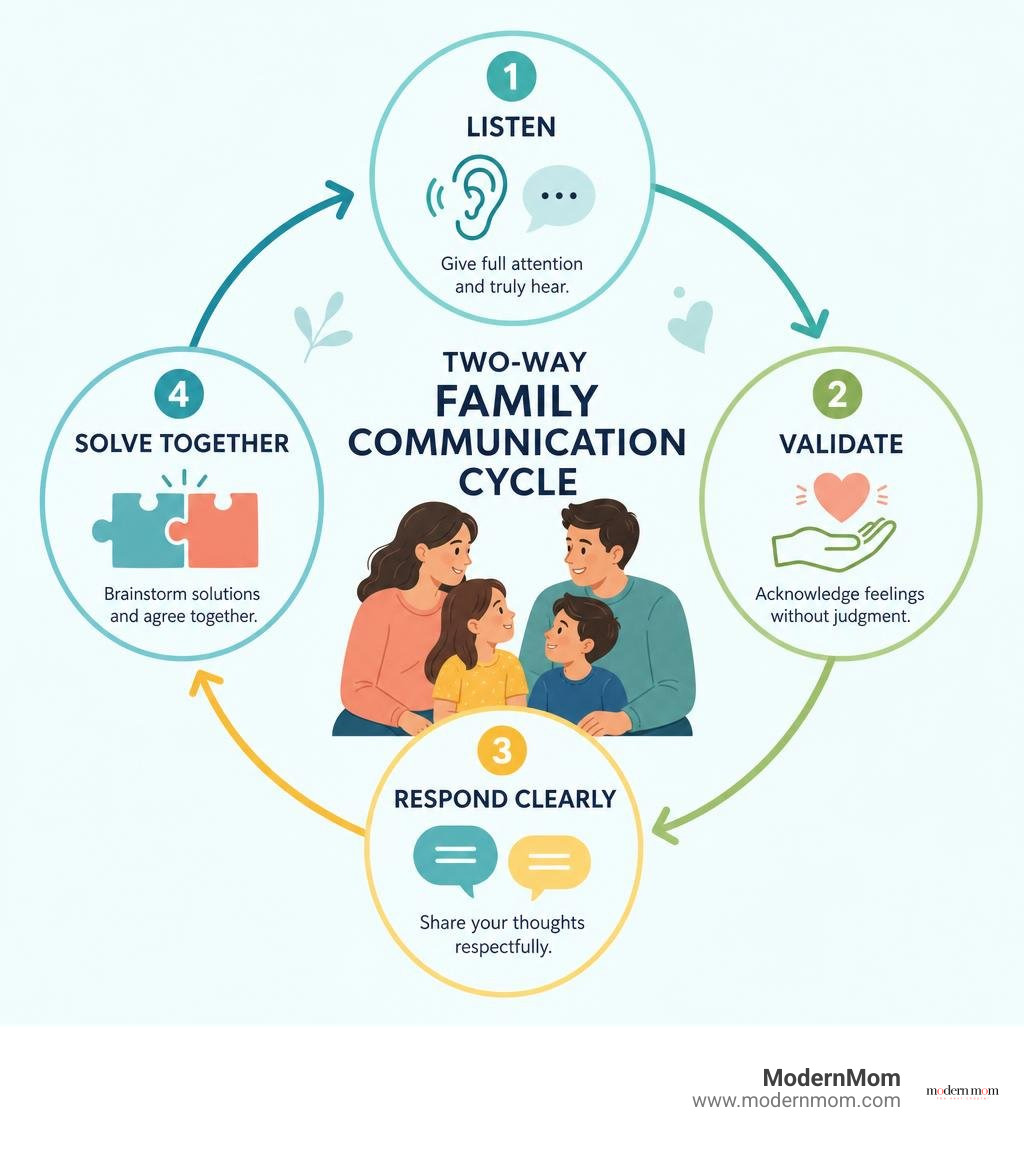
Quick look at family communication tips:
Why Healthy Family Communication Matters for Child Development and Connection
At its heart, our home is where our children first learn how human relationships work. When we build an emotionally safe environment, we provide our kids with a secure launchpad to express their vulnerabilities without fear of mockery or harsh judgment. This foundational trust directly builds emotional resilience, giving kids the confidence to face social pressures and school hurdles.

According to Cooperative Extension research on family communication, genuine two-way dialogue strengthens child self-esteem. When children and teens feel important, valued, and understood, their need for disruptive attention-seeking behaviors drops significantly. Instead of acting out to be noticed, they learn that their voices matter.
Furthermore, as our households expand, relationship dynamics multiply quickly—a family of four actually contains six distinct one-on-one relationships, each needing its own intentional care, listening, and open dialogue.
10 Core Family Communication Tips for Everyday Harmony
Creating peaceful communication in our homes doesn’t require sweeping lifestyle overhauls. Instead, it relies on small, thoughtful habits we can weave into our everyday routines:
- Practice the “Soft Startup”: Approach concerns with gentle curiosity and a calm tone rather than an immediate list of grievances.
- Offer Conversational Door-Openers: Use inviting phrases like “Tell me more about that” or “That sounds interesting” instead of rapid-fire questions.
- Listen to Understand, Not to Fix: Resist jumping straight into advice mode; let your child or partner feel validated first.
- Use More “Dos” Than “Don’ts”: Direct kids toward the positive behavior you want to see (e.g., “Please walk inside the house”) instead of barking prohibitions.
- Acknowledge Nonverbal Cues: Pay close attention to slumping shoulders, clenched jaws, and shifting eye contact when words are scarce.
- Normalize Emotional Vocabulary: Help little ones identify and label feelings like frustration, jealousy, nervousness, and exhaustion.
- Adopt Parallel Communication: Talk while cooking, walking, or driving—sitting side-by-side lowers pressure for reluctant talkers.
- Catch Them Doing Good: Aim for at least five positive affirmations for every corrective comment throughout the day.
- Embrace the Power of the “Do-Over”: When tempers flare or words come out sharp, offer a warm, shame-free reset: “Let’s try that again.”
- Establish Screen-Free Connection Windows: Protect shared mealtimes and bedtimes from digital distractions to foster eye-to-eye connection.
Practical Family Communication Tips for Active Listening
Active listening is an intentional practice where we slow down and offer our full presence. When our child walks in the door, putting down our phone or stepping away from our tasks signals that they are our top priority.
Employ reflective listening and mirroring techniques by paraphrasing both the core facts and underlying emotions: “What I’m hearing is that you felt frustrated during recess when the game rules changed without you.” This simple validation assures family members that their perspective is respected, which naturally softens defensive walls.
Replace Blame with Constructive “I” Statements
When we lead with accusatory “YOU” statements—like “You never put your shoes away!”—our family members instinctively jump into combat mode or shut down entirely. To protect relational warmth, we can shift to a simple three-part “I” message formula:
- “When…” (Describe the specific behavior neutrally)
- “I feel…” (Name your genuine emotion)
- “Because…” (Explain the tangible impact)
For example, try saying: “When shoes are left in the middle of the hallway, I feel overwhelmed because I trip over them while carrying groceries.” Mastering this style of clear, vulnerable emotional ownership is also essential when learning how to communicate feelings effectively with a spouse, turning potential marital friction into proactive boundary setting.
Digital-Age Family Communication Tips for Screen-Free Connection
In an era of constant notifications, intentional digital boundaries protect our face-to-face family bonds. Establishing simple tech-free sunsets—such as placing all devices in a central charging basket during dinner and before bed—reclaims space for spontaneous dialogue.
Implementing these practical strategies to strengthen family communication ensures that screens don’t quietly replace daily emotional check-ins, allowing our families to build authentic presence in a distracted world.
Constructive Conflict Resolution: De-escalating Heated Moments
Disagreements are completely normal in any healthy home; the goal is not to eliminate conflict, but to handle it constructively. When arguments peak, physiological arousal spikes—flooding the body with stress hormones. Research shows it takes approximately 20 minutes for our nervous systems to calm down after intense emotional distress.
Calling a structured 20-minute pause or cool-down period gives everyone time to reset their heart rates before attempting collaborative problem-solving.
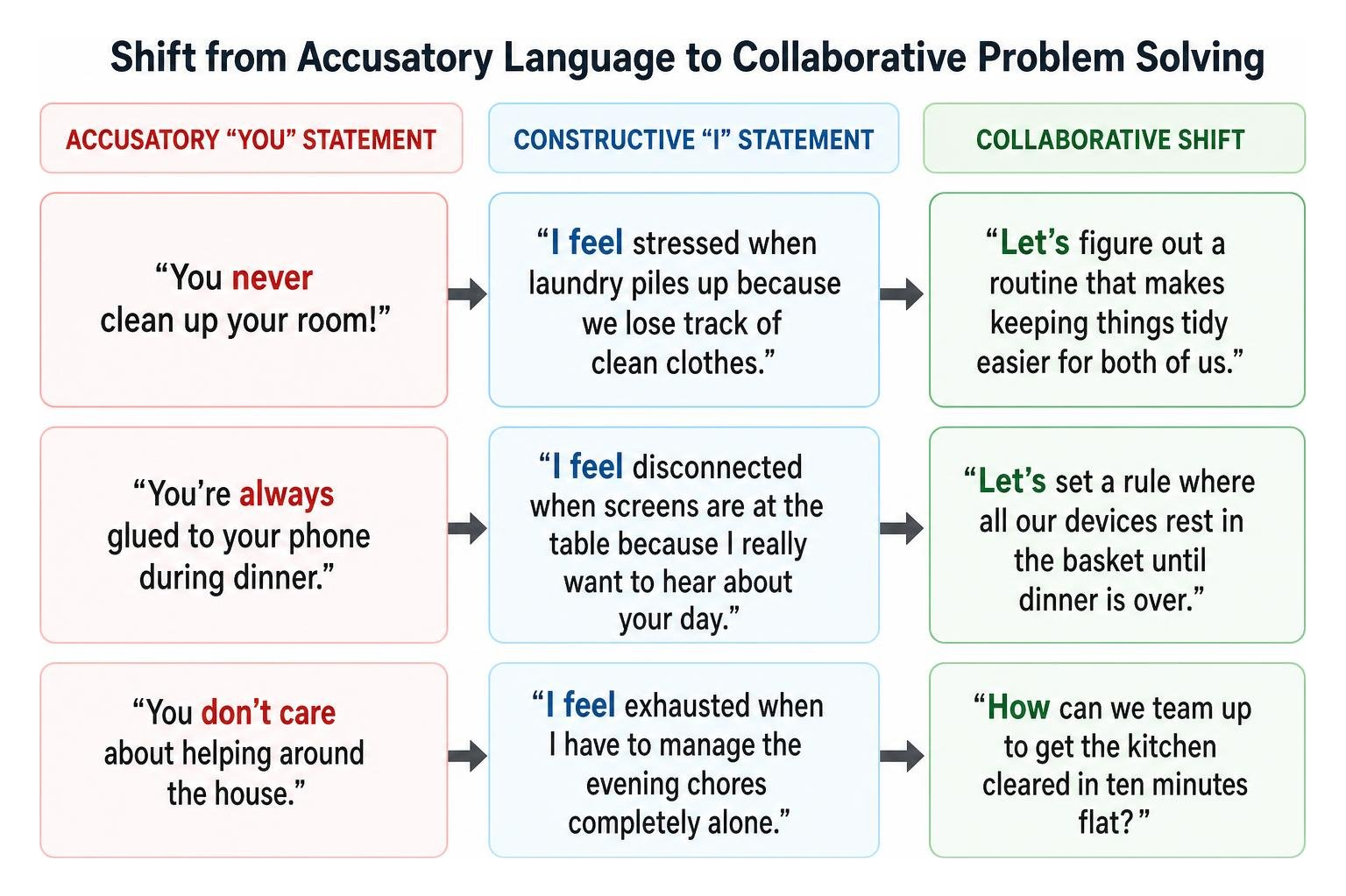
| Accusatory “YOU” Statement | Constructive “I” Statement | Collaborative Shift |
|---|---|---|
| “You never clean up your room!” | “I feel stressed when laundry piles up because we lose track of clean clothes.” | “Let’s figure out a routine that makes keeping things tidy easier for both of us.” |
| “You’re always glued to your phone during dinner.” | “I feel disconnected when screens are at the table because I really want to hear about your day.” | “Let’s set a rule where all our devices rest in the basket until dinner is over.” |
| “You don’t care about helping around the house.” | “I feel exhausted when I have to manage the evening chores completely alone.” | “How can we team up to get the kitchen cleared in ten minutes flat?” |
Once everyone has cooled down, focus on discovering a “new solution” rather than creating winners and losers. Brainstorm creative ideas together—even silly ones, which help relax tension—and vote on a compromise that respects everyone’s core needs.
Establishing Meaningful Family Rituals and Routines
Consistent routines serve as predictable emotional touchpoints throughout the week. Whether it is a relaxed Sunday family sync, short bedtime chats, or a Friday pizza-and-board-game night, these rituals weave a sense of shared belonging and security into our home life.

As outlined in the Montana State University guide on positive family communication, engaging in regular shared activities builds a reservoir of positive goodwill that carries us through difficult seasons.
Low-pressure routines like casual car-ride chats or weekend baking sessions invite parallel communication, allowing kids to open up naturally without the intimidating intensity of direct, across-the-table interrogation.
Overcoming Common Barriers in Family Communication
Even with the best intentions, everyday friction can stall open dialogue. One common pitfall is the Assumed Knowledge Trap—the subconscious belief that because we live under the same roof, our loved ones should instinctively know what we need without us voicing it clearly.
Additionally, bridging generational communication styles requires mutual grace: while parents often prefer direct, in-person discussions, teens may initially express themselves more comfortably through short digital check-ins or notes.
When communication breaks down and voices are raised, practicing swift post-conflict repair models true maturity for our kids. A simple, sincere apology—“I was exhausted earlier and spoke too sharply; let me try that again”—proves that relationships can bend without breaking. If negative communication cycles feel deeply entrenched or unmanageable, seeking professional family counseling is a proactive, empowering step to help everyone realign boundaries and restore emotional safety.
Frequently Asked Questions About Family Communication
How can parents get quiet teenagers to open up?
Create opportunities for parallel interaction where direct eye contact isn’t forced, such as while driving to practice or preparing dinner together. Ask open-ended questions about their interests rather than quizzing them on school performance, validate their emotional experiences without rushing to give advice, and simply maintain a warm, welcoming presence so they know you are ready to listen whenever they feel comfortable sharing.
How long does it take to calm down during a heated family argument?
It takes approximately 20 minutes for human physiology to return to its baseline resting state after experiencing intense anger or emotional overwhelm. When tempers flare, take a structured 20-minute break in separate rooms before returning to discuss the issue constructively.
What is the most effective way to handle sibling conflict?
Step into the role of a communication coach rather than an all-knowing courtroom judge. Avoid assigning blame or forcing rushed, hollow apologies while emotions are still high. Instead, help each child identify and name their underlying feelings, guide them in taking turns speaking with “I” statements, and empower them to brainstorm practical compromises together.
Conclusion
Transforming the way our families connect doesn’t happen overnight through one grand lecture; it happens in the quiet, daily micro-habits we choose to practice together. By listening with empathy, replacing blame with clear feelings, taking cool-down pauses when tempers rise, and prioritizing intentional routines, we cultivate a household where everyone feels deeply valued, secure, and heard.
At Modern Mom, we are here alongside you through every stage of motherhood. Embrace small, meaningful steps, celebrate every moment of relational repair, and explore our community resources to reconnect and strengthen your family foundation one conversation at a time.